
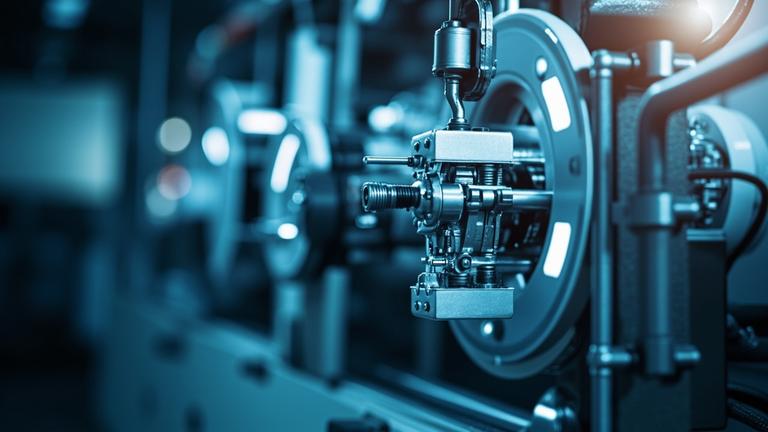
On-the-fly adaptation: In testing, GEN-1 adapted to an end effector swapped mid-task, finding a new contact strategy to reach the same goal.
- Expanded capability: Generalist's GEN-1 foundation model now supports a broad range of robot end effectors, from five-fingered hands to specialized tools with new actuation modes.
- Training scale: GEN-1 is pretrained on more than half a million hours of real interaction data covering approximately 9,000 end effector variations.
- Novelty measurement: Generalist quantifies how new an end effector is by analyzing model weight shifts during fine-tuning — whisks, for example, shift sensor-processing weights far more than peelers.
One model, many end effectors
Generalist announced that its GEN-1 embodied foundation model now supports a broad range of robot end effectors — and the company is framing that as evidence that a single base model can transfer manipulation skills across radically different hardware.
GEN-1 is compatible with five-fingered hands to specialized tools with new modes of actuation and everything in between.
The claim rests on scale. GEN-1 is pretrained on Generalist's in-house robotics dataset, which now spans more than half a million hours of real interaction data across a wide variety of end effectors. That variety is deliberate: the dataset includes approximately 9,000 variations, ranging from new form factors with their own actuation schemes to off-the-shelf tools, printed parts, and custom modifications of the company's two-finger grippers.
Why training across tools matters
The engineering logic is straightforward. Each end effector is a different sensorimotor interface — a distinct way for the model to learn about geometry, contact, friction, forces, and dynamics. A tape dispenser demands simultaneous management of tension and placement. Tongs introduce compliance and spring-force dynamics. Metal spatulas and scrapers work against a surface rather than around an object, forcing reasoning about distributed contact. A box cutter or vegetable peeler requires controlled force along a constrained path. Power screwdrivers rotate faster than fingers can match.
Scaling pretraining across thousands of these interfaces teaches GEN-1 what Generalist calls universal sensorimotor representations — physical commonsense that transfers to new hands and new ways to grasp, push, pull, and twist.
A single base AI model can learn sensorimotor policies on robots that transfer across radically different ways of interacting with the physical world.
Measuring what's actually new
Not every tool teaches the model something. Generalist quantifies novelty by analyzing how much model weights shift during fine-tuning on a new end effector, decomposing those updates across sensor processing and actuation in the architecture. The company found, for instance, that whisks shift sensor-processing weights far more than peelers do — likely because the model must perceive the whisk's thin wire geometry. That kind of signal points directly to targeted data collection.
Swapping hands mid-task
The more striking demonstration: with the model mid-rollout, Generalist physically swapped its end effector and let the same model keep running. GEN-1 perceived the new tool, conditioned on what it saw, and found a new trajectory and contact strategy to reach the same goal. Training on mixed data, the company says, forces the model to condition behavior on the hand in front of it rather than memorizing fixed manipulation strategies.
A toolbox, not a hand
The long-term vision is explicit about where humanoid-style hands fit.
The future of robot hands won't look like Generalist's, the company said. It will look more like a toolbox with a thousand hands: augmented, recombined, and scaled.
In that framing, five-fingered hands are one tool among many — and limiting robots to only that, the company argues, would be a failure of imagination. A suction pad, a brush, or a plasma welding nozzle is simply another interface through which the same intelligence acts. Tool changers are already common in automation; the missing piece was an intelligence that could recognize its own tooling and adapt.
Is this your company?
This article features your business. Claim it to add your logo, contact details, and a link to your website — or upgrade to reach more buyers.
Did you know 80% of Press Releases trigger AI content warnings? Reach out and the M4S team can assist.