
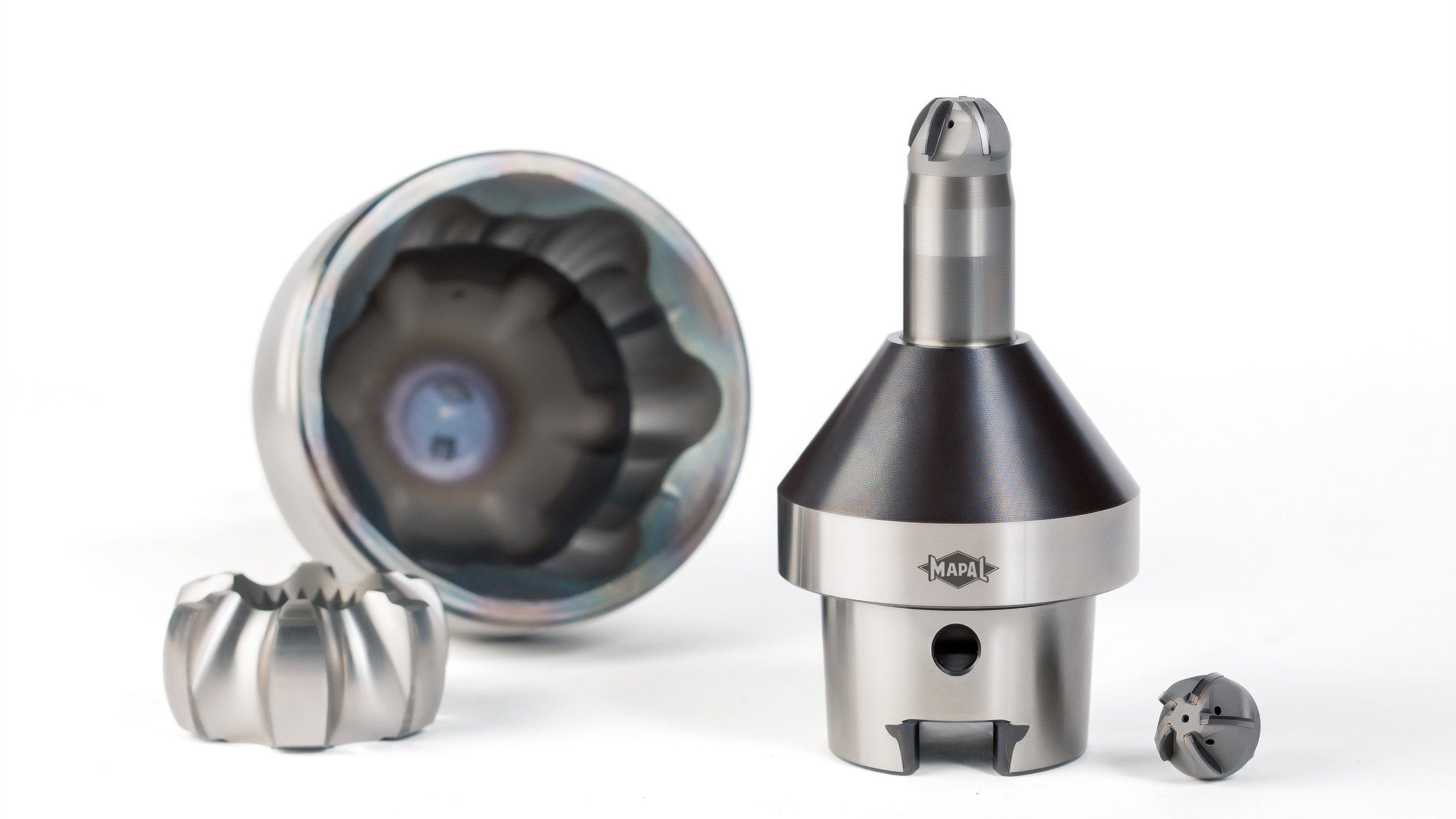
MAPAL new PcBN grades deliver upwards of 30% more workpieces per tool on constant velocity joint milling
MAPAL has developed two new uncoated PcBN cutting materials for hard milling constant velocity joints: FU240 for the outer race and FU290 for the inner race. The company reports upwards of 30% more workpieces per tool, alongside a new five-blade ball track cutter design that cuts machining time by around 20%.
MAPAL Dr. Kress, the German cutting tool maker, has developed new PcBN cutting materials for hard milling constant velocity joints, aimed at the ball tracks of the inner race and outer race. The company is also introducing a five-blade ball track cutter design alongside them.
Drive joints sit at the demanding end of volume automotive production. The ball tracks that carry the balls between inner and outer race are hard-milled to tight requirements on form and surface finish.
Because the balls run in those tracks, surface quality is not a cosmetic specification, and the cutting material and the cutting edge preparation have a direct effect on tool life, performance and the surface quality achieved.
MAPAL has worked as a technology partner to joint manufacturers for years, and the new grades were developed against the specific requirements of each race.
The new uncoated grade FU240 is matched to hard milling the ball tracks of the outer race, while FU290 is matched to the inner race. Different PcBN substrates are used so that the different machining behaviour and the different wear mechanisms at the edge can both be accounted for.
The base materials differ too. Outer race parts are typically made from hardened and tempered steels, while inner race parts are mostly case-hardening steels. Each carmaker follows its own philosophy on form and on ball guidance, but the materials themselves are broadly uniform across the industry.
Developing the grades meant balancing high abrasion and diffusion resistance against enough toughness, with the CBN content, grain size and binder composition as the main parameters.
MAPAL reports the first results as a significant gain in workpiece count: FU240 and FU290 deliver more than 30% more workpieces per tool than the grades previously used, at cutting speeds around 180 m/min and a feed per tooth of between 0.07 and 0.10 mm.
That figure does not yet include the effect of the new cutter design, which is the second part of the package.
Four-blade ball track milling cutters have been the standard in practice, so MAPAL's new five-blade design for 2026 is the change. The additional cutting edge cuts machining time by around 20% against the four-blade version.
Engagement time per edge on each ball track is shorter as well, which also has a positive effect on tool life in application. With annual volumes of around 15 million components, MAPAL says the combination of the two effects carries significant potential to reduce unit cost per part.
MAPAL has also developed PcBN cutting materials for hard turning of drive joints. FP240 is intended for continuous cutting applications such as the shank of the outer race.
For interrupted cuts, as encountered on the inner race and the cage, the tougher FP260 grade is used. Both are PVD-coated and reach well over 40% higher tool lives than conventional cutting materials. MAPAL is introducing the ball track milling cutters and the PcBN turning inserts gradually.
MAPAL was founded in 1950 and supplies precision tools for machining almost all materials, mainly to the automotive and aerospace sectors. It has production and sales sites and service partners in 42 countries, employs around 4,500 people and reported turnover of 514 million euros in 2025.
Frequently asked questions
What are FU240 and FU290?
FU240 and FU290 are new uncoated PcBN cutting materials from MAPAL for hard milling constant velocity joints. FU240 is matched to the ball tracks of the outer race and FU290 to the inner race, each built on a different PcBN substrate to suit the different machining behaviour and wear mechanisms of the two components.
How much longer do the new PcBN grades last?
MAPAL reports that FU240 and FU290 deliver upwards of 30% more workpieces per tool than the grades previously in use, measured at cutting speeds around 180 m/min with a feed per tooth of 0.07 to 0.10 mm. That figure does not yet include the effect of the new five-blade cutter design.
What does the five-blade ball track cutter change?
Four-blade ball track milling cutters have been the standard in practice, so MAPAL's new five-blade design for 2026 is the change. The additional cutting edge cuts machining time by around 20% against the four-blade version, and the shorter engagement time per edge on each ball track also has a positive effect on tool life.
Which PcBN grades does MAPAL offer for hard turning?
MAPAL has introduced FP240 for continuous cutting, such as the shank of the outer race, and the tougher FP260 for interrupted cuts encountered on the inner race and the ball cage. Both grades are PVD-coated and reach well over 40% higher tool lives than conventional cutting materials.
Why do the inner and outer race use different cutting materials?
The two races are machined from different steels. Outer race parts are typically hardened and tempered steels, while inner race parts are mostly case-hardening steels, and the wear mechanisms at the cutting edge differ accordingly. The base materials are broadly uniform across manufacturers even though each follows its own philosophy on form and ball guidance.
What were the development parameters behind the new PcBN grades?
MAPAL points to the balance between high abrasion and diffusion resistance and sufficient toughness, with the CBN content of the cutting material, the grain size and the composition of the binder as the main parameters varied during development.
Is this your company?
This article features your business. Claim it to add your logo, contact details, and a link to your website — or upgrade to reach more buyers.
Did you know 80% of Press Releases trigger AI content warnings? Reach out and the M4S team can assist.