
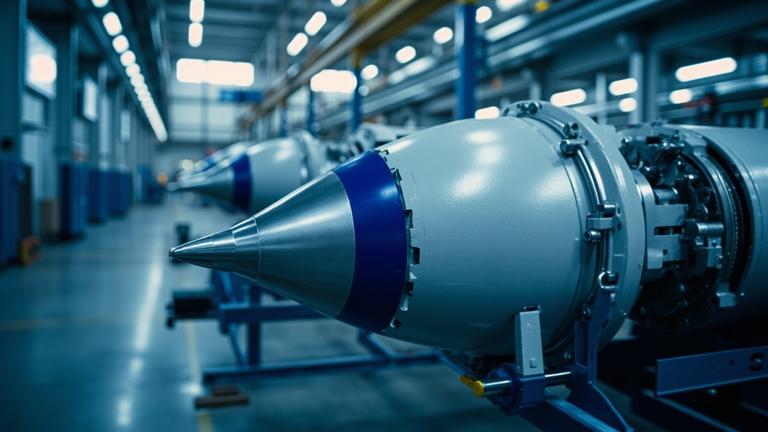
Belgian expertise: Safran Aero Boosters and BMT Aerospace bring experience in 3D printing titanium aerospace components.
- New agreement: Safran Aero Boosters will qualify and deliver large-scale 3D printed components for Pratt & Whitney's F135 engine, formalised at the Farnborough International Airshow.
- Strategic intent: Additive manufacturing will target the engine's most challenging parts to ease supply chain constraints on highest-priority components.
- Parallel effort: Pratt & Whitney announced a similar AM partnership with GKN Aerospace for large structural F135 components.
- Near-term milestone: The first large-scale proof of concept is expected to be ready soon, with the project aiming to position Belgium as an advanced manufacturing source for U.S. aerospace companies.
Agreement Formalised at Farnborough
Safran Aero Boosters has signed an agreement with Pratt & Whitney to qualify and deliver large-scale 3D printed components for the F135 engine. The agreement was formalised at the Farnborough International Airshow, where Pratt & Whitney also announced a similar partnership with GKN Aerospace to explore the use of additive manufacturing for large structural F135 engine components.
Targeting the Hardest Parts First
Working alongside BMT Aerospace, Safran Aero Boosters will apply additive manufacturing to tackle the most challenging parts of the F135 engine. The project aims to alleviate supply chain constraints for the engine's highest priority components — a pointed signal that AM is being positioned not as a prototyping exercise, but as a supply chain relief valve.
The first large-scale proof of concept is expected to be ready soon.
The joint development project is seen as a significant step toward validating this technology. Beyond the technical milestone, the project aims to position Belgium as a source of advanced manufacturing supply chain solutions for U.S. aerospace companies.
Leadership Perspective
Safran Aero Boosters CEO François Lepot framed the deal as a foundation rather than a finish line:
"This milestone validates the expertise developed by Safran Aero Boosters and BTM Aerospace in advanced manufacturing technologies. It is an important achievement, and also a starting point. We look forward to deepening our contribution to the F-35 program and to developing new collaborations that will support its future success."
What Comes Next
Qualification and delivery of large-scale printed components will be the proving ground. If the proof of concept holds, additive manufacturing moves from the margins of the F135 supply chain into its highest-priority territory — with Belgium at the center of that shift.
Is this your company?
This article features your business. Claim it to add your logo, contact details, and a link to your website — or upgrade to reach more buyers.
Did you know 80% of Press Releases trigger AI content warnings? Reach out and the M4S team can assist.