
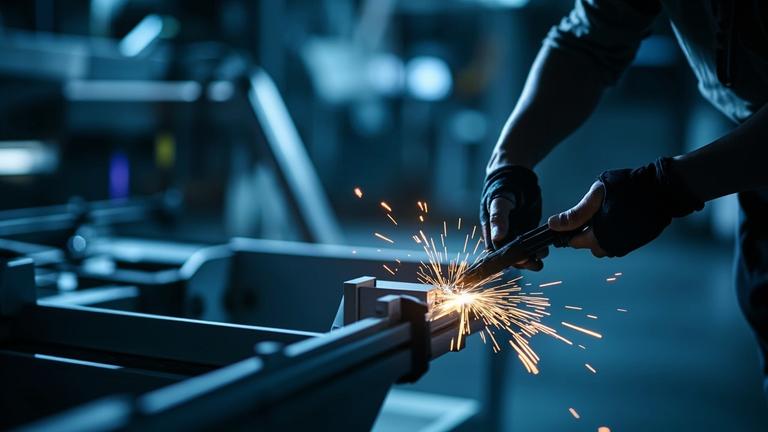
Automation: Advanced robotics and machine learning were integrated into the WAAM process to enhance precision and consistency.
- Problem: Traditional manufacturing methods struggle to meet the demands of modern automotive production, particularly in terms of scalability, efficiency, and quality.
- Solution: The company implemented Wire Arc Additive Manufacturing (WAAM), leveraging its scalability, material efficiency, and ability to produce complex geometries.
- Results: The company achieved a 30% reduction in production costs, a 50% decrease in lead times, and improved quality and flexibility in their manufacturing operations.
- Impact: WAAM has revolutionized the company's production capabilities, providing a competitive advantage in the automotive industry.
Problem: The Need for Scalable, Automated Manufacturing Solutions
In the highly competitive automotive industry, companies are constantly seeking innovative ways to enhance production efficiency, reduce costs, and maintain high-quality standards. Traditional manufacturing methods often struggle to meet these demands, particularly when it comes to producing complex, high-precision components. The challenge is to implement scalable solutions that can adapt to varying production volumes while ensuring consistent quality and reducing lead times.
Solution: Embracing Wire Arc Additive Manufacturing (WAAM)
The automotive company in focus has turned to Wire Arc Additive Manufacturing (WAAM) as a key technology to address these challenges. WAAM, a subset of Directed Energy Deposition (DED), uses an electric arc as a heat source to melt a wire feedstock, which is then deposited layer by layer to build a 3D component. This method offers several advantages over traditional manufacturing techniques, including:
- Scalability: WAAM systems can be easily scaled up or down to accommodate different production volumes, making them ideal for both low-volume, high-mix and high-volume production.
- Material Efficiency: The use of wire feedstock results in minimal material waste, reducing material costs and environmental impact.
- Complex Geometries: WAAM enables the production of complex geometries that are difficult or impossible to achieve with traditional subtractive manufacturing methods.
- Reduced Lead Times: The ability to produce near-net-shape components reduces the need for subsequent machining, thereby shortening lead times.
The company has invested heavily in automating the WAAM process, integrating advanced robotics and machine learning algorithms to optimize the deposition process. This has resulted in improved precision, consistency, and overall efficiency.
Results: Enhanced Production Capabilities and Cost Savings
The implementation of WAAM in series production has yielded significant benefits for the automotive company. According to internal reports, the company has achieved:
- 30% Reduction in Production Costs: By minimizing material waste and reducing the need for post-processing, WAAM has led to substantial cost savings.
- 50% Decrease in Lead Times: The ability to produce components in a single step, without the need for extensive machining, has significantly shortened production cycles.
- Improved Quality and Consistency: The integration of automation and machine learning has enhanced the precision and repeatability of the manufacturing process, resulting in higher-quality components.
- Increased Flexibility: The scalability of WAAM allows the company to quickly adapt to changes in demand, providing a competitive edge in the fast-paced automotive market.
"The adoption of Wire Arc Additive Manufacturing has transformed our production capabilities," said a company spokesperson. "We are now able to produce complex components more efficiently and cost-effectively than ever before."
##
Is this your company?
This article features your business. Claim it to add your logo, contact details, and a link to your website — or upgrade to reach more buyers.
Did you know 80% of Press Releases trigger AI content warnings? Reach out and the M4S team can assist.