
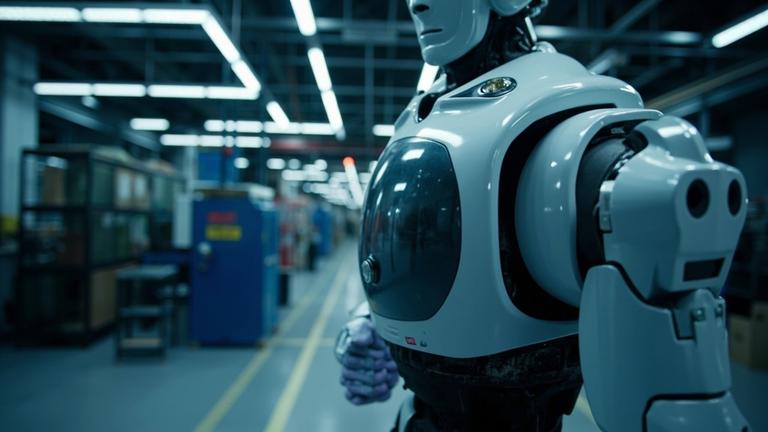
Agent layer: Gemini Robotics ER 2 handles multi-step tasks with self-correction, progress tracking, and human communication.
- Whole-body control: Gemini Robotics 2 adds intelligent whole-body control, advanced dexterity, and multi-robot collaboration to DeepMind's VLA lineup.
- Dexterous hardware support: The model controls the five-fingered, 22 degree-of-freedom SharpaWave hand on Apptronik's Apollo 2, plus two-fingered parallel grippers on a Franka Duo platform.
- Fast embodiment transfer: Gemini Robotics On-Device 2 runs locally and adapts to new bi-arm embodiments with less than 200 examples.
- Safety tooling: DeepMind introduced the ASIMOV-Agentic benchmark, and ER 2 can detect nearby humans and stop the robot safely.
Google DeepMind has unveiled Gemini Robotics 2, the latest version of its vision-language-action (VLA) model, and the headline capability is a significant one for anyone watching humanoid deployment: intelligent whole-body control, paired with advanced dexterity and multi-robot collaboration.
From tabletop tasks to full-body coordination
Where earlier work focused on upper-body manipulation, Gemini Robotics 2 extends control across an entire humanoid platform. The model can control the five-fingered, 22 degree-of-freedom SharpaWave hand on Apptronik's Apollo 2 humanoid robot — the kind of end effector complexity that has historically demanded hand-tuned control stacks. It can also operate standard two-fingered parallel grippers on a Franka Duo platform for complex dexterous tasks, suggesting the model is not locked to a single hardware configuration.
"Gemini Robotics 2 enables robots to reason through every movement, unlocking a broad range of tasks."
That reasoning claim matters. DeepMind's framing is that finesse, not just strength or speed, is the barrier to real-world utility.
"To be genuinely useful in our homes and workplaces, robots need finesse."
A two-layer architecture: reasoning above, action below
Alongside the VLA, DeepMind released Gemini Robotics ER 2, an embodied reasoning model that acts as the company's agent layer — enabling robots to communicate with people and understand the physical world. ER 2 can execute complex multi-step tasks, self-correct if a step fails, and generalize to novel situations. Notably, the model now understands when tasks begin and end and can pinpoint the moment key events occur, a capability that underpins longer, more reliable task sequences.
The update also introduces multi-robot collaboration, allowing different types of robots to work together — a workflow dimension a single robot cannot address alone.
On-device inference for disconnected environments
For deployments where connectivity is unreliable or latency is unacceptable, Gemini Robotics On-Device 2 is optimized to run locally on robotic devices.
"Gemini Robotics 2 can run locally on-device while adapting to entirely new robotic bodies in just a few hours."
The on-device model can adapt to new bi-arm robot embodiments with less than 200 examples — a data-efficiency figure that, if it holds in the field, meaningfully lowers the integration cost of porting the model across platforms.
Safety as a stated foundation
"Safety is foundational to its robotics research."
DeepMind introduced ASIMOV-Agentic, a benchmark for agentic safety orchestration and uncertainty resolution. On the practical side, Gemini Robotics ER 2 can detect when humans are nearby, trigger safety tool calls, and bring the robot to a safe stop if someone approaches too closely — behavior directly relevant to collaborative operation requirements.
Gemini Robotics ER 2 is available on Google AI Studio and in private preview on Gemini Enterprise Agent Platform, with the VLA and On-Device models offered to early-access partners.
Is this your company?
This article features your business. Claim it to add your logo, contact details, and a link to your website — or upgrade to reach more buyers.
Did you know 80% of Press Releases trigger AI content warnings? Reach out and the M4S team can assist.