
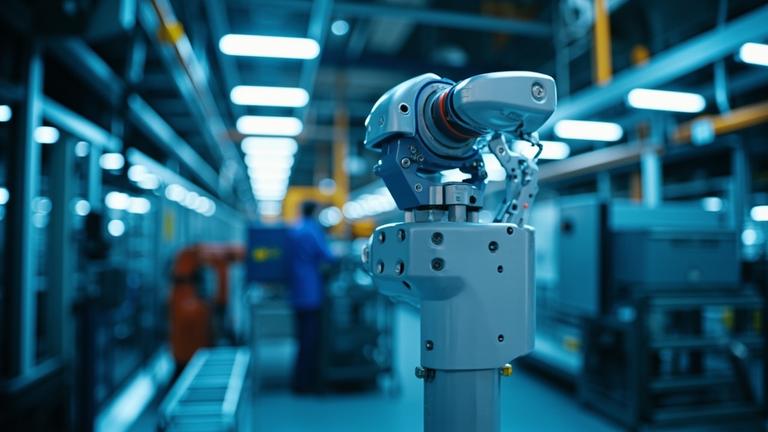
This analysis underscores the critical need for a more strategic national approach to robotics and automation in the U.S. to compete with global leaders like China.
- 11% year-on-year increase in U.S. industrial robot installations, reaching 38,000 units in 2025
- Food industry leads non-traditional sectors with a 30% surge in robot adoption
- U.S. ranks eighth globally in robot density with 307 robots per 10,000 manufacturing workers
- China installs roughly ten times more robots than the U.S.
Problem: Lagging Behind Global Automation Leaders
In 2025, the United States saw a notable 11% year-on-year increase in industrial robot installations, reaching 38,000 units. This growth was primarily fueled by the food industry, which experienced a 30% surge in robot adoption, alongside the metal and machinery and electrical-electronics sectors, each recording approximately 3,000 installations. Despite this progress, the U.S. automotive industry remained the largest adopter, installing 13,500 units, just 1% below the previous year's figures.
The U.S. market's growth is significant, but it still pales in comparison to China's dominance. In 2024, China installed 295,000 industrial robots, more than half of the global demand, and IFR estimates that China's 2025 installations will be roughly ten times higher than those in the United States.
Solution: A Push for a National Robotics Strategy
To address this gap, industry groups in the U.S. are advocating for a more coordinated national approach to robotics and automation. The Association for Advancing Automation (A3) has proposed the creation of a Federal Robotics Office and a National Robotics Commission. These entities would be tasked with coordinating policy, research, workforce development, and commercialization efforts, mirroring the strategic approach seen in other leading nations.
"The United States are back on the growth track," said Takayuki Ito, President of the International Federation of Robotics. "The data highlights a growing demand for flexible automation in the food industry."
Results: Improved Global Standing, but Challenges Remain
The rise in robot installations has positively impacted the U.S. global ranking in robot density, a metric that measures the number of industrial robots per 10,000 manufacturing workers. The U.S. now ranks eighth worldwide with 307 robots per 10,000 employees, moving up two positions from the previous year. However, this is still significantly lower than the global leader, South Korea, which boasts 1,220 robots per 10,000 workers, followed by Germany and Japan.
The IFR anticipates sustained long-term growth in North American automation, driven by several factors:
- Reshoring of manufacturing facilities
- Persistent labor shortages
- Expanding demand for automation in non-traditional sectors
Despite these positive indicators, the U.S. continues to face challenges in catching up with China's rapid automation advancements. China's decade-long national robotics strategy and ongoing government support through its latest Five-Year Plan, which prioritizes robotics and AI-enabled physical systems, have been instrumental in its dominance.
Is this your company?
This article features your business. Claim it to add your logo, contact details, and a link to your website — or upgrade to reach more buyers.
Did you know 80% of Press Releases trigger AI content warnings? Reach out and the M4S team can assist.