
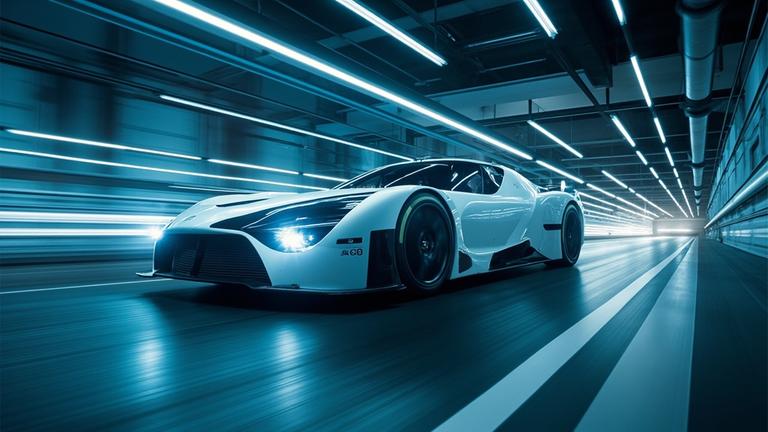
Race outcome: Unimore Racing from the University of Modena and Reggio Emilia won the competition, facing Purdue AI Racing in the final heat.
- Simulation gate: Teams qualified through a D-Space simulation race — the first time virtual qualification was required before competing on a physical track.
- Common hardware platform: All AV-24s share the same Dallara base design, Honda engine, Luminar sensors, and NVIDIA GPU, making the event a pure AI driver software contest.
- Program reach: University teams from North America, Europe, and Asia competed, with alumni founding companies including Aidoptation, driveblocks, and Autonoma AI.
This year’s event featured the first time in IAC history that the autonomous racecars overtook one another on a road course.
University teams from North America, Europe, and Asia competed in the event, with their AI driver software piloting AV-24s supplied by the IAC. The AI drivers made all decisions about when and where to pass once the heats began.
From simulation qualification to on-track passing
A notable change this year came before any car touched pavement.
The teams qualified for the event a few months earlier, in a simulation race event hosted by D-Space.
This is the first time that participating teams have been required to qualify for an autonomous race within a virtual testing environment before being allowed to compete on a physical track.
That gate matters. It shifts risk out of the physical world and forces teams to prove their software before committing hardware to the circuit — a workflow manufacturing engineers will recognize from virtual commissioning practice.
A software competition wearing a racing suit
The IAC strips away hardware differentiation by design.
The IAC event is primarily an AI driver software event, as the vehicles all have the same Dallara base design, Honda engine, Luminar sensors, and NVIDIA GPU.
With identical vehicles, lap time becomes a pure measure of algorithm quality. The winning team was Unimore Racing from the University of Modena and Reggio Emilia, which faced Purdue AI Racing in the final heat. The corkscrew turn at Laguna Seca Raceway was the site of multiple overtakes at this year's autonomous race.
A growing talent pipeline
The IAC event started in 2021 at the Indianapolis Motor Speedway, with an international lineup of university teams. Teams consist of Ph.D. and master's students working on autonomous driving research, and the program is supported by sponsors and donors in the automotive and AI markets. Several team members have gone on to start new companies in the automotive space after working with the IAC, including Aidoptation, driveblocks, and Autonoma AI.
For engineers watching autonomous development, the takeaway is straightforward: the pace of software validation is accelerating, and simulation-first qualification is becoming the entry ticket.
Is this your company?
This article features your business. Claim it to add your logo, contact details, and a link to your website — or upgrade to reach more buyers.
Did you know 80% of Press Releases trigger AI content warnings? Reach out and the M4S team can assist.