
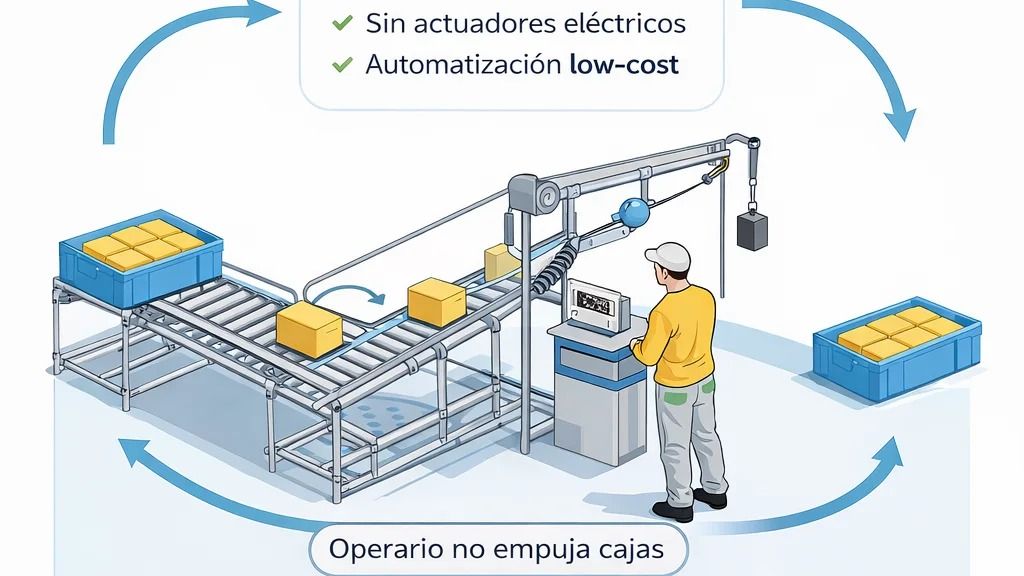
Arsam's structural extrusions are the backbone behind Karakuri Kaizen cells, which move work between stations using gravity, levers and counterweights instead of motors, PLCs or sensors. The cells carry no powered device, so they cut CAPEX and OPEX, need little maintenance and remove manual handling from the job. Arsam has not published named customer installations, measured payback or unit pricing, so the case rests on the mechanism rather than on results.
## M4S quote
Mechanical automation that costs almost nothing to run.
Karakuri Kaizen uses gravity, levers, springs and counterweights to shift work between stations without a single powered device. The approach cuts both CAPEX and OPEX, simplifies maintenance and takes manual handling out of the job, so it sits alongside conventional automation rather than replacing it. Arsam supplies the modular G.S.-ACE extrusion these cells are built from.
The G.S.-ACE tubes and fittings give high mechanical strength, adapt quickly to a revised layout and assemble without welding. That suits Karakuri work because the first cell is usually a prototype: the structure has to be cheap to change and cheap to build.
Gravity-fed rails and rollers take over transfers that would otherwise need a motorised unit. Counterweighted carts move between workstations under lever control. Mechanical separators advance cartons in FIFO order without sensors. Each removes a powered device from the cell and shortens the cycle.
Implementation follows the Kaizen route: document the material flow, walk the floor to find waste, design a mechanical answer, prototype it from the same extrusion and validate it in the plant. Because it carries no electronics, it sits inside a Kanban pull system rather than beside it, and the teams building the cell are the ones who can improve it afterwards.
Frequently asked questions
How does Karakuri Kaizen reduce operational costs in manufacturing?
Karakuri Kaizen reduces operational costs by eliminating the need for electric actuators and complex controls, significantly lowering both CAPEX and OPEX. It relies on mechanical principles like gravity and springs, which require minimal maintenance and fewer components prone to failure.
What are the key differences between Karakuri Kaizen and traditional automation?
Karakuri Kaizen uses mechanical solutions without motors or electronics, resulting in lower costs, simpler maintenance, and higher flexibility compared to traditional automation, which relies on electricity, pneumatics, and complex software.
What are the specific applications of Karakuri Kaizen in various industries?
Karakuri Kaizen is applied in industries for tasks like gravity-based part transfer in assembly stations, automated movement of carts between workstations using counterweights, and box separators that advance items without sensors or actuators. These applications improve workflow, reduce manual handling, and enhance productivity.
What materials are commonly used in building Karakuri devices?
Common materials include modular tubes like G.S.-ACE, metal profiles, rollers, levers, springs, and standard plastic or metal parts. These materials allow for robust and adaptable structures without welding or electronic components.
Can Karakuri Kaizen be implemented without significant investment?
Yes, Karakuri Kaizen is known for its low entry cost. Effective solutions can be developed using accessible materials and basic mechanical knowledge, enabling in-house teams to propose and execute improvements without relying on external suppliers.
Is Karakuri Kaizen compatible with Lean Manufacturing and Kanban?
Absolutely. Karakuri Kaizen originated as part of the Japanese Lean culture and integrates naturally into Kanban and continuous improvement environments. Its principles support waste elimination, value flow, and active team participation in process improvement.
Get the long read at Suministros Arsam S.A.
Is this your company?
This article features your business. Claim it to add your logo, contact details, and a link to your website — or upgrade to reach more buyers.
Did you know 80% of Press Releases trigger AI content warnings? Reach out and the M4S team can assist.