
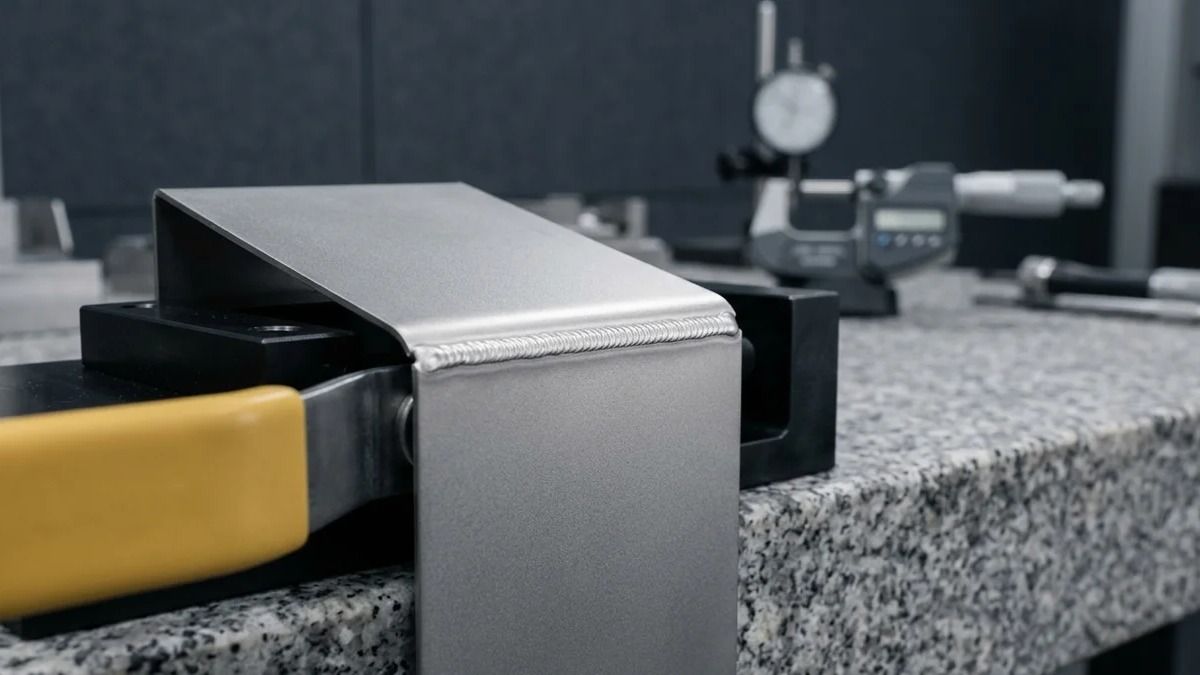
Super Pulse Technology makes laser repair welding safe on components too heat-sensitive for conventional methods.
Super Pulse Technology gives Sigma Laser machines fine control over laser pulses, shrinking the heat-affected zone and cutting distortion and cracking risk on thin-walled or heat-treated components. The maker advises conservative starting parameters, systematic testing, and full documentation to secure reproducible repair quality on difficult alloys.
The system fine-tunes pulse duration, energy, and frequency to keep the heat-affected zone minimal on delicate components.
Thin-walled sections, previously heat-treated parts, and components near seals or bearing points carry the highest risk: even small temperature increases can cause distortion, cracking, or hardness loss. SPT's precise energy dosing cuts that risk, making safe repairs possible on titanium, high-alloyed steels, and reactive metals where conventional methods fail.
The recommended approach starts with conservative settings — low pulse energy, short pulses, reduced frequency — followed by systematic testing, documented parameters, and inspection of the heat-affected zone after welding. The technology is available on all six Sigma Laser welding machines.
Frequently asked questions
How does Super Pulse Technology (SPT) enhance welding precision for heat-sensitive components?
Super Pulse Technology (SPT) allows for precise control of laser pulses, minimizing the heat-affected zone (HAZ) and reducing the risk of distortion or material changes. This is achieved through adjustable pulse parameters such as duration, energy, and frequency, enabling safe repairs on challenging materials and geometries.
What are the best practices for welding heat-sensitive components to minimize thermal impact?
To minimize thermal impact, start with conservative parameters like low pulse energy, short pulse duration, and reduced frequency. Carefully monitor the first test weld for signs of surface changes or micro-cracks. Document all parameters and results to create a reliable set for future use. Adjust parameters individually for each component and material, and reassess after each adjustment to ensure optimal results.
What are the advantages of localized energy input in laser welding?
Localized energy input in laser welding minimizes the heat-affected zone (HAZ), reducing the risk of distortion, cracking, and material changes. This helps maintain the dimensional accuracy and functionality of precision components and thin-walled structures, while also lowering the risk of thermal stress on adjacent functional surfaces.
How does SPT help in welding reactive metals like titanium?
SPT aids in welding reactive metals like titanium by providing precise control over the heat input, which is crucial for avoiding oxidation and structural changes. This technology ensures that the welding process maintains the integrity of the material and prevents unwanted reactions.
What are the common pitfalls when welding heat-sensitive parts?
Common pitfalls include using excessive energy, incorrect pulse parameters, or inadequate control of the welding environment, which can lead to distortion, cracking, or loss of hardness. Careful selection and documentation of parameters are essential to avoid these issues.
Get the expert read at Sigma Laser Applications & Systems GmbH
Is this your company?
This article features your business. Claim it to add your logo, contact details, and a link to your website — or upgrade to reach more buyers.
Did you know 80% of Press Releases trigger AI content warnings? Reach out and the M4S team can assist.