
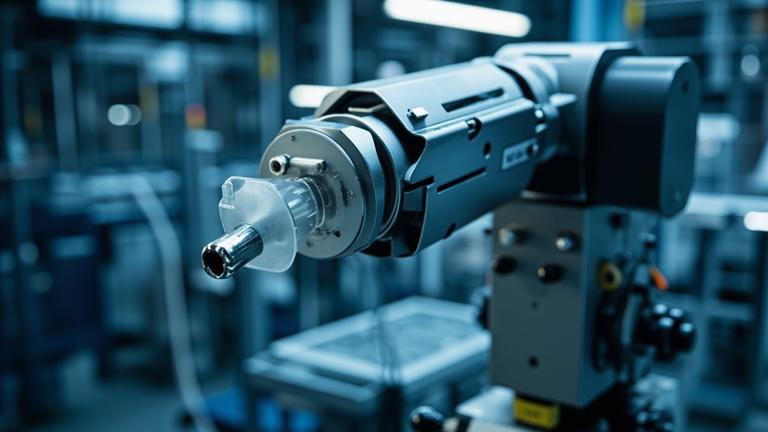
Clinician authority preserved: The robotic arm assists and recommends, but the clinician remains in control of every step.
- Scale of the procedure: Over a million feeding tubes are inserted into U.S. patients each year, most placed blindly, with 3% to 5% misplaced into the lungs.
- Navigation core: ENvue Drive pairs a feeding-tube-tip sensor with the Ask Oscar AI software on the 510(k) FDA-cleared ENvue Navigation Platform, refreshing position roughly 40 times per second.
- Handling patient motion: Additional ECG sensors on the patient's body keep guidance accurate even when sedated or ventilated patients move mid-procedure.
- Expansion path: ENvue targets vascular access and peripherally inserted central catheters next, with additional clearances planned in the coming years.
ENvue Medical Inc. has unveiled ENvue Drive, a robotic-assisted tool for automatic feeding tube placement that integrates AI, real-time navigation, and robotic-assisted procedural execution into a single clinical workflow. The system targets a procedure performed at massive scale — over a million feeding tubes are inserted into patients in the United States each year — and one that today is still largely done blind.
A blind procedure with a measurable error rate
Most feeding tubes are placed blindly, meaning the clinician relies on experience and tactile feedback to guide the tube through the nose and into position. The consequences of getting it wrong are not trivial.
"About 3% to 5% of all those procedures are misplaced, and they land in the lungs," said Dr. Doron Besser, CEO of ENvue Medical.
"If that occurs, it creates a cascade of problems. It can cause lung collapse. Sometimes, one even leaves the feeding tube within the lungs, and it fills up the lung with fluid nutrients."
The patient population is broad. "It can be in critical care patients — that means elderly patients, adult patients, and all the way down to pediatrics and pre-term infants," Besser said.
Sensor-driven navigation, robot-assisted execution
ENvue Drive builds on the company's ENvue Navigation Platform, whose core technology is already 510(k) FDA-cleared. A sensor at the end of the feeding tube gives clinicians visibility during placement, paired with the company's AI navigation software, Ask Oscar.
Refresh rate is central to the design. "One of the most important things with electromagnetic navigation systems is that the sensors have to have a very, very high refresh rate," Besser said. "With ours, it's about 40 times per second. Why is that important? Because if the clinician inserts that feeding tube, you want to see an immediate response on the screen, so there's no delay."
The system moves in five degrees of freedom and provides directional guidance throughout the procedure. "Our system provides steering directions. In other words, the clinician will always know in which direction is the feeding tube pointing," Besser said — a GPS-like approach to a procedure that previously had no equivalent.
Engineering for an uncooperative environment
Patients move, and that complicates any automated bedside procedure. "Even heavily sedated patients, even mechanically ventilated patients, can move during the procedure. Nobody likes to have a feeding tube inserted," Besser said. ENvue addresses this with additional ECG sensors placed on the patient's body to keep the system accurate when position shifts.
Control, however, stays with the human operator. The system alerts the clinician when the tube nears an area it shouldn't and recommends next steps — but the clinician decides.
"We don't want robots to take over from the clinicians. We want the robotic arm to assist, to provide more confidence, to facilitate the procedures, while having the clinician, who's highly capable and is highly provisioned, still keep control of the system."
Beyond feeding tubes
Besser frames ENvue Drive as a first step toward automating common bedside procedures. "The first step, naturally, would be internal feeding. The next step would be vascular access, and that specifically would be peripherally inserted central catheters," he said. ENvue plans to pursue additional clearances for ENvue Drive in the coming years.
Is this your company?
This article features your business. Claim it to add your logo, contact details, and a link to your website — or upgrade to reach more buyers.
Did you know 80% of Press Releases trigger AI content warnings? Reach out and the M4S team can assist.