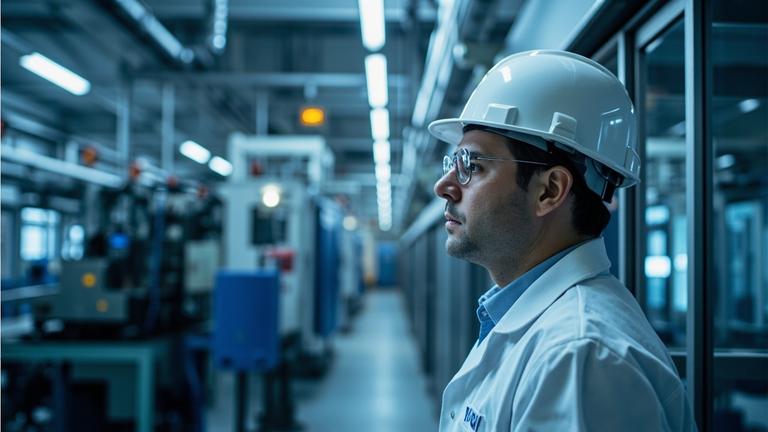
Gustavo Suarez was drawn to manufacturing by the satisfaction of being part of a team that creates physical products.
“I decided to pursue a career in manufacturing because there’s something really satisfying about being part of a team that creates physical products.”
Now a Process Engineer at Elcon Precision, a TPC Company, Suarez has been with Elcon Precision, LLC for 1 year, 4 months. The company operates in photochemical manufacturing, and his remit is broad: reviewing customer requirements, defining processes, writing work instructions, monitoring the process, responding to escalations, recommending corrective actions, qualifying equipment, writing SOPs, training operators on new processes or tools, dispositioning nonconforming materials, identifying root causes for defects, and conducting analysis.
A role built across functions
Suarez’s view of manufacturing is explicitly cross-functional. The product may be made by process control, but successful delivery relies on the alignment of various teams.
“Manufacturing only works when people from different areas come together: engineering, operations, quality, supply chain, HR and so on.”
That perspective fits the job description. A process engineer at Elcon Precision is not only tuning a line; Suarez is translating customer requirements into stable instructions, then supporting the people and equipment that have to repeat those instructions under production pressure.
Since 2025, he has been a process owner for the electroplating and etch departments. The technical aspect remains a key draw.
“The part of my job I find most interesting is the science behind it.”
Pride in repeatability
His education includes a Bachelor's of Science in Nanoengineering, but the pride he describes is operational: procedures improved, processes stabilized, problems solved with the team.
“I’m proud of the consistency.”
That consistency is also what he strives to achieve from concept to production.
“I enjoy taking something that’s theoretical and building a process around it that’s stable, repeatable and produces high-quality parts.”
The larger point is that technical work does not remain purely technical; it becomes shared work, measured in whether internal teams and customers can rely on the same outcome repeatedly.
“I love that manufacturing mixes technical work with teamwork.”
Exposure as the talent strategy
Suarez’s advice to students is straightforward: stay curious and pay attention in school, as a strong technical foundation opens up more opportunities. His advice to manufacturers is equally practical and more structural.
“The most important thing is simply giving kids exposure to what manufacturing actually is.”
He emphasizes hands-on activities, short tours, and demonstrations as ways to connect classroom learning with real applications. The goal is not glossy recruitment but to provide students with a realistic view of the environment, helping them envision themselves within it.
For manufacturing professionals, the takeaway from Oct. 15, 2026, is clear: process excellence depends on science, but workforce renewal may depend on showing the work early enough for curiosity to take hold.
Is this your company?
This article features your business. Claim it to add your logo, contact details, and a link to your website — or upgrade to reach more buyers.
Did you know 80% of Press Releases trigger AI content warnings? Reach out and the M4S team can assist.