
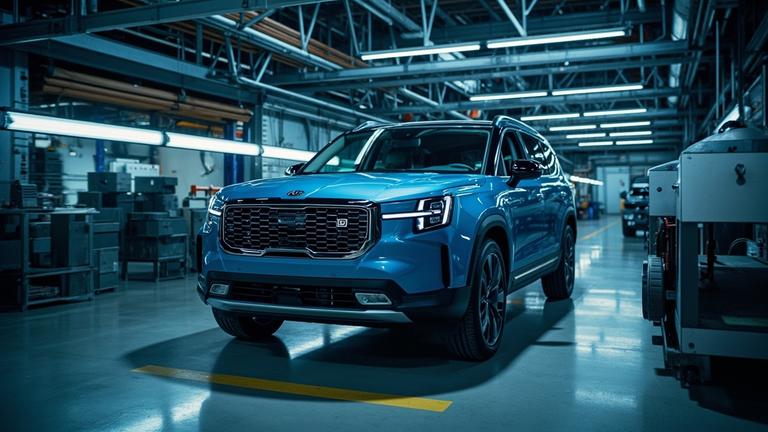
Tesla performance: The Model Y achieved good ratings across all crash, headlight, and front crash prevention categories.
- Award outcome: The IIHS granted Top Safety Pick+ to the 2027 Kia Telluride and the 2026-27 Tesla Model Y, the only two of seven newly tested models to qualify.
- Build-date restriction: The Telluride award applies only to units produced after June 2026, when a headlight upgrade took effect; post-June vehicles posted scores equivalent to the Model Y.
- Test requirements: The award demands good ratings in moderate overlap front, small overlap front, and side crash tests, acceptable or better headlights on all trims, a good pedestrian front crash prevention score, and at least an acceptable V2V front crash prevention 2.0 result introduced in 2024.
- Misses among the rest: The 2026 BMW i4 had the weakest outcome (poor V2V, incomplete small overlap result, marginal to poor headlights), the GMC Canyon crew cab also rated poor on V2V, and the BMW 3 Series, Lexus IS, and Toyota Crown Signia each missed at least one category.
A Tight Field
The Insurance Institute for Highway Safety (IIHS) has awarded Top Safety Pick+ to the 2027 Kia Telluride and the 2026-27 Tesla Model Y. The two vehicles were the only qualifiers out of seven newly tested models — a pass rate that underscores how demanding the current criteria have become.
The award requirements leave little room for weak links. Vehicles must achieve good ratings across the moderate overlap front, small overlap front, and side crash tests. Headlights must rate acceptable or better across all trims — not just the flagship configuration. Top Safety Pick+ additionally demands a good pedestrian front crash prevention score and at least an acceptable result in the V2V front crash prevention 2.0 evaluation, which was introduced in 2024.
One Component, One Cut-Off Date
The Telluride result carries a detail that matters directly to production and quality engineers. The award applies only to units produced after June 2026, when a headlight upgrade took effect. Vehicles built before that date do not qualify.
That build-date condition is a reminder that a single component specification can determine whether an entire vehicle line clears an external rating threshold. For post-June production, the 2027 Telluride posted equivalent scores to the Model Y — good ratings across the board.
The Model Y itself achieved good ratings across all crash, headlight, and front crash prevention categories, a clean sweep for the 2026-27 model.
Where the Other Five Fell Short
The five remaining tested models each failed to clear at least one requirement.
The 2026 BMW i4 recorded the weakest outcome of the group: a poor V2V score, an incomplete small overlap front result, and headlights rated marginal to poor. The GMC Canyon crew cab also received a poor V2V rating. The BMW 3 Series, Lexus IS, and Toyota Crown Signia each missed the threshold in at least one category.
The pattern is notable. Front crash prevention performance — particularly the V2V evaluation introduced in 2024 — is proving to be a common failure point, alongside headlight performance that varies by trim or build date.
What This Signals for Manufacturing
The Telluride case shows IIHS criteria operating at the component level: a headlight change mid-cycle moved a vehicle from non-qualifying to Top Safety Pick+. For manufacturing teams, that means rating outcomes are now tied to changeover dates, supplier revisions, and trim-level hardware consistency — not just structural design. Getting the architecture right is necessary. Getting every unit built with the right hardware is what earns the award.
Is this your company?
This article features your business. Claim it to add your logo, contact details, and a link to your website — or upgrade to reach more buyers.
Did you know 80% of Press Releases trigger AI content warnings? Reach out and the M4S team can assist.