
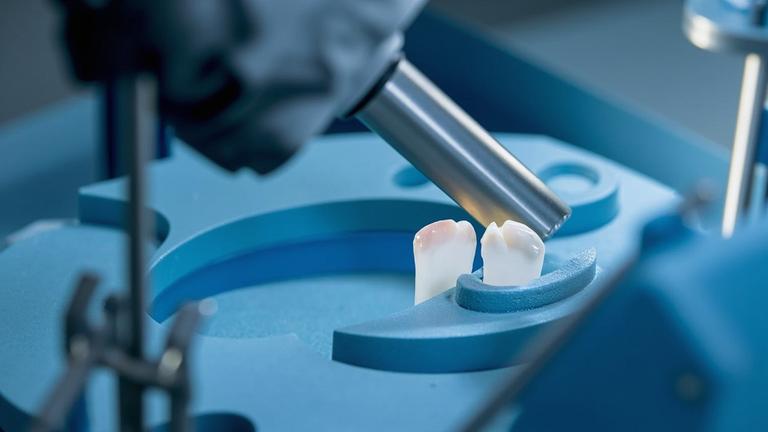
Process pairing: polymer 3D printing complements titanium implants rather than replacing them.
- KLS Martin workflow: 3D printing has supported personalized titanium medical devices for a decade.
- Guide role: polyamide drilling and marking guides transfer surgical plans into the operating room.
- Software context: SPR-Pathfinder® PRO adds simulation depth, process transparency, and accurate time prediction for metal additive manufacturing involving LPBF parts.
- Measurement context: a new scanner combines 0.02 mm single-frame accuracy, Wi-Fi 6 wireless operation, and marker-free optical tracking for inspection, reverse engineering, and on-site measurement.
September 18, 2026, 8:00 am
From plan to operating room
KLS Martin has been using 3D printing for personalized titanium medical devices for a decade. That history matters because personalization raises the manufacturing burden: titanium implants are built for an individual patient, and the surgical workflow has to match that same level of specificity.
To support that workflow, KLS Martin additively manufactures polyamide drilling and marking guides to transfer surgical plans into the operating room. In practical terms, polymer 3D printing is not competing with the implant program; it is extending it. The implant remains the high-value titanium device, while the guide becomes the patient-specific interface between plan and procedure.
The engineering point is straightforward but easy to underestimate. A personalized titanium implant only delivers its intended benefit if placement follows the plan. By producing polyamide drilling and marking guides alongside titanium implants, KLS Martin is treating surgical guidance as part of the manufacturing problem rather than as a separate clinical accessory.
Adjacent tools worth watching
The same push toward controlled, application-specific additive work shows up elsewhere in the allowed technology set. Solukon’s SPR-Pathfinder® PRO provides simulation depth, process transparency, and accurate time prediction for metal additive manufacturing, with LPBF parts becoming more demanding as geometry complexity rises.
Measurement is moving in a similar direction. The new scanner offers 0.02 mm single-frame accuracy, supports Wi-Fi 6 wireless operation and marker-free optical tracking, and is designed to support industrial inspection, reverse engineering, and on-site measurement.
Those capabilities sit within a broader technical conversation hosted by the ASTM Additive Manufacturing Center of Excellence through ICAM, a forum for technical conversations on additive and advanced manufacturing technologies.
Why this case matters
KLS Martin’s approach is a useful reminder that additive manufacturing value is not always in the final part alone. In this case, the titanium implants carry the therapy, but the polyamide drilling and marking guides carry the plan. For manufacturing professionals, that is the more transferable lesson: polymer 3D printing can create precision tooling around a metal AM core, aligning design, production, and execution without pretending that one material or process should do everything.
Is this your company?
This article features your business. Claim it to add your logo, contact details, and a link to your website — or upgrade to reach more buyers.
Did you know 80% of Press Releases trigger AI content warnings? Reach out and the M4S team can assist.