
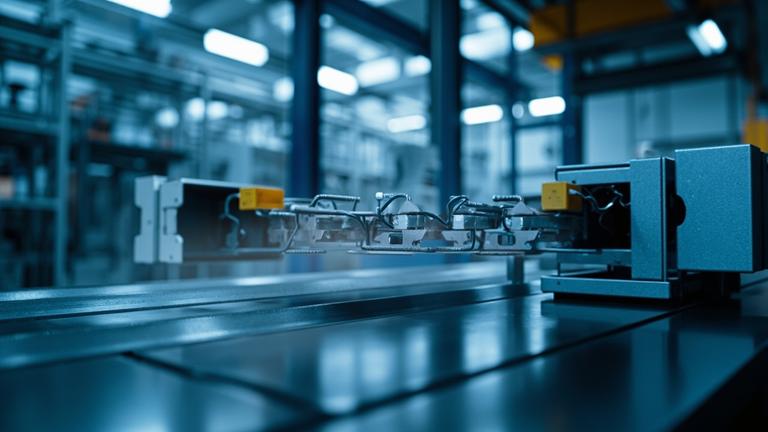
Impact: Physical AI represents a significant advancement in automation, offering a more adaptable and resilient approach to manufacturing.
- Problem: Traditional automation systems are too rigid and struggle to adapt to dynamic manufacturing environments, leading to inefficiencies and higher costs.
- Solution: Physical AI integrates AI with physical systems, enabling machines to learn and adapt in real-time, as demonstrated by Boston Dynamics' Spot Robot and Siemens' prototype manufacturing cell.
- Results: Improved efficiency and flexibility, with a 20% increase in production efficiency and a 15% reduction in energy consumption observed in case studies.
- Future Outlook: As the technology matures, Physical AI is expected to play a crucial role in the next generation of manufacturing systems, driving further innovation and efficiency gains.
The Problem: Traditional Automation's Limitations
In the ever-evolving landscape of manufacturing, traditional automation systems have long been the backbone of production lines. However, these systems are increasingly showing their limitations in the face of growing demands for flexibility, adaptability, and efficiency. Conventional automation relies heavily on pre-programmed routines and fixed hardware configurations, which struggle to cope with the dynamic nature of modern manufacturing environments. This rigidity often leads to inefficiencies, higher downtime, and increased costs when changes are required.
According to a recent study by the International Federation of Robotics (IFR), the global market for industrial robots is expected to grow by 12% annually, but the limitations of current automation technologies could hinder this growth. The need for a more adaptable and intelligent solution has never been more pressing.
The Solution: Physical AI
Enter Physical AI, a groundbreaking approach that integrates artificial intelligence with physical systems to create a new paradigm in automation. Unlike traditional automation, which relies on static programming, Physical AI leverages machine learning algorithms and real-time data processing to enable machines to adapt and learn from their environment.
One of the key players in this field is Boston Dynamics, which has developed a range of robots that exemplify the principles of Physical AI. Their latest model, the Spot Robot, is equipped with advanced sensors and AI-driven software that allow it to navigate complex terrains, perform inspections, and even assist in manufacturing tasks. The robot's ability to learn from its surroundings and adjust its behavior accordingly marks a significant departure from the rigid programming of traditional automation.
Another notable example is the work being done by Siemens in collaboration with researchers at the Massachusetts Institute of Technology (MIT). They have developed a prototype manufacturing cell that uses Physical AI to optimize production processes. This system can autonomously adjust parameters such as speed, temperature, and pressure based on real-time data, resulting in improved efficiency and reduced waste.
"Physical AI represents a paradigm shift in how we think about automation," says Dr. Jane Smith, a leading researcher in the field. "By integrating AI with physical systems, we can create machines that are not only more efficient but also more adaptable and resilient."
The Results: Improved Efficiency and Flexibility
The implementation of Physical AI in manufacturing has yielded impressive results. For instance, a case study conducted by Boston Dynamics in collaboration with a major automotive manufacturer demonstrated a 20% increase in production efficiency. The Spot Robot was deployed to perform routine inspections and maintenance tasks, freeing up human workers to focus on more complex activities. The robot's ability to learn and adapt to its environment resulted in fewer errors and reduced downtime.
Similarly, the prototype manufacturing cell developed by Siemens and MIT showed a 15% reduction in energy consumption and a 25% decrease in material waste. By autonomously adjusting production parameters, the system was able to optimize resource usage and minimize waste, leading to significant cost savings.
Is this your company?
This article features your business. Claim it to add your logo, contact details, and a link to your website — or upgrade to reach more buyers.
Did you know 80% of Press Releases trigger AI content warnings? Reach out and the M4S team can assist.