
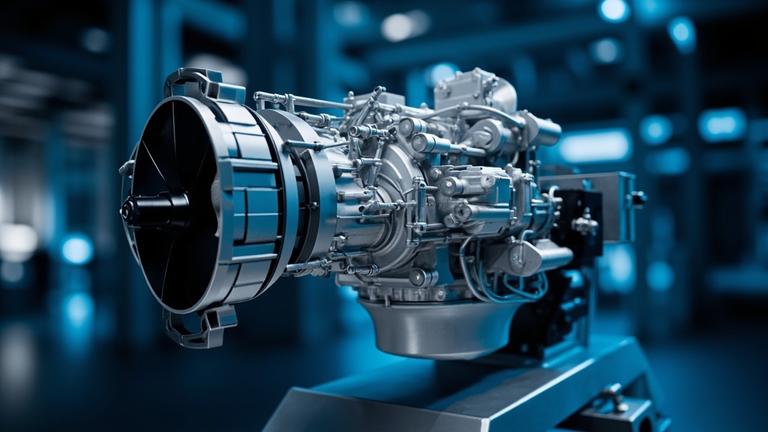
Broader application: Lessons from the TJ150 are being leveraged for other programs, including the Pratt & Whitney Valox engine family.
- Demonstration milestone: Pratt & Whitney announced successful completion of demonstration testing for its additively manufactured TJ150 engine at the Farnborough International Airshow.
- Additive content: Nearly 60% of the engine by volume was produced through additive manufacturing, including major static and rotating hardware.
- Part consolidation: More than 50 individual hot section components have been consolidated into a handful of additively manufactured parts, and a 3D-printed rotating turbine wheel was successfully tested.
- Mission profile: The TJ-150 is high-performance propulsion for tactical missiles, decoys, and effectors, with missions that can last minutes or hours.
RTX business Pratt & Whitney has demonstrated the successful completion of testing for its additively manufactured TJ150 engine, announcing the milestone at the Farnborough International Airshow.
A Turbojet Built for Additive
The TJ-150 is high-performance propulsion for tactical missiles, decoys, and effectors — applications where production speed matters as much as performance. Nearly 60% of the TJ150 engine by volume was produced through additive manufacturing, including major static and rotating hardware.
The testing focused on validating material behavior in an operational environment and demonstrating durability aligned with mission demands. For expendable engines, that's the crux: the hardware has to work reliably for the duration of the mission, and the production method has to scale.
"For expendable engines like the TJ150, where missions can last minutes or hours, simplifying the design and scaling production quickly is essential to meeting rising demand," said Jill Albertelli, President of Military Engines at Pratt & Whitney.
Part Consolidation as a Design Strategy
Pratt & Whitney has made targeted investments to advance additive manufacturing for the TJ150. To date, the company has consolidated more than 50 individual hot section components into a handful of additively manufactured parts — a consolidation that directly simplifies assembly and reduces the part count that must be qualified, stocked, and tracked.
The company has also successfully tested a 3D-printed rotating turbine wheel. Rotating hardware is where additive manufacturing earns its credibility in a turbojet: a printed turbine wheel has to survive the same centrifugal and thermal loading as conventionally manufactured hardware. Together, these efforts led to the recently tested TJ150 configuration.
What Comes Next
The lessons from the TJ150 program aren't staying with the TJ150. Albertelli indicated that Pratt & Whitney is leveraging what it learned on the engine to benefit other programs, including the Pratt & Whitney Valox engine family.
For manufacturing professionals, the takeaway is straightforward: additive manufacturing isn't being used here as a prototyping shortcut. It's the production strategy — one that moves designs from concept to capability faster, and one built around the specific economics of engines whose missions can last minutes or hours.
Is this your company?
This article features your business. Claim it to add your logo, contact details, and a link to your website — or upgrade to reach more buyers.
Did you know 80% of Press Releases trigger AI content warnings? Reach out and the M4S team can assist.