
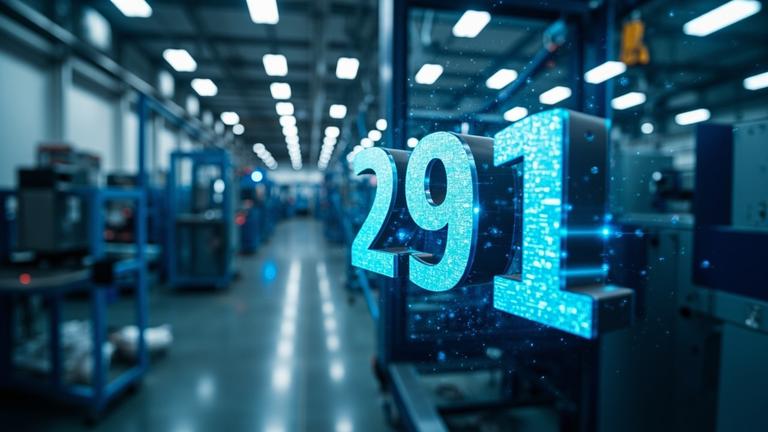
Record economic output: U.S. manufacturing value added hit $2.91 trillion in 2024, the highest nominal level on record, per a Misumi Americas report.
- Strong investment momentum: Factory construction spending peaked at $235.6 billion in 2024, while foreign direct investment reached $2.42 trillion, and the ISM Manufacturing PMI hit 54 in May 2026.
- Looming workforce shortfall: Manufacturers will need 3.8 million additional workers by 2033, according to projections from the Manufacturing Institute and Deloitte.
- Visible talent strain: 65% of manufacturers cite attracting and retaining skilled workers as their biggest challenge, with 409,000 open manufacturing jobs as of August 2025.
- Policy response proposed: Misumi Americas backs H.R. 9097, the American Manufacturing Revitalization Exchange Program Act, which would let U.S. workers train six to 12 months in allied countries.
U.S. manufacturing is posting numbers the industry has never seen before. The question now is whether there will be enough skilled workers to sustain them.
Record output, accelerating investment
U.S. manufacturing value added reached $2.91 trillion in 2024, the highest nominal level on record, according to The Rise of U.S. Manufacturing, a new report released by Misumi Americas. According to the report, if U.S. manufacturing were a standalone economy, it would rank as the world's eighth largest.
The report compiles data from the U.S. Bureau of Labor Statistics, Bureau of Economic Analysis, U.S. Census Bureau, NIST, the American Society for Engineering Education and the Reshoring Initiative.
Momentum indicators are equally strong:
- The ISM Manufacturing PMI reached 54 in May 2026, its strongest reading since May 2022, with new orders, production and order backlogs all expanding.
- Factory construction spending peaked at $235.6 billion in 2024, nearly triple the roughly $81.9 billion spent in 2021, driven largely by semiconductor fabrication plants and EV battery facilities. Although spending eased to roughly $196 billion by January 2026, it remains more than double pre-boom levels.
- Foreign direct investment in U.S. manufacturing reached $2.42 trillion, making manufacturing the largest recipient of inbound foreign investment among U.S. industries.
- Since 2010, companies have announced more than 2 million reshoring and foreign direct investment-related manufacturing jobs, including a record 364,000 announced in 2022. Approximately 1.7 million of those positions have already been filled.
The constraint isn't capital—it's people
Despite those indicators, the report argues that workforce availability has become the industry's largest constraint.
"Manufacturers will need 3.8 million additional workers by 2033, with 1.9 million positions at risk of going unfilled without additional action."
That projection comes from the Manufacturing Institute and Deloitte. Roughly 2.8 million of those workers will be needed to replace retiring employees, while the remainder reflects expected industry growth.
The strain is already visible. 65% of manufacturers identify attracting and retaining skilled workers as their biggest business challenge, and there were 409,000 open manufacturing jobs as of August 2025.
A pipeline that's growing—but not fast enough
There are signs of movement on the talent front. Enrollment at high-vocational community colleges has increased 20% since Spring 2020, and undergraduate certificate programs have grown for four consecutive years.
The catch: current enrollment levels remain well below what will be needed to meet projected workforce demand.
An exchange-based response
Alongside the report, Misumi Americas announced its support for H.R. 9097, the American Manufacturing Revitalization Exchange Program Act, introduced by Rep. Bill Huizenga. The legislation would establish an exchange program allowing American manufacturing workers to spend six to 12 months training in allied countries in advanced manufacturing fields such as robotics, semiconductor fabrication and automotive production.
The proposal is intended to accelerate the development of advanced manufacturing skills by exposing U.S. workers to established production systems and training models already in use abroad.
The bottom line, as senior editor at engineering.com Michael Ouellette put it:
"The company argues that while investment, factory construction and production continue to grow, sustaining that momentum will require expanding the industry's skilled workforce at a faster pace than current domestic training pipelines can provide."
For manufacturing professionals, the takeaway is clear: the capital, the factories and the orders are in place. The workforce is the bottleneck—and closing it is now the industry's defining challenge.
Is this your company?
This article features your business. Claim it to add your logo, contact details, and a link to your website — or upgrade to reach more buyers.
Did you know 80% of Press Releases trigger AI content warnings? Reach out and the M4S team can assist.