
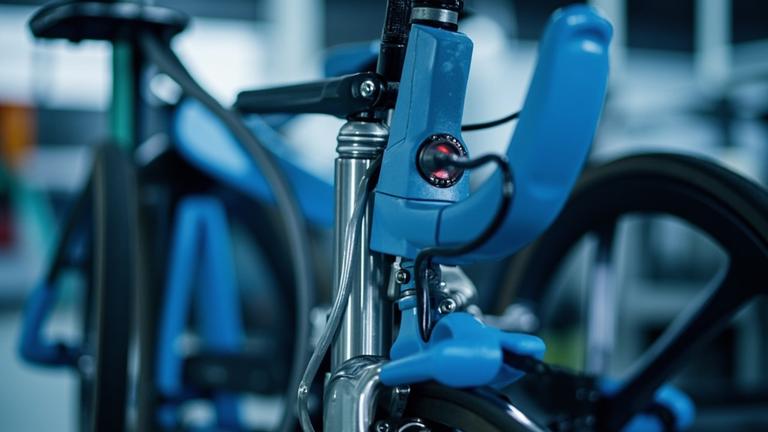
This case study highlights the growing viability of 3D printing in cycling, particularly for custom components in triathlon and high-performance road bikes.
- 3D printed parts on Tadej Pogačar's Tour de France bikes reduced costs and enabled precise customization.
- Triathlon companies like 4 Frames and Hinloopen offer affordable, user-centric components using 3D printing.
- Silca's metal 3D printed derailleur hangers demonstrate enhanced performance over OEM parts.
- Targeted 3D printing reduces costs, improves customization, and enhances bike performance.
- The approach makes advanced customization more accessible to a wider range of cyclists.
Problem: Balancing Cost and Customization in High-Performance Cycling
The cycling industry has long grappled with the challenge of delivering high-performance components that are both lightweight and customizable, without prohibitive costs. Traditional manufacturing methods struggle to meet these demands, often resulting in compromises between performance, customization, and affordability. The advent of 3D printing promised a potential solution, but its adoption has been uneven, with high costs and limited accessibility hindering widespread use.
Solution: Targeted 3D Printing for Specific Components
Recent developments in 3D printing technology have enabled more cost-effective production of specific bicycle components, particularly in the realm of customization. This case study examines several companies that have successfully integrated 3D printing into their manufacturing processes, focusing on triathlon bikes and high-performance road bikes.
### Tadej Pogačar's Tour de France Bikes
In 2023, Tadej Pogačar’s Tour de France bikes featured 3D printed parts, including holders, buttons, housings, and clips. These components were designed in collaboration with Pogačar and his mechanics, ensuring a perfect fit and precise functionality. The use of desktop 3D printers for these parts significantly reduced costs, making customization more accessible.
### Triathlon Bike Innovations
Several companies have emerged in the triathlon sector, leveraging 3D printing to deliver custom components:
- 4 Frames: Offers a range of products, including Garmin seat post mounts ($36), AirTag mounts ($4), GoPro mounts ($6), and number mounts ($14). Their hydration bladder, priced at $120, fits seamlessly beneath the steering wheel. 4 Frames utilizes Material Extrusion, ensuring affordability and user-centric design.
- Hinloopen: Specializes in Rocket Mounts for bike computers, with mounts for popular models like the Y1Rs priced at $179. These mounts are produced using powder bed fusion by an ex-BMC engineer.
- 3DPari: Provides road and triathlon bike parts, including bottle cages mounted behind the back for $45. Custom designs are also available.
- Slipstream3D: Offers between-the-armrests and bottle holders for around $200. Custom designs are a specialty, allowing cyclists to emulate their heroes.
- Neat Components: Produces $26 holders for Garmin devices, catering to budget-conscious consumers.
### Silca's Metal 3D Printing
Silca, a company with a history dating back to 1917, has embraced 3D printing for cleats, computer mounts, and derailleur hangers. Their $99 derailleur hangers, made using metal 3D printing, are touted as stiffer and lighter than OEM components, improving shifting performance. This demonstrates the potential of metal 3D printing to enhance high-performance cycling components.
Results: Enhanced Performance and Affordability
The integration of 3D printing in cycling has yielded several tangible benefits:
- Cost Reduction: By focusing on specific components, companies have reduced production costs, making customization more affordable for consumers.
- Customization: 3D printing allows for precise customization, tailoring components to individual rider preferences and needs.
- Performance Improvement: Lightweight and precisely engineered components contribute to better overall bike performance.
- Accessibility: The use of desktop 3D printers and targeted production has made customization more accessible to a broader range of cyclists.
"The key to successful 3D printing in cycling lies in identifying the right components to target," says a spokesperson for 4 Frames. "By focusing on specific areas, we can deliver high-quality, affordable solutions that meet the demands of modern cyclists."
Is this your company?
This article features your business. Claim it to add your logo, contact details, and a link to your website — or upgrade to reach more buyers.
Did you know 80% of Press Releases trigger AI content warnings? Reach out and the M4S team can assist.