
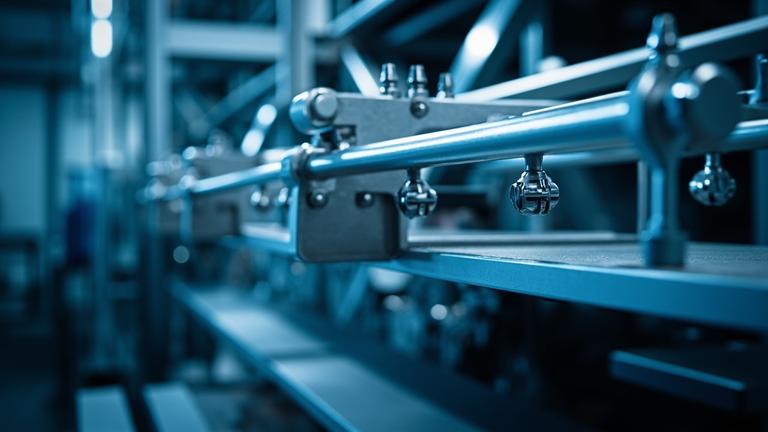
Crash protection: easily replaceable track plate minimizes cost when a crash occurs.
- Compact footprint: exceptionally compact design minimizes space requirements on the machine tool.
- Market-leading range: cam curve in the gripper arm delivers the largest gripping range of any standard steady rest on the market.
- Precision spec: repeatability within 5 microns supports slender and heavy part turning.
- Lifecycle focus: standard coolant through the gripper arms yields scratch-free surfaces and longer bearing life, continuing a design philosophy in service since 1973.
Atling has detailed the engineering behind its flagship workholding product.
Compact Footprint, Wide Grip
The exceptionally compact design minimizes space requirements, letting shops put the steady rest to work without surrendering machine envelope. That matters on crowded turrets and tight workzones where every millimeter of clearance counts.
Gripping range is the headline spec. Atling claims the largest gripping range for any standard steady rest on the market, achieved through a cam curve integrated into the gripper arm rather than bolt-on range extenders. One arm geometry covers more diameters, which cuts changeover friction for shops running mixed part families.
Repeatability and Crash Economics
Repeatability comes in within 5 microns. For turning operations on slender shafts, where support position drift shows up directly as taper and roundness error, that figure defines whether the steady rest is a precision tool or just a parts catcher.
The crash scenario got engineering attention too. The track plate for the gripper arms can be easily replaced, minimizing costs if a crash occurs. Anyone who has run a steady rest into a chuck knows this is not a hypothetical feature. Designing the sacrificial element into the structure, rather than treating a crash as a rebuild event, is a direct attack on lifecycle cost.
Coolant Through the Arms
Coolant delivery comes standard through the gripper arms. The payoff is twofold: a scratch-free machined surface at the contact zone, and extended bearing life from continuous lubrication and chip flushing. Both translate to lower running cost over the machine's service life.
The Long Game
Fifty-plus years in production gives the design unusual continuity.
M4S Take:: Compared to a generic standard steady rest, the Atling unit differentiates on two axes that rarely coexist: widest gripping range and 5-micron repeatability. Most shops accept range or precision, not both. The replaceable track plate and through-arm coolant are the quieter story, but they address the two biggest steady-rest cost drivers — crashes and bearing wear. For turning operations evaluating total lifecycle cost rather than purchase price, the spec sheet warrants a hard look.
Is this your company?
This article features your business. Claim it to add your logo, contact details, and a link to your website — or upgrade to reach more buyers.
Did you know 80% of Press Releases trigger AI content warnings? Reach out and the M4S team can assist.