
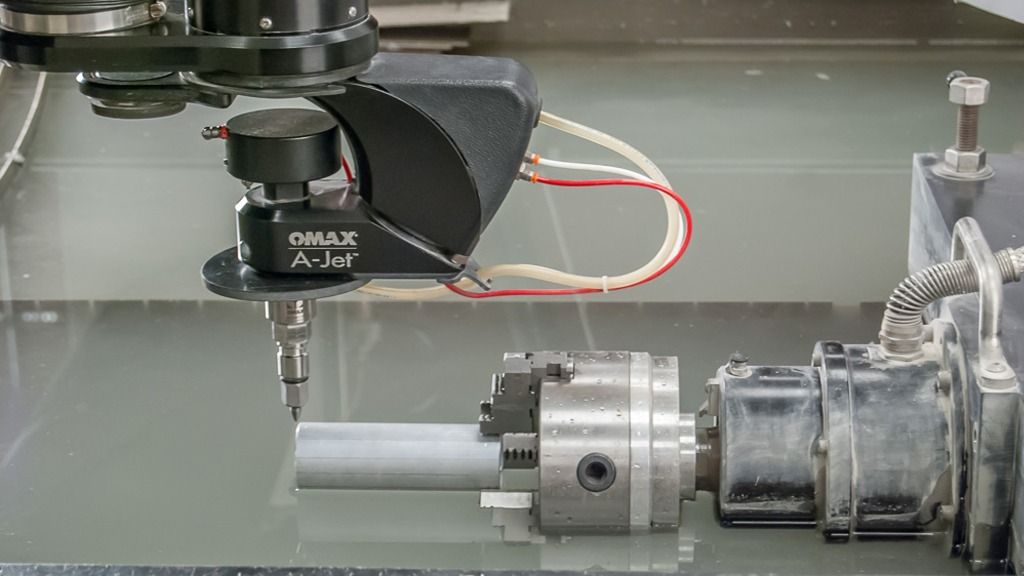
November is the practical window to check spare-part needs before year-end shutdowns and winter maintenance.
Aquajet says worn or wrongly specified components can produce an unstable jet, slower cutting and abrasive feed interruptions, with wear often showing quieter signs than sudden failure. The UK partner recommends checking machine-specific compatibility now, while November leaves time to act before year-end shutdowns and the return to full production.
The advice comes from Aquajet, the UK partner for OMAX abrasive waterjet cutting machines.
Orifices, focusing nozzles, seals, tubing and pump parts all play a part in creating a stable cutting stream. Genuine waterjet spare parts are made to the manufacturer's specified dimensions, materials and operating tolerances, and the cutting head, abrasive delivery system and pump all rely on correctly matched components to produce predictable results.
Wear does not always announce itself with a sudden failure. For critical cuts, where edge quality, dimensional accuracy, repeatability, material integrity and production continuity must all be maintained, a worn or incorrectly specified part can contribute to an unstable jet, slower cutting or abrasive feed interruptions.
Frequently asked questions
Why do genuine waterjet spare parts matter for critical cuts and tight production tolerances?
Genuine waterjet spare parts are made to the manufacturer’s specified dimensions, materials and operating tolerances. In a high-pressure cutting system, a small variation in one part can affect another, so the cutting head, abrasive delivery system and pump rely on correctly matched components for predictable results. For precision engineering, aerospace supply chains, metal fabrication, automotive production and specialist material cutting, a poor result can trigger extra inspection, finishing, re-cutting or material replacement. Fitting the correct specification helps maintain a consistent jet and avoid unnecessary uncertainty.
What warning signs show a waterjet component is wearing and affecting cut accuracy?
Wear does not always announce itself with sudden failure. A waterjet system may first show a change in edge finish, a wider kerf, more taper, or a cut that no longer holds accuracy as reliably. A worn or incorrectly specified part can also contribute to an unstable jet, slower cutting or abrasive feed interruptions. These symptoms matter because they can spread beyond one component, contributing to rework, scrap or repeated programme adjustments. Monitoring consumable condition and cutting results helps identify whether the issue is normal component wear or needs wider technical attention.
What stock level should a shop hold for larger OMAX pump components before winter maintenance?
The right stock level depends on machine usage, lead times and the impact of an unexpected stoppage. Everyday consumables may be sensible to keep available, while larger or less frequently changed components are often best ordered after an inspection or service recommendation. The aim is not to hold every possible part, but to understand which items could interrupt work if unavailable. A planned inspection before year-end shutdowns, winter maintenance windows and the return to full production gives time to assess wear items.
Which industries face extra work when a finished part misses its standard?
Precision engineering, aerospace supply chains, metal fabrication, automotive production and specialist material cutting are named as areas where a poor result can create more work further down the line. Extra inspection, finishing, re-cutting or replacing material can interrupt planned production flow. Where the finished component has to meet a defined standard, genuine parts can help keep machine performance closer to what your OMAX system was designed to deliver.
What items belong in a log that helps spot changing cutting results?
A useful maintenance record can track cutting hours for key consumables, visual condition of nozzles, seals and related wear parts, changes in kerf width, taper and edge finish, and abrasive feed behaviour and machine warnings. Following recommended maintenance intervals gives a starting point. When performance changes, reviewing recent cutting work and inspecting known wear items helps identify whether the issue is normal component wear or needs wider technical attention.
What details should be checked on a replacement before it is installed?
Before fitting a component, confirm it matches your specific machine model and intended application. A practical parts check should cover the component specification, material quality, expected service interval and fitting requirements. You should be able to identify exactly what has been supplied and where it belongs in the machine. Clear identification helps where machines have different configurations or several systems are in use on the same site, and traceability supports later review because of wear, a machine issue or a planned service.
Get the long read at Aquajet Machining Systems
Is this your company?
This article features your business. Claim it to add your logo, contact details, and a link to your website — or upgrade to reach more buyers.
Did you know 80% of Press Releases trigger AI content warnings? Reach out and the M4S team can assist.