
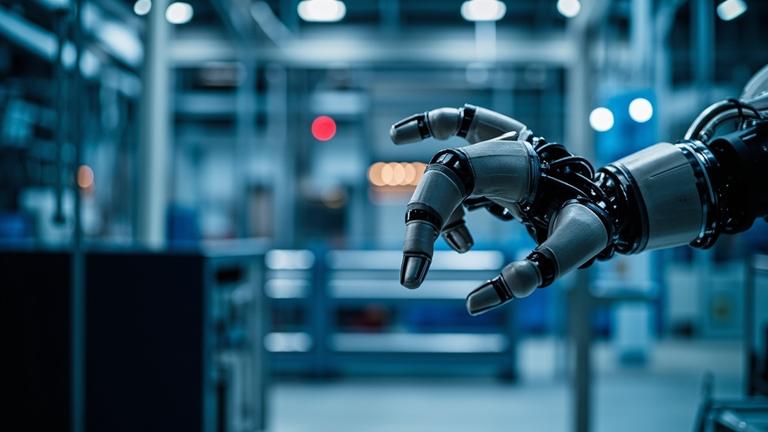
The humanoid robotics sector faces a significant data challenge in its pursuit of labor solutions.
Nikita Rudin, co-founder and CEO of Flexion, contends that this approach has inherent limitations. Teleoperation datasets are significantly smaller than those used to train language and vision models, and this gap cannot be bridged simply by hiring more operators. The real world is constantly changing, requiring new demonstrations for every variation, which makes scaling through human labor alone impractical.
The Demonstration Bottleneck
The challenges extend beyond the volume of data. The quality of teleoperation data is compromised by operators' inability to accurately feel touch or judge depth, resulting in hesitant and overcorrected movements. This forces robots to learn from suboptimal demonstrations. Despite a commercial ecosystem emerging around the sale of teleoperation data, with startups in various countries supplying it, the reliance on human labor remains a fundamental issue.
Teleoperation is often viewed as a transitional method to more advanced robot training techniques, particularly for repetitive tasks in controlled environments. Tools like the Universal Manipulation Interface (UMI) aim to ease the burden on operators. However, without evidence that human dependency decreases over time, teleoperation risks becoming a permanent fixture rather than a temporary solution.
"The robotics industry is largely stuck in that early moment. Scaling teleoperation data is the equivalent of scaling pre-training text on 100,000x less data."
— Nikita Rudin, co-founder and CEO of Flexion
Reinforcement Learning as the Alternative
Reinforcement learning in simulation offers a potential solution to reduce dependency on human demonstrations. Instead of imitating an operator, an RL-trained system learns through trial and error, iterating millions of times. Simulation enables rapid iteration and scaling of training data without damaging hardware, as environments can reset instantly, run in parallel, and scale with computational power.
Flexion's Position
Flexion is developing a reinforcement learning and sim-to-real platform for humanoid robots. The company argues that the robotics industry must move beyond teleoperation to achieve true autonomy. Rudin's background includes a Ph.D. from the Robotic Systems Lab at ETH Zurich and work at NVIDIA, where he contributed to the development of simulation tools like Isaac Gym and Isaac Lab, now widely used in the robotics industry.
Flexion recently secured $50 million from DST/NVentures to build a general-purpose "brain" for humanoid robots, betting that simulation-driven learning, rather than more operators, is the scalable path forward.
The Path that Fits the Problem
Early language models trained on vast amounts of text could mimic Shakespeare but produced nonsensical words. The breakthrough came through reinforcement learning in synthetic environments, leading to systems capable of reasoning, coding, and following complex instructions.
The robotics industry is currently in a similar early stage. Scaling teleoperation data is like scaling pre-training text with far less data, resulting in robots that can imitate basic movements but struggle with reasoning. Approaches like egocentric video capture and devices like the UMI offer improvements by allowing more natural demonstrations, but they still require human involvement and do not fully resolve the dependency issue.
Reinforcement learning changes this by enabling systems to learn through trial and error without human intervention. Simulation is a natural complement, allowing for millions of iterations without destroying hardware. Unlike teleoperation, simulation scales directly with computational power, meaning more GPUs lead to more environments, more variation, and faster iteration.
The people involved in teleoperation work and the investors funding these projects deserve clarity on whether autonomy is the true goal. If data does not show a reduction in human dependency over time, teleoperation may become a permanent rather than a temporary solution.
Is this your company?
This article features your business. Claim it to add your logo, contact details, and a link to your website — or upgrade to reach more buyers.
Did you know 80% of Press Releases trigger AI content warnings? Reach out and the M4S team can assist.