
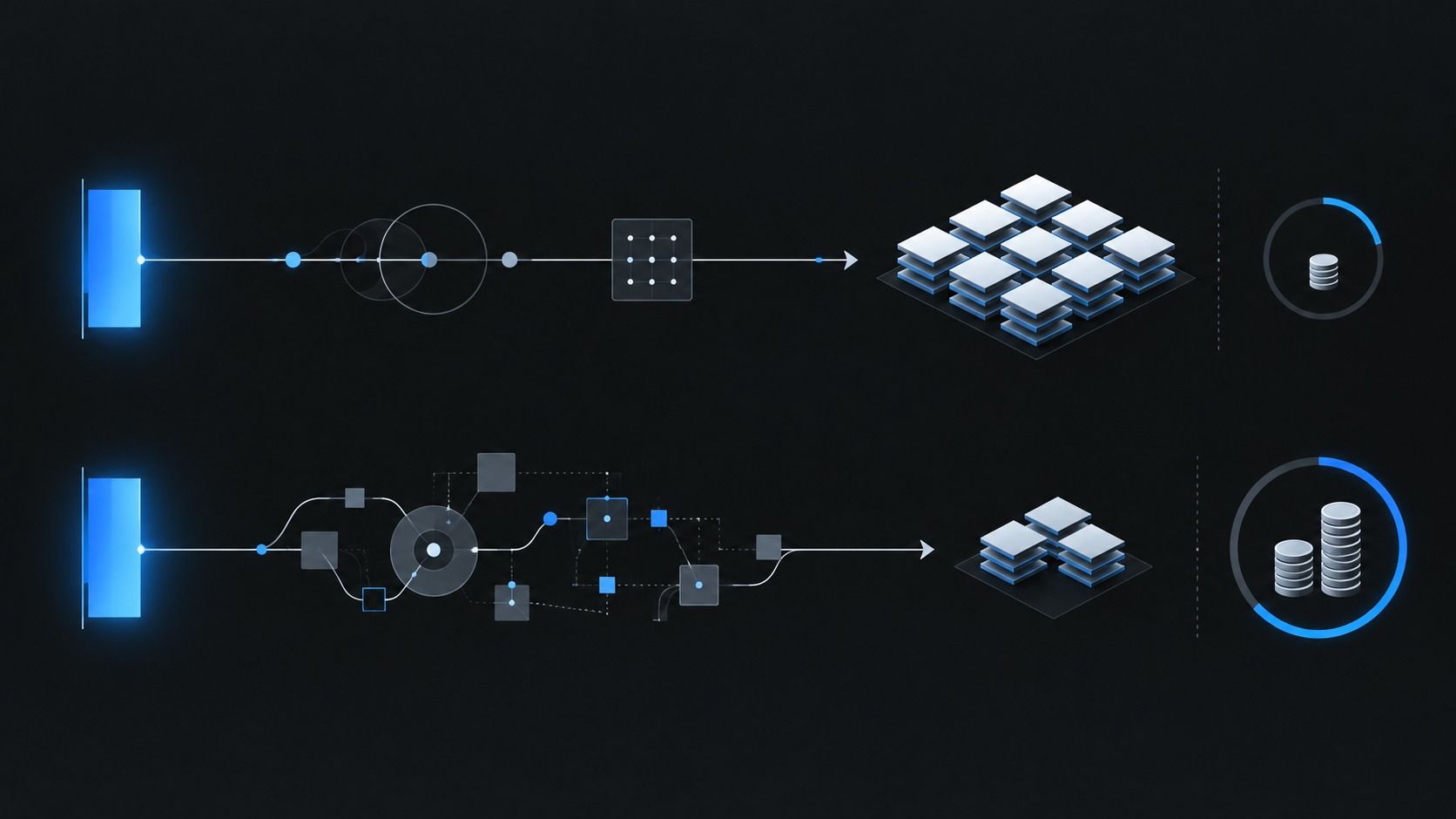
Two fiber lasers with the same kW can perform very differently in real production.
Machine buyers comparing fiber lasers should weigh acceleration, motion control, process stability and automation alongside power, since consumable interventions and waiting states erode real output. Energy per acceptable finished part beats hourly consumption as a measure. The reasoning is grounded in cited research, though the source offers no benchmark figures quantifying how wide the gap between equally rated machines actually runs.
Identical power ratings hide large gaps in shift output, and the specification sheet is where the hiding starts.
Acceleration and motion control decide how fast a machine moves through real nests of corners, small holes and repeated pierces. Research published in CIRP Annals shows actual feed rates are limited by part geometry and the machine's velocity, acceleration and jerk limits, not the commanded figure.
A study by researchers from Loughborough University and the University of Manchester found productivity and energy use depend as much on idle states as on cutting. NIST defines Overall Equipment Effectiveness as the combination of availability, performance and quality. The metric that matters is cost per acceptable finished part.
Frequently asked questions
What role does process stability play in determining the cost per acceptable part?
Process stability is crucial as it affects the quality of the cut, including piercing quality, edge quality, and dimensional accuracy. An unstable process can lead to more rejected parts, increased scrap, and the need for rework, all of which raise the cost per acceptable part.
How can manufacturers reduce the cost per acceptable part beyond just comparing laser power?
Manufacturers can reduce costs by focusing on factors like machine dynamics, process stability, and automation. Improving acceleration, motion control, and the reliability of the production process, along with better material handling and reduced idle time, can lead to more efficient production and lower costs per acceptable part.
How does predictive maintenance impact the cost per acceptable part?
Predictive maintenance uses sensor data to foresee potential issues, allowing for planned maintenance that prevents unexpected stoppages. This approach increases machine uptime and productivity, directly contributing to a lower cost per acceptable part by minimizing downtime and the associated losses.
What is the relationship between material flow and cutting productivity?
Material flow, including loading, unloading, pallet changes, and scrap removal, is integral to cutting productivity. As laser power increases and cutting times decrease, the time spent on these surrounding processes becomes more significant. Efficient material flow is essential to fully utilize the laser's capabilities and achieve higher productivity.
How does energy consumption relate to the cost per acceptable part?
Energy consumption should be considered in the context of the number of acceptable parts produced. A machine that consumes more power but produces significantly more acceptable parts may have a lower energy cost per part. The calculation becomes more meaningful when it includes cooling, extraction, and other supporting systems, providing a comprehensive view of energy efficiency.
Get the expert read at Eagle Group
Is this your company?
This article features your business. Claim it to add your logo, contact details, and a link to your website — or upgrade to reach more buyers.
Did you know 80% of Press Releases trigger AI content warnings? Reach out and the M4S team can assist.