
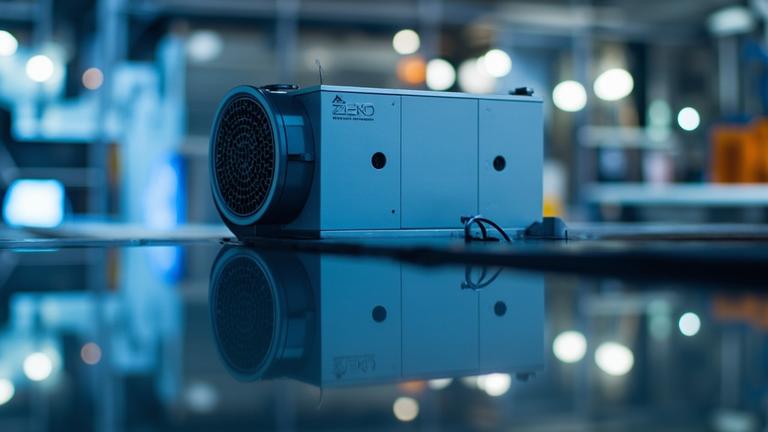
Payload design: The package pairs a 5W thermal americium-241 RHU with a dedicated platform, generating passive heat through natural radioactive decay without solar power.
- Commercial agreement: Firefly Aerospace and Zeno Power Systems signed a commercial payload agreement to fly the Survive-the-Night Package on a Blue Ghost lunar lander mission to the Moon's near side, launching no earlier than 2028.
- Thermal challenge: The lunar night lasts approximately 14 Earth days, with temperatures ranging from over 230°F in daytime to below -275°F — and as low as -280°F — at night.
- Program context: The mission supports NASA's Commercial Lunar Payload Services (CLPS) initiative and will deliver data to advance radioisotope and nuclear-powered technologies.
- Flight heritage: The effort builds on the 2025 Blue Ghost mission — the first successful commercial moon landing — and Firefly's upcoming missions to the Moon's far side and Gruithuisen Domes.
Surviving two weeks of darkness at temperatures below -275°F is not a materials problem or a battery problem — it's an energy problem. Firefly Aerospace and Zeno Power Systems are now moving to solve it with nuclear heat.
Firefly Aerospace announced a commercial payload agreement with Zeno Power Systems to fly the Survive-the-Night Package, built around a Radioisotope Heater Unit (RHU), aboard a Blue Ghost lunar lander mission to the Moon's near side. The mission is scheduled to launch no earlier than 2028.
Why the Lunar Night Is the Bottleneck
The lunar night lasts approximately 14 Earth days. Firefly's first Blue Ghost mission gave the company direct measurements of the environment involved: temperatures ranging from more than 230°F during the lunar day to below -275°F at night. Hardware designed for solar-powered daylight operations simply does not persist through that swing without a heat source that doesn't depend on sunlight.
"Firefly is proud to collaborate with innovative companies like Zeno to solve one of the most complex challenges of lunar exploration – surviving the lunar night," said Ray Allensworth, vice president of Spacecraft at Firefly Aerospace.
The Payload: Passive Heat from Radioactive Decay
Zeno's payload combines a 5W thermal americium-241 RHU with a dedicated platform. The RHU generates passive thermal energy through the natural decay of radioactive material — continuous heat with no moving parts and no reliance on solar input. During the mission, the payload will operate through the lunar night, where temperatures can fall below -280°F.
"Hardware capable of surviving the extreme cold of the lunar night will be essential to enabling sustained operations on the moon," said Tyler Bernstein, CEO and co-founder of Zeno Power.
The demonstration targets a specific gap identified for future lunar surface systems under NASA's Commercial Lunar Payload Services (CLPS) initiative: keeping spacecraft and infrastructure alive past sunset.
What the Flight Data Buys
The mission will provide critical data for advancing radioisotope and nuclear-powered technologies needed for longer robotic and human operations on the lunar surface. It builds on a real flight heritage: the Blue Ghost mission in 2025 achieved the first successful commercial moon landing, and Firefly's upcoming missions include flights to the Moon's far side and the Gruithuisen Domes.
For manufacturing and engineering professionals watching the lunar supply chain take shape, the takeaway is straightforward: radioisotope thermal hardware is transitioning from concept work to scheduled flight hardware, and the near-side demonstration planned for no earlier than 2028 is the proof point.
Is this your company?
This article features your business. Claim it to add your logo, contact details, and a link to your website — or upgrade to reach more buyers.
Did you know 80% of Press Releases trigger AI content warnings? Reach out and the M4S team can assist.