
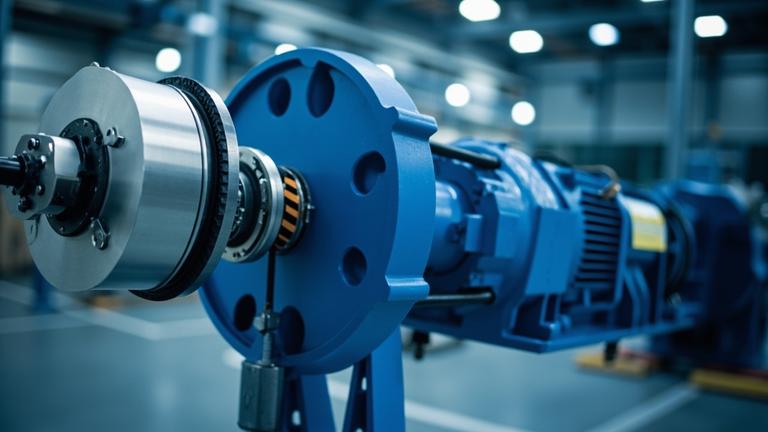
Commercialization: Hyliion commercialized the KARNO 200 kilowatt power module, with plans for larger, scalable solutions.
- Strategic Pivot: Hyliion shifted from electric vehicles to power generation, acquiring GE Aerospace’s KARNO technology for $37 million.
- Additive Manufacturing: The company embraced AM for its ability to handle complex designs, using Colibrium Additive M2, M Line, and X Line machines.
- Team Integration: The acquisition included the KARNO team, led by now-CTO Josh Mook, who assembled a top-tier engineering group.
- Market Potential: The technology offers on-site power generation for data centers, malls, and military applications, providing a competitive edge in the power generation market.
Problem
Hyliion, a company founded over a decade ago with a focus on transitioning 18-wheel semi-trucks from diesel to electric, faced significant challenges in the EV market by 2021. The company’s leadership, including CEO Thomas Healy, a Carnegie Mellon mechanical engineering graduate, observed a troubling trend: increasing bankruptcies among peers, difficulties in raising capital, slowing adoption rates of electric vehicles by fleets, and softening mandates. These factors contributed to a growing uncertainty about the company’s future as an EV entity.
Solution
In 2022, Hyliion seized an opportunity to pivot its business model by acquiring GE Aerospace’s KARNO power generation technology for $37 million. This acquisition marked a strategic shift from electric vehicles to power generation, with Hyliion fully committing to the new technology. The KARNO system is a linear heat generator that converts heat into electricity, offering on-site power generation as an alternative to grid dependency.
“For data centres where the grid doesn’t have the capacity that data centres need, now they can move to on-site power generation, and move faster than they could before,” Healy explained. “If you look at a shopping mall, it enables them to make their own electricity cheaper than buying grid electricity. And then if you look at applications like the military, we’re the power plant on board the new unmanned military ship.”
Hyliion has also set its sights on developing power generation solutions capable of delivering megawatts of power, emphasizing the inherent scalability of the technology. The company’s approach to manufacturing leverages additive manufacturing (AM), a method favored by GE Aerospace and retained by Hyliion post-acquisition. The complexity of the heat exchangers makes AM the most viable production method.
Results
Hyliion has successfully commercialized the KARNO power generation technology within a few years, despite having limited prior experience in additive manufacturing. The acquisition of KARNO included not just the intellectual property but also the team behind it, notably Josh Mook, who became Hyliion’s CTO. Mook, a founding member of the KARNO technology at GE, assembled a team of world-class additive designers and engineers, which has been instrumental in bringing KARNO to market.
The KARNO 200 kilowatt power module is now available, with Hyliion utilizing its Colibrium Additive M2 system and larger M Line and X Line machines for production. The design of the KARNO module fits within the 250 x 250 mm build plate size of the M2 system, with larger modules in development. The company is currently servicing high-power needs by linking multiple 200kW units, akin to an EV car battery pack.
“These machines are pretty universal in what they can print,” Healy said. “One of the great things about additive is it doesn’t really care if it’s printing a block of metal or an extremely complex part. It’s just lasers going around that are melting layer by layer and building up whatever structure you want.”
The KARNO power generation products operate similarly to Stirling engines, with a heating and cooling process occurring 20 times per second to drive a piston and generate electricity. This method, while challenging to manufacture traditionally, has been made feasible through additive manufacturing.
##
Is this your company?
This article features your business. Claim it to add your logo, contact details, and a link to your website — or upgrade to reach more buyers.
Did you know 80% of Press Releases trigger AI content warnings? Reach out and the M4S team can assist.