
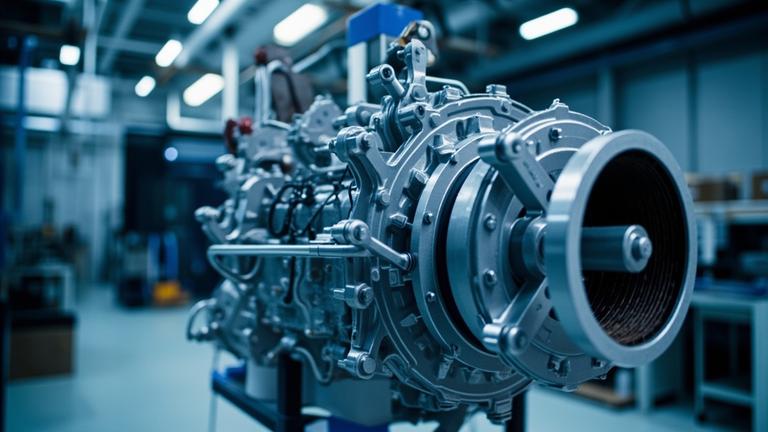
Broader application: Lessons from the TJ150 program are being applied to other efforts, including the Pratt & Whitney Valox engine family.
- Demonstration milestone: Pratt & Whitney announced successful completion of testing for its additively manufactured TJ150 engine at the Farnborough International Airshow.
- Additive content: Nearly 60% of the TJ150 engine by volume was produced through additive manufacturing, including static and rotating hardware.
- Part consolidation: More than 50 individual hot section components were consolidated into a handful of additively manufactured parts, and a 3D-printed rotating turbine wheel was successfully tested.
- Mission fit: The TJ-150 provides propulsion for tactical missiles, decoys, and effectors, where missions last minutes or hours and rapid production scaling is essential.
Pratt & Whitney, an RTX business, has completed demonstration testing of its additively manufactured TJ150 engine, the company announced at the Farnborough International Airshow.
What the testing showed
Nearly 60% of the TJ150 engine by volume was produced through additive manufacturing, including major static and rotating hardware. The testing validated material behavior in an operational environment and demonstrated durability aligned with mission demands — the two things that matter most when you're printing parts that have to survive inside a running turbine.
The TJ-150 is high-performance propulsion for tactical missiles, decoys, and effectors, with parts optimized for 3D printing. That application profile is exactly why additive makes sense here: these are expendable engines with short service lives, where production speed and design simplification outweigh the economics of conventional manufacturing.
From 50 parts to a handful
The part-count story is the real engineering headline. Pratt & Whitney has consolidated more than 50 individual hot section components into a handful of additively manufactured parts. Fewer joints, fewer fasteners, fewer assembly steps — and fewer failure points. The company has also successfully tested a 3D-printed rotating turbine wheel, addressing one of the hardest challenges in printed turbomachinery: rotating hardware under operational loads.
"For expendable engines like the TJ150, where missions can last minutes or hours, simplifying the design and scaling production quickly is essential to meeting rising demand."
That statement comes from Jill Albertelli, President of Military Engines at Pratt & Whitney, who framed the program as a response to growing demand for expendable engines.
Beyond the TJ150
The implications extend past a single engine. Albertelli indicated the company is carrying its TJ150 lessons forward to other programs, including the Pratt & Whitney Valox engine family. Additive manufacturing helps move designs from concept to capability faster — and for expendable propulsion, that speed is the entire point.
The demonstration doesn't answer every question about printed rotating hardware at scale, but a validated engine with nearly 60% additively manufactured content is a concrete data point, not a promise.
Is this your company?
This article features your business. Claim it to add your logo, contact details, and a link to your website — or upgrade to reach more buyers.
Did you know 80% of Press Releases trigger AI content warnings? Reach out and the M4S team can assist.