
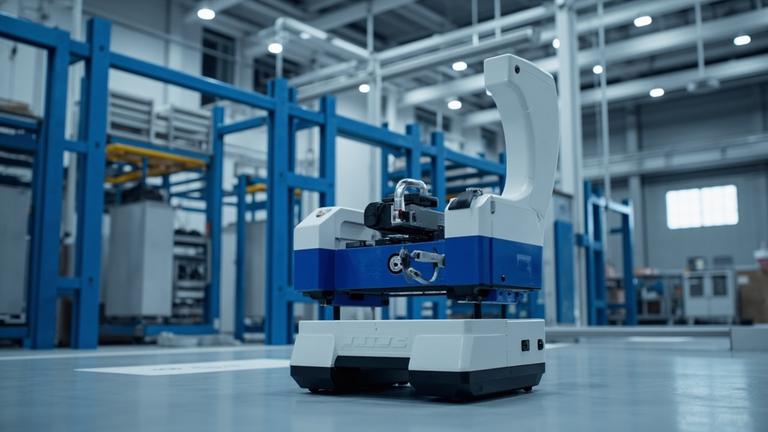
Pallet flexibility: PUDU MP2000 supports common pallet formats and adapts to customized or non-standard load carriers.
- New product launch: Pudu Robotics announced the PUDU MP2000, an AI-native pallet handling robot with a 2,000 kg payload capacity for autonomous floor-to-floor material transport.
- Simplified deployment: The robot supports plug-and-play deployment using multi-sensor navigation, edge intelligence, and AI-native perception, mapping environments without extensive site modifications.
- Sensing and coordination: The system uses 3D LiDAR, depth cameras, and multi-sensor perception, combining local intelligence with fleet-level coordination and offline operation capability.
- Portfolio expansion: The MP2000 joins Pudu Robotics' T Series AMRs, including the PUDU T300, extending the lineup into pallet handling and heavier-load transport.
Pudu Robotics has announced the launch of the PUDU MP2000, an AI-native pallet handling robot aimed squarely at one of the more stubborn automation problems in industrial operations: moving palletized loads autonomously without rebuilding the facility around the robot.
The headline specification is a 2,000 kg payload capacity, putting the MP2000 into heavier-load territory. The robot is designed for autonomous floor-to-floor material transport across warehouses, logistics facilities, and manufacturing environments — the kind of repetitive transport work that consumes labor hours and ties up forklifts on predictable routes.
Deployment Without the Infrastructure Overhaul
The more interesting engineering story here is deployment. The PUDU MP2000 supports plug-and-play deployment built on multi-sensor navigation, edge intelligence, and AI-native perception. The robot can map its operating environment for autonomous navigation without extensive site modifications — a meaningful claim for plant managers who have watched automation projects stall in commissioning.
Pallet variety is the other classic deployment killer. The MP2000 supports common pallet formats and can adapt to customized or non-standard load carriers, which addresses the reality that most facilities run a mix of pallet types rather than a single clean standard.
Perception and Fleet Behavior
On the sensing side, the robot uses 3D LiDAR, depth cameras, and multi-sensor perception to detect and interpret obstacles. Control architecture combines local intelligence with fleet-level coordination for autonomous operation, and the system can operate in offline environments — relevant for facilities where network coverage is inconsistent or deliberately restricted. Integration with compatible peripheral equipment rounds out the workflow picture.
A Broader Industrial Portfolio
The launch extends Pudu Robotics' industrial lineup. The company's portfolio now spans the T Series AMRs, including the PUDU T300, alongside the PUDU MP2000 for pallet handling and heavier-load transport. The design intent, per the company, is to reduce deployment complexity and support adaptation across different operating environments.
For manufacturing professionals evaluating autonomous pallet handling, the MP2000's pitch is straightforward: heavy payload, minimal facility modification, and tolerance for real-world pallet variety. Whether the plug-and-play claim holds up across messy, mixed-format facilities is exactly what pilot deployments will need to prove.
Is this your company?
This article features your business. Claim it to add your logo, contact details, and a link to your website — or upgrade to reach more buyers.
Did you know 80% of Press Releases trigger AI content warnings? Reach out and the M4S team can assist.