
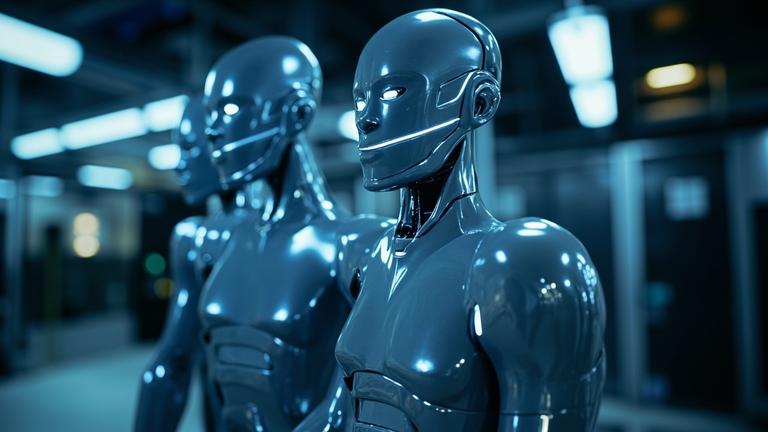
Safety imperative: Efficient semiconductor operation enables the split-second decision-making needed to protect human workers in dynamic settings.
- Factory-floor shift: Advances in semiconductors and AI are moving humanoid robots from science fiction toward practical, scalable deployment on factory floors.
- Compute foundation: Humanoids require semiconductor-based platforms that process multiple sensory data streams and coordinate motor feedback in real time.
- Thermal strategy: Heterogeneous integrated circuits (ICs) stack multiple chips in one package and distribute workloads by compute intensity to reduce heat.
- Validation loop: The comprehensive Digital Twin lets engineers model, validate, and continuously improve humanoid systems — before build and after deployment.
A new generation of humanoid robots is moving from science fiction toward the factory floor, driven by advances in semiconductors and artificial intelligence. But for manufacturers, the real engineering challenge isn't the human-like form factor — it's the compute architecture, thermal management, and validation infrastructure that make these machines safe and scalable.
Software-Defined Machines, Not Just Robots
Humanoids represent a fundamental shift in how manufacturers should think about automation. They are not simply another class of robot.
"Humanoids are fundamentally software‑defined products, made possible through the convergence of hardware and software advancements."
Recent improvements in battery efficiency, semiconductor performance, and AI capabilities have brought humanoid systems to a level where they are now practical and scalable. Physical AI connects perception, sensor feedback, and motion planning, allowing robots to interact with real-world environments rather than executing fixed, pre-programmed tasks.
That adaptability places enormous demands on silicon.
"Humanoids need powerful semiconductor-based compute platforms capable of processing complex, real-time workloads, coordinating software and hardware decisions and supporting safe behavior in dynamic settings."
The Compute and Safety Equation
Semiconductors provide the computing foundation that can process multiple streams of sensory data while coordinating motor feedback in real time. The compute architecture must process not only reasoning and decision-making but also constant streams of sensory data and motor-control feedback — requiring highly integrated hardware and software architectures that coordinate multiple systems simultaneously.
This isn't just a performance question. Efficient semiconductor operation is crucial for ensuring the safety of human workers by enabling rapid decision-making — such as switching instantly from performing a task to avoiding a collision. Cooling remains the primary limitation of semiconductor performance, and heterogeneous integrated circuits (ICs) — which combine and stack multiple chips in a single package, distributing tasks by compute intensity — offer one path to lower overall package temperatures.
Validation Through the Digital Thread
Managing this complexity requires a digital thread connecting decisions across disciplines, from chip architecture to the deployed fleet. A comprehensive Digital Twin allows engineers to model and validate the entire humanoid system before physical hardware is built. Teams can perform trade studies, allocate requirements, and evaluate software/hardware decisions early in development.
The Digital Twin also supports the robot learning process after deployment, validating software updates and AI-driven improvements virtually before they reach physical operations.
"The Digital Twin facilitates semiconductor design (Image credit: Siemens)."
Siemens envisions humanoids that become progressively smarter, safer, and more capable over time through advancements in semiconductors and physical AI.
"The companies that succeed will be those that treat humanoids not as standalone machines, but as complex industrial systems."
Is this your company?
This article features your business. Claim it to add your logo, contact details, and a link to your website — or upgrade to reach more buyers.
Did you know 80% of Press Releases trigger AI content warnings? Reach out and the M4S team can assist.