
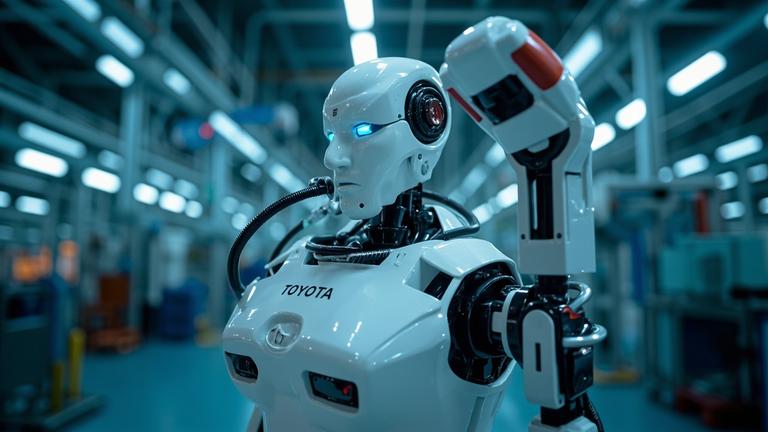
Flagship design: Eley is a 50 kg wheeled humanoid with two-fingered hands, prioritizing reliability over bipedal mobility.
- Deployment scale: Toyota plans 400,000 robots globally from 2028, with investment potentially reaching JP¥1tn (US$6.4bn) annually.
- Split allocation: 150,000 robots at Toyota's own plants and 250,000 across group company facilities, spanning 60 factories worldwide.
- Training method: Eley learns from workers wearing finger-shaped jigs, hitting near-perfect T-shirt folding after 1,500 sessions over two weeks.
- Competitive field: Tesla's Optimus, Figure, and Hyundai's Atlas — headed to Georgia from 2028 — take the bipedal route, while Toyota also fields Agility Robotics' Digit.
Toyota has laid out one of the largest factory automation programs on record: roughly 400,000 robots deployed globally from 2028, backed by annual automation investment that could reach JP¥1tn (US$6.4bn).
The deployment plan
Of the 400,000 units, 150,000 robots will go into Toyota's own plants, with 250,000 deployed across group company facilities. That scale matters. Toyota operates 60 factories globally, so this is not a pilot program — it is a fleet-level retrofit of the production system.
Eley: reliability over bipedalism
The flagship machine is Eley, a humanoid that weighs 50 kg and uses two-fingered hands rather than a full humanoid grip. Eley moves on wheels powered by battery or cord — a deliberate trade-off toward proven reliability, contrasting with the bipedal approach pursued by rivals such as Tesla's Optimus and Figure.
Training is equally pragmatic. Eley learns by observing Toyota workers wearing finger-shaped jigs modelled on the robot's hands, generating training data directly from demonstration rather than depending on simulation. At a briefing at Toyota's European headquarters, Eley achieved near-perfect T-shirt folding accuracy after 1,500 practice sessions over two weeks.
Capturing takumi expertise
Toyota employs 18,000 veteran "takumi" workers whose expertise it intends to capture as training data. The plan also calls for robots to help train new human employees, not just learn from existing ones.
"We aim for a world where robots coexist with humans, rather than replacing them," said Executive Vice President Hiroki Nakajima.
Two decades of groundwork
This is not a new direction. Toyota has been developing robots for more than two decades, from the Human Support Robot to the Welwalk rehabilitation exoskeleton and the teleoperated T-HR3 humanoid. More recently, Toyota Research Institute has developed Large Behavior Models using diffusion-based generative AI to teach physical skills from human demonstration. Separately, Toyota has partnered with Agility Robotics to deploy bipedal Digit robots at sites including Toyota Motor Manufacturing Canada.
Meanwhile, Hyundai's Boston Dynamics-built Atlas robots will be deployed at its Georgia plant from 2028 — setting up a direct contest between wheeled, multi-form-factor designs and bipedal platforms on real factory floors.
Is this your company?
This article features your business. Claim it to add your logo, contact details, and a link to your website — or upgrade to reach more buyers.
Did you know 80% of Press Releases trigger AI content warnings? Reach out and the M4S team can assist.