
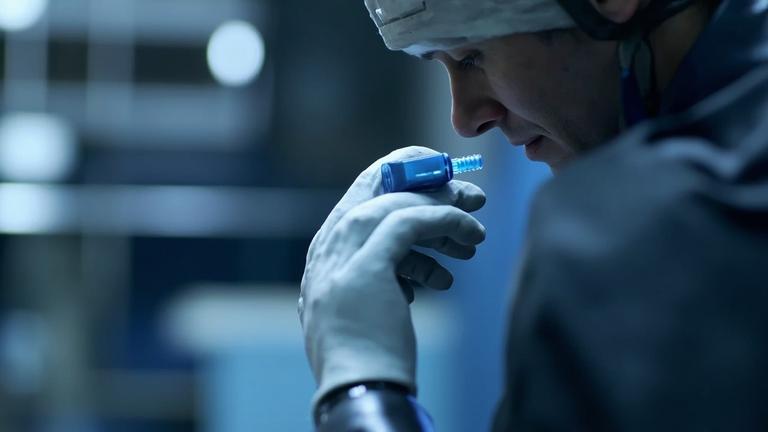
Physical AI is evolving from digital reasoning to real-world interaction, and that shift is exposing a weak link in robotic manipulation: reliable touch sensing. Robots can see, plan, navigate, and move with sophistication.
The scaling problem with surface sensors
Many tactile approaches rely on flexible electrical sensing layers placed on or near the contact surface. These technologies have advanced the field.
However, for high-duty-cycle robotic fingers and grippers, electronic skin faces a scaling challenge: the sensing layer is often located close to the harshest mechanical environment on the robot.
That environment includes repeated compression, abrasion, contamination, humidity, temperature variation, cleaning exposure, and material aging. Even when encapsulated, a surface-coupled stack remains tied to the outer skin. Over time, that can introduce wear, hysteresis, creep, delamination, baseline drift, and recalibration burden.
For a laboratory prototype, these issues may be manageable. For a commercial robotic hand operating over millions of contact cycles, they become central to product viability.
Moving sensing below the damage zone
UltraSense believes the better path is protected sub-surface ultrasound. The platform uses acoustic waves to analyze changes in the material stack and infer contact behavior from beneath it.
The approach extends beyond simple contact detection. Ultrasound can detect touch, map force, understand shear and slip, and classify materials through acoustic impedance. The company has demonstrated tactile sensing at 500 µm spatial resolution through an elastomer layer, localized compressive force profiling at approximately 1.25 mN precision, and shear-force inference with a roughly 5 mN noise floor.
Let the outer surface handle mechanics, while ultrasound delivers tactile intelligence below the surface.
Platform reuse, not lab assembly
Scaling tactile sensing requires manufacturable hardware, and UltraSense leans on production experience here. The company has shipped more than 4 million units into automotive applications, building expertise in ultrasound sensing and integration.
Its ASIC roadmap is designed as an intelligent SoC-based architecture with embedded processing for tactile zones. The intent is a local tactile intelligence layer that detects touch, estimates force, infers shear and slip, and classifies contact state — actionable data for the robot controller rather than raw signals.
The platform is designed to work with various materials, including metal, elastomer, polymer, and fabric, letting designers adapt the outer surface to the application rather than forcing one fragile sensing material. UltraSense has also built a patent portfolio covering ultrasound-based touch, force sensing, and related system architectures.
Contact intelligence as the next layer
The next generation of physical AI will require reliable contact intelligence to detect forces, classify contact, and adapt in real time — under real environmental conditions, at manufacturable cost. UltraSense, led by CEO Mo Maghsoudnia and chief technology officer Hao-Yen Tang, is positioning its UltraTouch platform for that role.
UltraTouch can enable physical AI, asserts UltraSense.
Ultrasound offers cost-effective scaling through platform reuse
To scale, tactile sensing cannot remain a custom research assembly. It must become a manufacturable platform with repeatable electronics, calibration, firmware, packaging, and integration.
UltraSense brings a foundation built through automotive human-machine interaction (HMI) and AI device experience. Automotive applications require reliability, temperature performance, vibration tolerance, moisture resistance, manufacturability, and repeatability. AI devices require small form factors, low power, premium materials, sealed construction, and intuitive interaction.
The company has shipped more than 4 million units into automotive applications, providing production experience in ultrasound sensing, mixed-signal ICs, firmware, calibration, test, and integration. The same platform principles now extend into tactile intelligence for physical AI.
This platform reuse matters. A scalable tactile solution cannot depend on complex lab-grade assemblies or fragile sensor films requiring frequent replacement. It needs compact modules, integrated electronics, repeatable manufacturing, and edge processing.
UltraSense’s ASIC roadmap reflects this experience. Without disclosing implementation details, the platform is designed as an intelligent SoC-based architecture with embedded processing for tactile zones.
The goal is to create a local tactile intelligence layer that can detect touch, estimate force maps, infer shear and slip, classify contact state, detect material response, and provide actionable information to the robot controller.
Material flexibility and IP protection
In HMI, UltraSense has enabled touch on real product surfaces, including metal. Conventional capacitive touch struggles with solid metal interfaces, where electric fields are shielded or distorted. Ultrasound changes the interaction model by sensing through acoustic propagation rather than surface electric-field modulation.
The same applies to robotics. A robotic fingertip may need an elastomer surface for compliance and friction. An industrial gripper may require a rugged polymer. A medical or service robot may need a cleanable surface. AI devices may use metal, glass, leather, or fabric for premium industrial design. A tactile platform should adapt to these surfaces rather than force designers into one fragile sensing material.
As tactile sensing moves to commercial deployment, IP becomes critical. UltraSense has built a strong issued and pending patent portfolio around ultrasound-based touch, force sensing, ToF tactile sensing, calibration, and related system architectures, including tactile sensing under a cover layer, ultrasonic touch systems, force-measuring integrated circuits, and calibration and test methods.
Ultrasound could enable the next layer of physical AI
The next generation of physical AI will need more than better vision and motion. It will need reliable contact intelligence.
Robots must detect forces, classify contact, and adapt in real time. They must do this through real materials, under real environmental conditions, over long operating lifetimes, and at manufacturable cost.
UltraSense’s platform is designed to meet this challenge. By combining protected sub-surface sensing, high-resolution force mapping, shear and slip inference, acoustic impedance-based material response detection, custom ASICs, edge processing, and a strong IP portfolio, UltraSense is positioning ultrasound as a foundational tactile intelligence platform for physical AI.
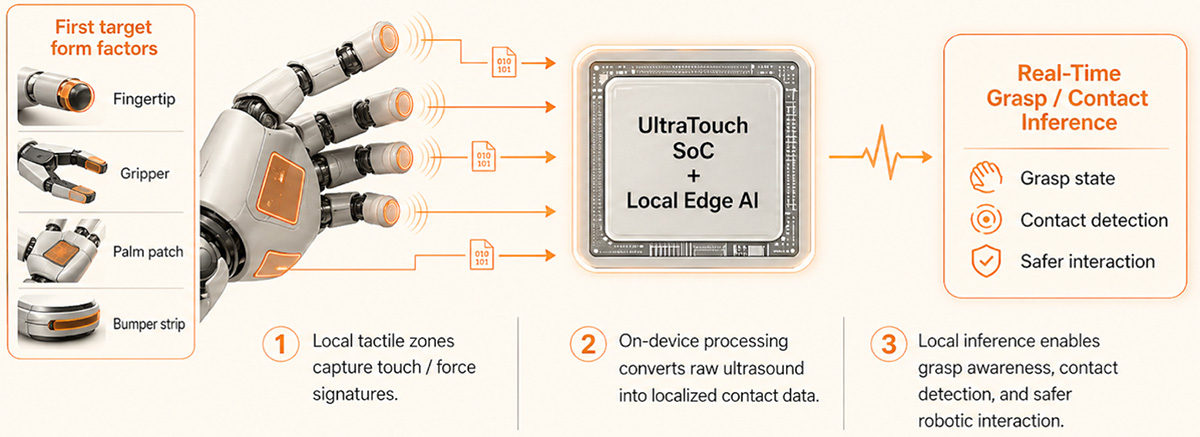
UltraTouch can enable physical AI, asserts UltraSense. Source: UltraSense
Is this your company?
This article features your business. Claim it to add your logo, contact details, and a link to your website — or upgrade to reach more buyers.
Did you know 80% of Press Releases trigger AI content warnings? Reach out and the M4S team can assist.