
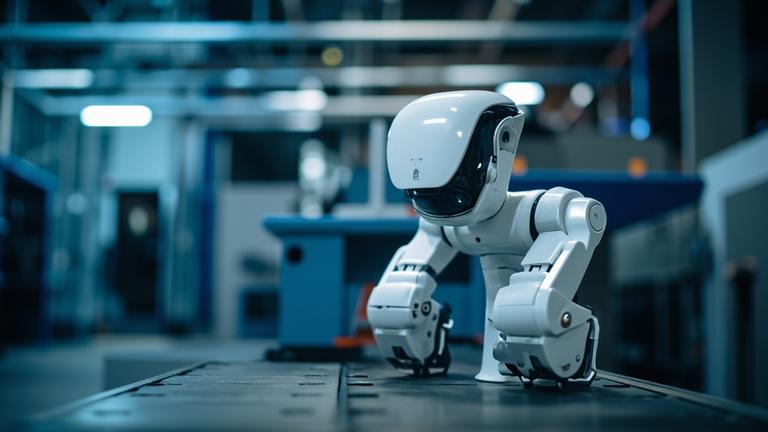
The AI focus: Gen 7 targets physical AI applications, letting robots perceive and adapt in high-mix environments where conventional automation struggles.
- The scope: A full platform redesign — robot hardware, rebuilt core controller, TP7 Core teach pendant, SP7 Smart Panel, and PolyScope X software — not a single new arm.
- The integration story: Fewer components and less cabling for end-of-arm tooling, cameras, and networking, plus managed-switch architecture and security for plant-scale deployment.
- The foundation: The platform builds on more than 6 generations of cobots and over 100,000 deployments, keeping the familiar programming and deployment approach intact.
This is not a single new robot arm. The launch represents a broader platform update — a unified redesign from the robot's controller through its tool flange. Gen 7 combines new robot hardware with a rebuilt core controller, the TP7 Core teach pendant, the SP7 Smart Panel, and PolyScope X software.
Physical AI as the design center
Universal Robots is positioning Gen 7 squarely as a platform for physical AI — systems that allow robots to perceive and adapt to conditions in the physical environment. That matters most in high-mix manufacturing, where variability can make conventional automation difficult to deploy.
"Gen 7 is designed to support advanced AI-powered applications alongside conventional industrial automation."
The platform provides the hardware and software infrastructure for connecting AI applications to the robot. The tool flange architecture is intended to integrate end-of-arm tooling, cameras, physical AI applications, and industrial networking with fewer components and less cabling.
"The platform's architecture supports expanded camera and end-of-arm-tool integration as well as modern industrial networking."
For plant-scale deployment, Gen 7 incorporates a managed-switch architecture and security features — an acknowledgment that connected, AI-driven cells need networking discipline, not just robot smarts.
Continuity, not disruption
The platform builds on more than 6 generations of collaborative robots and more than 100,000 deployments. Universal Robots continues to emphasize ease of programming and deployment as part of the design — a deliberate choice, since the platform is being introduced as manufacturers look to add AI capabilities to physical production processes.
"The platform is intended to give customers and partners a way to deploy AI-powered applications using the same robot environment already familiar to operators, engineers and integrators."
That's the pragmatic angle here: rather than bolting AI on as a separate layer, Gen 7 folds it into an environment the installed base already knows. Whether the reduced-component architecture delivers on its integration promises will be proven on real factory floors — but the engineering intent is clear.
Source reporting: Michael Ouellette, senior editor at engineering.com.
Is this your company?
This article features your business. Claim it to add your logo, contact details, and a link to your website — or upgrade to reach more buyers.
Did you know 80% of Press Releases trigger AI content warnings? Reach out and the M4S team can assist.