
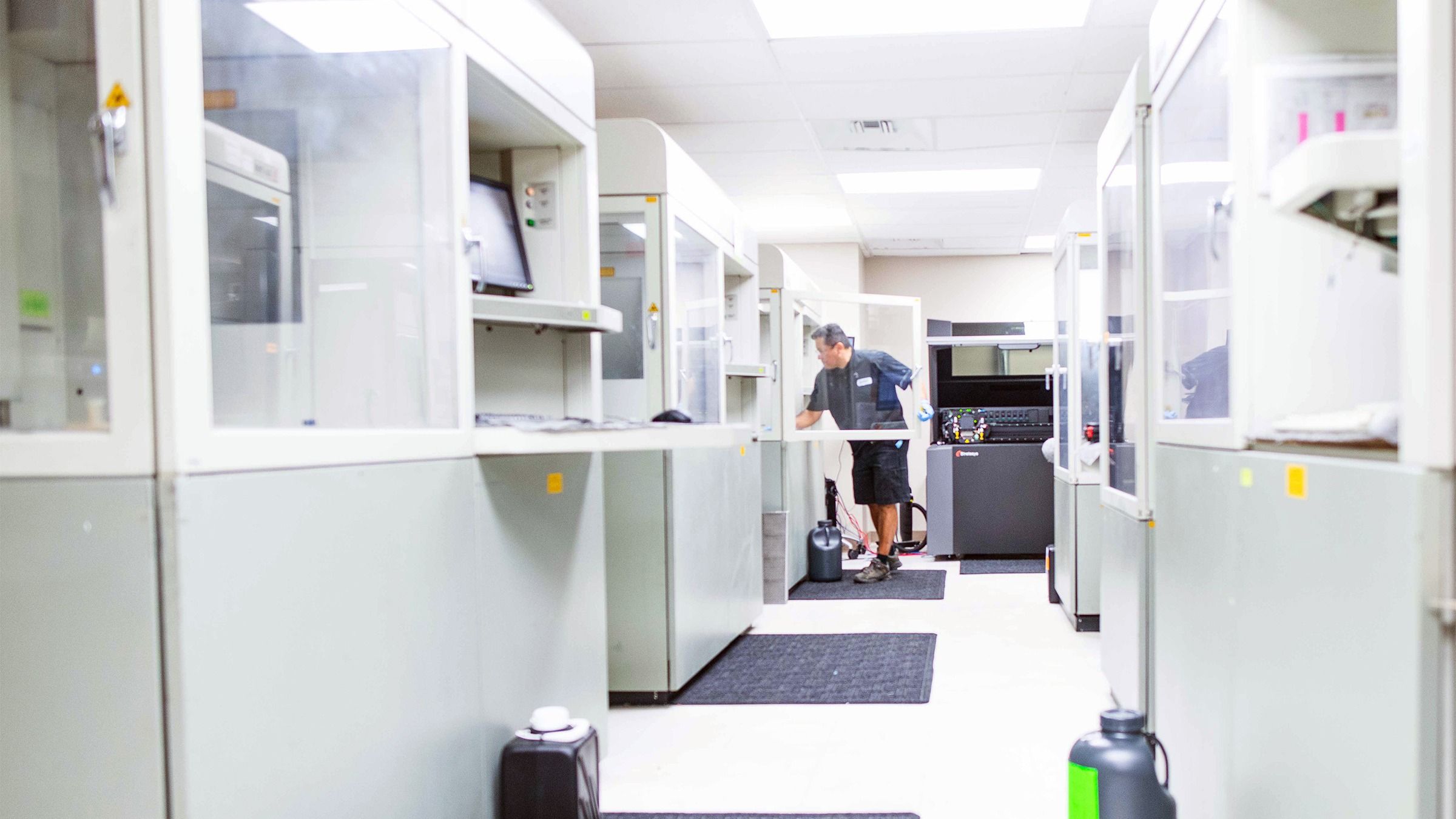
Founded in 2020, ADDMAN now operates nine locations across the United States and recently committed to investing in 81 additional 3D printers from HP. It is a young, rapidly expanding manufacturing service bureau — and, according to HP, a representative one.
"Service providers are outrunning the market," says François Minec, global VP of sales and business development for HP Additive Manufacturing Solutions. "When we look at the demand on our printers, the service providers are growing at double the rate of the rest of the market."
The data backs him up. HP Additive's own figures show service providers growing by 15% in 2025, even as machine sales remained flat that year — suggesting bureaus absorbed existing demand.
Where Does the MJF 1200 Fit?
It is an industrial system without industrial requirements — but it does not appear aimed at service bureaus.
"It's a great idea, but we're probably not the intended target market for it," says Keith Schneider, general manager of ADDMAN.
So who is it for? According to Marc Garcia Grau, product manager for 3D printing at HP, "The ideal MJF 1200 user is someone who will use it for ten percent of their time."
"Imagine a university or a small design firm," he explains, "places where you spend ten percent of your time working with a printer and then you move on to other things."
Alex Moñino, SVP and general manager of HP Additive Manufacturing Solutions, frames the distinction in terms of personnel:
"In an industrial environment, like at ADDMAN or Streamline 3D, there are professional operators whose job is to run the printers."
Clara Remacha Corbalán, head of product management for HP 3D printing polymers, argues the deciding factor is functionality:
"There's always a reason why you get into powder, and that reason is always that the parts you're getting out of a Bambu are not good enough for what you need."
Elastic Capacity and the Road Ahead
The contract manufacturing model offers a structural advantage: elastic production capacity without molds or tooling. Brian Ingold, head of applications and business development at HP Additive Manufacturing Solutions, explains:
"If you're a manufacturer with your own MJF machines, you can overflow to the contract manufacturers by sending them the same build and you'll get the same parts from them that you're getting from your machines."
That model depends on consistency across machines — historically not 3D printing's strength. HP Additive Solutions aims to ensure consistency through process development using AI to calibrate its printers.
Looking further out, manufacturing service bureaus may play a key role in printing parts for humanoid robots, according to Minec — another signal that suppliers, not OEMs, are where AM growth will happen.
Get the full article here for free:
Read the full article on Engineering.com→
Follow news on Engineering.com
Is this your company?
This article features your business. Claim it to add your logo, contact details, and a link to your website — or upgrade to reach more buyers.
Did you know 80% of Press Releases trigger AI content warnings? Reach out and the M4S team can assist.