
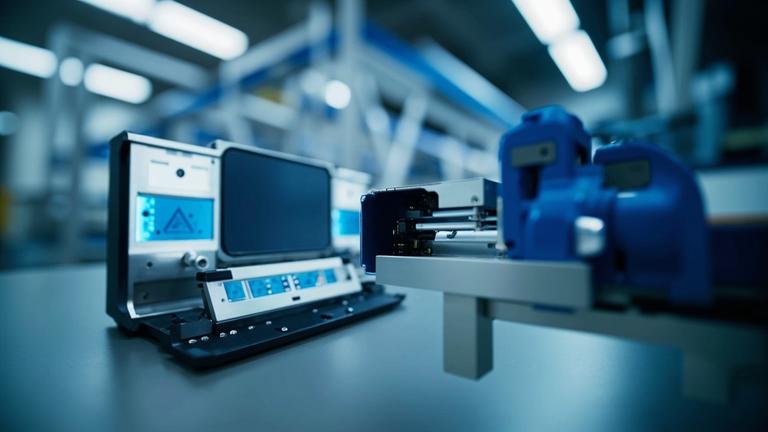
Service launch: Dover Precision Components is offering advanced product and material testing capabilities to OEMs and end users.
- Core services: Offerings include prototype validation, design optimization, failure mode analysis, accelerated lifecycle testing, regulatory and compliance testing, and custom test rigs replicating proprietary assemblies.
- Materials expertise: The lab performs thermal, mechanical, chemical, optical, and tribological characterization and comparative tests.
- Emerging markets: Testing services extend to hydrogen economy applications, addressing wear challenges in high-pressure hydrogen environments.
Dover Precision Components is extending its advanced product and material testing capabilities to OEMs and end users, giving product development engineers outside the company access to validation, analysis, and performance verification services built around rotating and reciprocating machinery.
A purpose-built test hub
The backbone of the offering is the company's flagship Innovation Lab, a 12,000-square-foot facility in Houston, Texas. That consolidation matters: engineers working across turbines, compressors, and rotating equipment systems can now run comprehensive analysis across a product's full development lifecycle, from early concept validation through final performance verification under real-world operating conditions.
What's on the service menu
The lab's service portfolio reads like a checklist of what development teams typically scramble to outsource piecemeal:
- Prototype validation and design optimization: — refining components before committing to full-scale production
- Failure mode and root cause analysis: — data-driven diagnosis of complex performance problems
- Accelerated lifecycle testing: — validating durability and long-term reliability under demanding conditions
- Regulatory and compliance testing: — confirming products meet industry standards
- Custom test rigs: — built to replicate proprietary assemblies and real-world operating environments
- Materials characterization: — thermal, mechanical, chemical, optical, and tribological characterization and comparative tests for advanced material systems
That last capability set is increasingly relevant as the industry pushes into new territory. The company is also providing testing services for emerging applications such as the hydrogen economy, where advanced tribology testing helps engineers address wear challenges in high-pressure hydrogen environments.
Positioning testing as an extension of the customer
Burak Bekisli, director of innovation, frames the move as more than an equipment rental arrangement:
"When your reputation is built on precision, reliability, and performance, testing is not just an option, it's a competitive advantage."
"Our lab services are designed to act as a true extension of our customers' engineering teams, providing the advanced testing, analysis, and collaboration required to bring high-performance and mission-critical solutions to market with confidence."
The takeaway for development teams
For engineers facing compressed development schedules, the pitch is straightforward: access to centralized, purpose-built test infrastructure — including custom rigs that replicate proprietary assemblies — without standing up equivalent capability in-house. Whether the bottleneck is root cause work on a failing component or lifecycle validation ahead of a production ramp, the Houston lab consolidates the tooling and the teams in one place.
Is this your company?
This article features your business. Claim it to add your logo, contact details, and a link to your website — or upgrade to reach more buyers.
Did you know 80% of Press Releases trigger AI content warnings? Reach out and the M4S team can assist.