
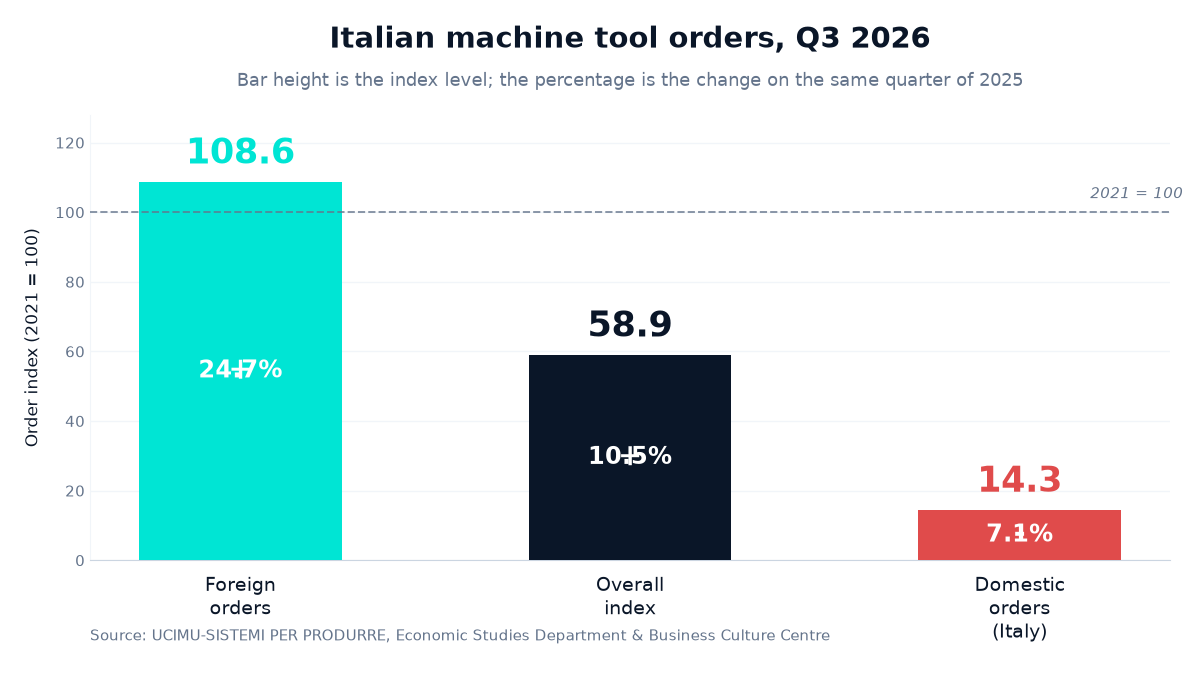
Foreign orders up 24.7%. Domestic orders down 7.1%.
Italian machine tool orders rose 10.5% in the third quarter of 2026, but the gain comes entirely from overseas. UCIMU reports foreign orders up 24.7% while domestic orders fell 7.1%, with aerospace, defence and energy driving demand. The United States and Germany led exports, and the hyper-depreciation measure lets operators spread investment out until September 2028.
Italian machine tool orders rose 10.5% in the third quarter of 2026, but the gain is all overseas.
The order index compiled by the Economic Studies Department & Business Culture Centre of UCIMU-SISTEMI PER PRODURRE stood at 58.9 for the July-September quarter, against the same period of 2025, on a base year of 2021 = 100. Orders collected overseas grew 24.7%, reaching an index value of 108.6. Order intake in Italy fell 7.1%, to an index value of 14.3.
Riccardo Rosa, President of UCIMU-SISTEMI PER PRODURRE, said domestic demand remains weak despite numerous ongoing negotiations. The uncertainty of the international context and the rise in energy costs are affecting manufacturing operators in Italy, who are postponing investments while waiting for greater clarity. He is confident the industry can regain momentum, supported by the hyper-depreciation measure, which in its 5.0 version lets investments be spread out until September 2028.
The business of Italian manufacturers in foreign markets was extremely dynamic. Demand in the United States remains particularly strong, and Germany is beginning to show signs of recovery. In the first half of 2026, the main export markets for Italian machine tools were the United States at 329 million euro, up 12.6%, and Germany at 137 million euro, up 7.6%, followed by France, Poland and Spain.
Rosa said orders are driven by the aerospace, defence and energy fields, across all target countries. The figures were presented at the inauguration of 35.BI-MU, the international machine tool show, at fieramilano Rho on 13 October.
Frequently asked questions
Italian machine tool orders rose 10.5%, but foreign orders rose 24.7% and domestic fell 7.1%. What does that split mean for buyers?
It tells you where the demand actually is. The 10.5% headline is a blended number, and underneath it the two halves are moving in opposite directions. The overall index reached 58.9 on a base year of 2021 = 100, with the foreign index at 108.6 — above its 2021 base — and the domestic index at 14.3. For a buyer in the United States or Germany, the order flow is strong: UCIMU reports exports of 329 million euro to the United States in the first half of 2026, up 12.6%, and 137 million euro to Germany, up 7.6%. For a buyer in Italy, the message is that suppliers here are competing for your order more aggressively than they were a year ago.
Aerospace, defence and energy are driving orders in every target country. Why are those sectors pulling ahead?
UCIMU does not explain the mechanism in the release — it states the fact. Rosa said orders are driven by the aerospace, defence and energy fields across all target countries. What the numbers suggest is the scale of it: a 24.7% rise in foreign orders in a single quarter, led by the United States and Germany, with those three sectors named as the driver everywhere. The source does not break the growth down by sector or by country, so any reading of why aerospace is outpacing the rest is an inference rather than something the index confirms.
What is the hyper-depreciation measure, and how does it help?
It is the Italian government incentive that allows companies to depreciate capital investment faster than normal. In its 5.0 version it enables better investment planning, because the benefit can be spread out until September 2028. Rosa raised it as the thing that can support a recovery in the Italian machine tool industry, at a time when operators are postponing investment while they wait for greater clarity. The release does not give the percentage rate or the eligible investment thresholds.
How does this compare with the previous quarter?
The release gives the year-on-year comparison only, so it does not state the quarter-on-quarter movement directly. The context from UCIMU's own earlier releases is that the order index was still falling in the second quarter of 2026, at -25.8%. A 10.5% year-on-year rise in the third quarter is therefore a marked change in direction against the previous quarter's decline, though the two figures are measured against different comparison periods.