
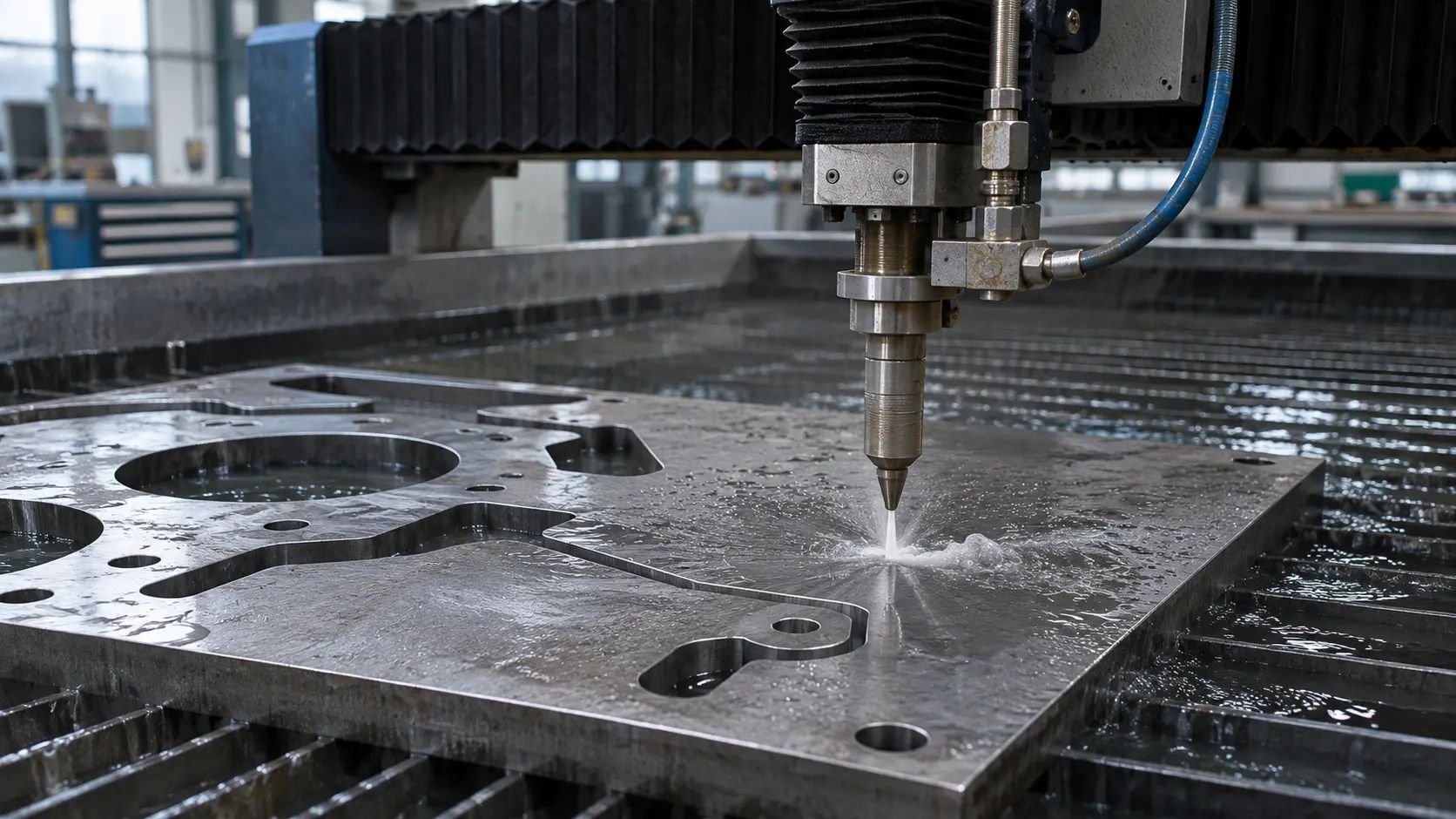
PRV combines waterjet cutting with in-house machining, fabrication, assembly and finishing.
PRV’s waterjet service operates alongside machining, fabrication, assembly and finishing. Waterjet avoids a thermal heat-affected zone and suits heat-sensitive materials, thick or hardened metals and intricate profiles. But not every feature can be cut by waterjet alone; CNC machining may follow for bores, pockets, threads and machined faces.
The arrangement lets engineering and procurement teams assess a component's full manufacturing route with one supplier instead of coordinating separate cutting and machining contracts.
Waterjet cutting creates no thermal heat-affected zone, making it suitable for heat-sensitive materials, thick or hardened metals and intricate profiles. PRV’s published capabilities cover steels, aluminium, titanium, specialist alloys, copper, composites, plastics and rubber. But a material being suitable does not mean every drawing feature can be cut by waterjet alone.
A cut profile can resemble the finished component while still having several operations ahead. CNC machining can produce bores, pockets, threads and machined faces after profiling. A useful enquiry gives the supplier enough information to assess the cutting requirement and any subsequent operations.
Frequently asked questions
What information should engineers provide when inquiring about waterjet cutting services to ensure accurate quoting and process selection?
Engineers should supply drawings and CAD files, identifying the applicable revision. They must state the material grade or specification, stock thickness, and any relevant dimensional requirements or tolerances. Quantities, required edge condition and finishing, and details of any subsequent operations like machining, drilling, forming, welding, or assembly within the requested scope are also crucial. Delivery requirements and any unresolved aspects should be flagged to the supplier.
How does waterjet cutting compare to laser, plasma, and mechanical cutting in terms of material suitability, edge quality, and overall cost?
Waterjet cutting is beneficial when avoiding thermal effects is necessary, as it produces no heat-affected zone. Laser and plasma are thermal processes, while mechanical cutting involves operations like sawing. The choice depends on the material and whether thermal effects are acceptable. Edge condition, dimensional acceptance criteria, and whether the cut edge remains on the finished component or requires further machining are key comparison points. Speed and price vary; there is no universal ranking, and the quotation scope, including subsequent operations, must be assessed for accurate commercial comparison.
What are the primary advantages of using waterjet cutting for automotive and rail manufacturing components?
Waterjet cutting is advantageous for automotive and rail manufacturing components, particularly for initial plate profiles that may require subsequent operations. Its ability to cut without thermal effects is useful for heat-sensitive materials or when specific material properties must be maintained. It can produce intricate profiles and prepare material for machining, drilling, or forming, which are common requirements for brackets, mounting components, and development parts in these sectors. The process allows for precise profiling before further fabrication or assembly.
What types of materials can be cut using waterjet technology?
PRV's published waterjet capabilities include a wide range of materials such as steels, aluminium, titanium, specialist alloys, copper, composites, plastics, and rubber. However, the enquiry should specify the actual material grade and thickness, as a general material family is not sufficient detail for accurate assessment.
When is waterjet cutting the preferred choice over other cutting methods?
Waterjet cutting is worth considering when avoiding thermal effects is a critical manufacturing requirement. It is also beneficial for heat-sensitive materials, thick or hardened metals, and intricate profiles. The decision should be based on the specific component's needs, including required edge conditions and dimensional tolerances, especially when some surfaces will remain as-cut and others will be machined further.
What does 'subsequent operations' refer to in the context of waterjet cutting enquiries?
Subsequent operations refer to any manufacturing steps required after the initial waterjet profiling to achieve the final component specification. This can include CNC machining for features such as bores, pockets, threads, and faces, as well as metal fabrication, welding, assembly, or finishing processes like coating. Clearly identifying these within the enquiry scope ensures accurate quoting and planning.
Get the long read at PRV Engineering Ltd
Is this your company?
This article features your business. Claim it to add your logo, contact details, and a link to your website — or upgrade to reach more buyers.
Did you know 80% of Press Releases trigger AI content warnings? Reach out and the M4S team can assist.