
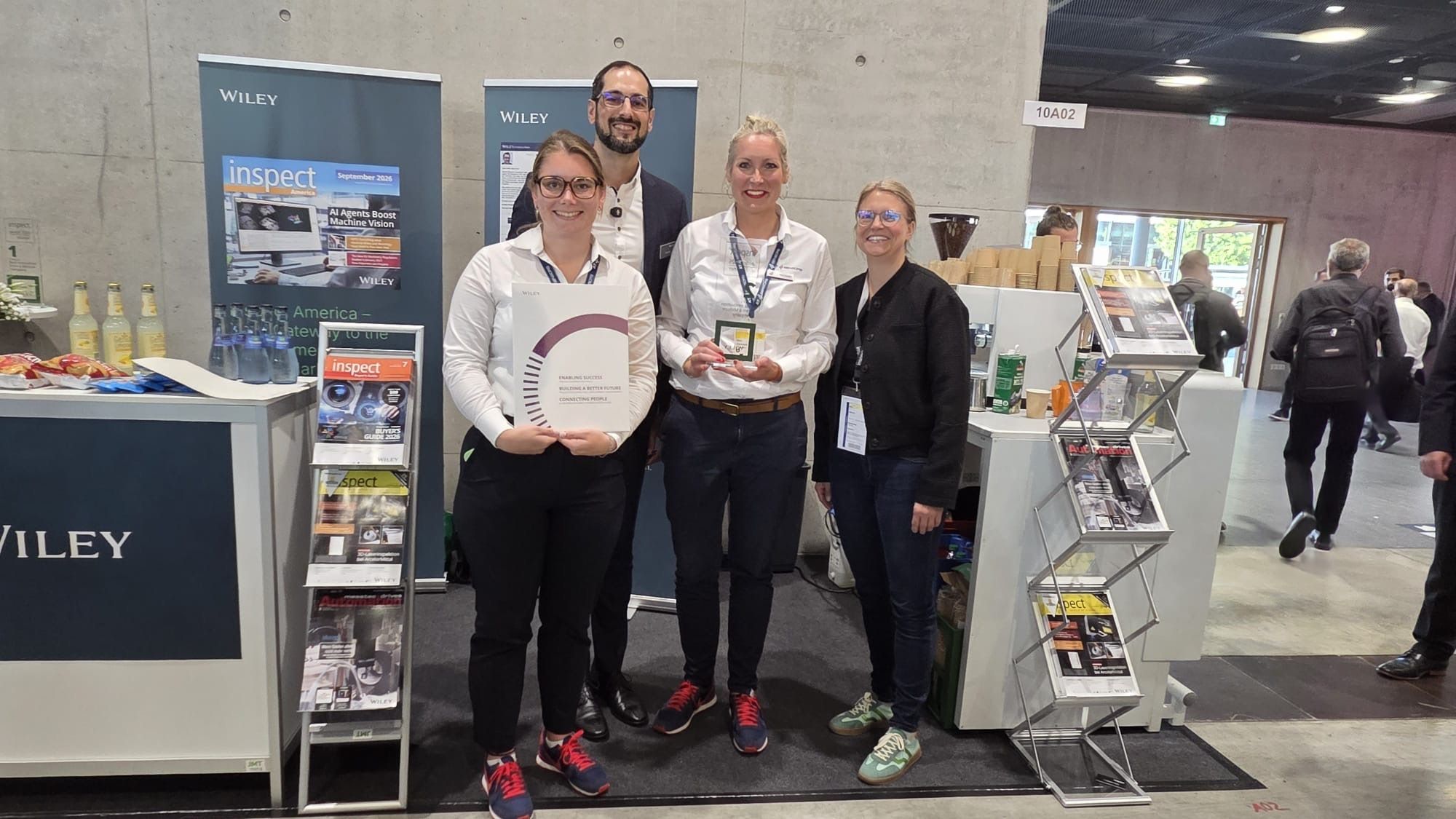
AT Sensors took second place at the inspect award 2026 for its 5GigE 3D Camera.
AT Sensors secured second place at the inspect award 2026 for its 5GigE 3D Camera. The C7 series uses 5 GigE and on-sensor processing to transmit 3D, intensity, reflectance, and scatter data simultaneously, making demanding inspection tasks economically feasible on standard Ethernet.
The C7 series transmits 3D, intensity, reflectance, and scatter data simultaneously without loss of quality.
AT Sensors achieves high data compression using on-sensor chip processing. André Kasper, Technical Director, said: "For us, 5 GigE is the optimal solution in terms of the bandwidth required for high-speed applications and integration considerations such as power dissipation, thermal load, and cost."
This allows three components to be sent at profile rates in the double-digit kHz range. The C7 series and 5 GigE enable higher profile rates for battery production, semiconductor manufacturing, and weld seam inspection. These tasks are now economically feasible using standard Ethernet infrastructure, replacing expensive multi-solution setups.
Frequently asked questions
How does the camera's 5 GigE interface, combined with on-sensor processing, allow for simultaneous transmission of multiple data types like 3D, intensity, and reflectance at high profile rates?
The camera utilizes NBASE-T technology for 5 GigE, offering up to 5 gigabits per second. This choice balances required bandwidth with practical integration factors like power and thermal load. Combined with on-sensor chip processing, significant data compression is achieved before transmission. Optimized pixel formats for data components further enable efficient use of Ethernet bandwidth, allowing simultaneous transmission of 3D, reflectance, and scatter data even at double-digit kHz profile rates. This approach ensures optimal utilization of the available interface speed.
What specific advantages does the simultaneous and lossless transmission of 3D, intensity, reflectance, and scatter data offer for demanding inspection tasks compared to previous limitations?
Previously, users often had to compromise by reducing or disabling individual data channels to stay within bandwidth limits. The simultaneous and lossless transmission of all data channels, including 3D for geometry, intensity and reflectance for grayscale information, and scatter for surface structure details, provides complete, synchronized, pixel-level precision. This significantly improves detection rates for challenging tasks like material differentiation, surface inspection, weld seam inspection, battery cell inspection, and identifying defects with subtle geometric contrast.
What are the integration considerations that led to the selection of 5 GigE over 10 GigE for the new camera?
The selection of 5 GigE was based on an optimal balance between the bandwidth required for high-speed applications and crucial integration considerations. Specifically, 5 GigE was chosen because it offers sufficient bandwidth while managing factors such as power dissipation, thermal load, and overall cost more effectively than 10 GigE in this context. The on-sensor chip processing contributes to efficient data handling, making 5 GigE a practical choice.
What demands does the camera place on the host system, and how can users manage the resulting data volume?
Modern industrial PCs with multi-core processors, fast NVMe storage, and optimized 5-GigE or 10-GigE network adapters are well-equipped to handle the demands. Current analysis algorithms efficiently utilize GPU resources for real-time processing of large data volumes. Furthermore, in many inline applications, data is analyzed during production and reduced to quality characteristics, managing the amount of data requiring permanent storage.
What types of defects can be better detected with the simultaneous transmission of all data channels?
The simultaneous and lossless transmission of 3D, intensity, reflectance, and scatter data enhances the detection of defects that have only slight geometric contrast. This includes anomalies such as scratches and pores, and improves the ability to differentiate between materials. The comprehensive data set allows for more precise identification of surface structure anomalies and other subtle imperfections.
Besides geometry, intensity, and reflectance, what additional information does scatter data provide?
Scatter data provides supplementary information about an object's surface structure and anomalies. This includes details about surface roughness, micro-texture, and the presence of imperfections like scratches and pores. Integrating this scatter data alongside geometric and grayscale information offers a more comprehensive understanding of the surface quality.
Beyond battery, semiconductor, and electronics manufacturing, what other industrial inspection tasks become economically feasible with the C7 series and its 5 GigE capability?
The full answer is in the original report. Read it at Automation Technology.
Get the long read at Automation Technology
Is this your company?
This article features your business. Claim it to add your logo, contact details, and a link to your website — or upgrade to reach more buyers.
Did you know 80% of Press Releases trigger AI content warnings? Reach out and the M4S team can assist.