
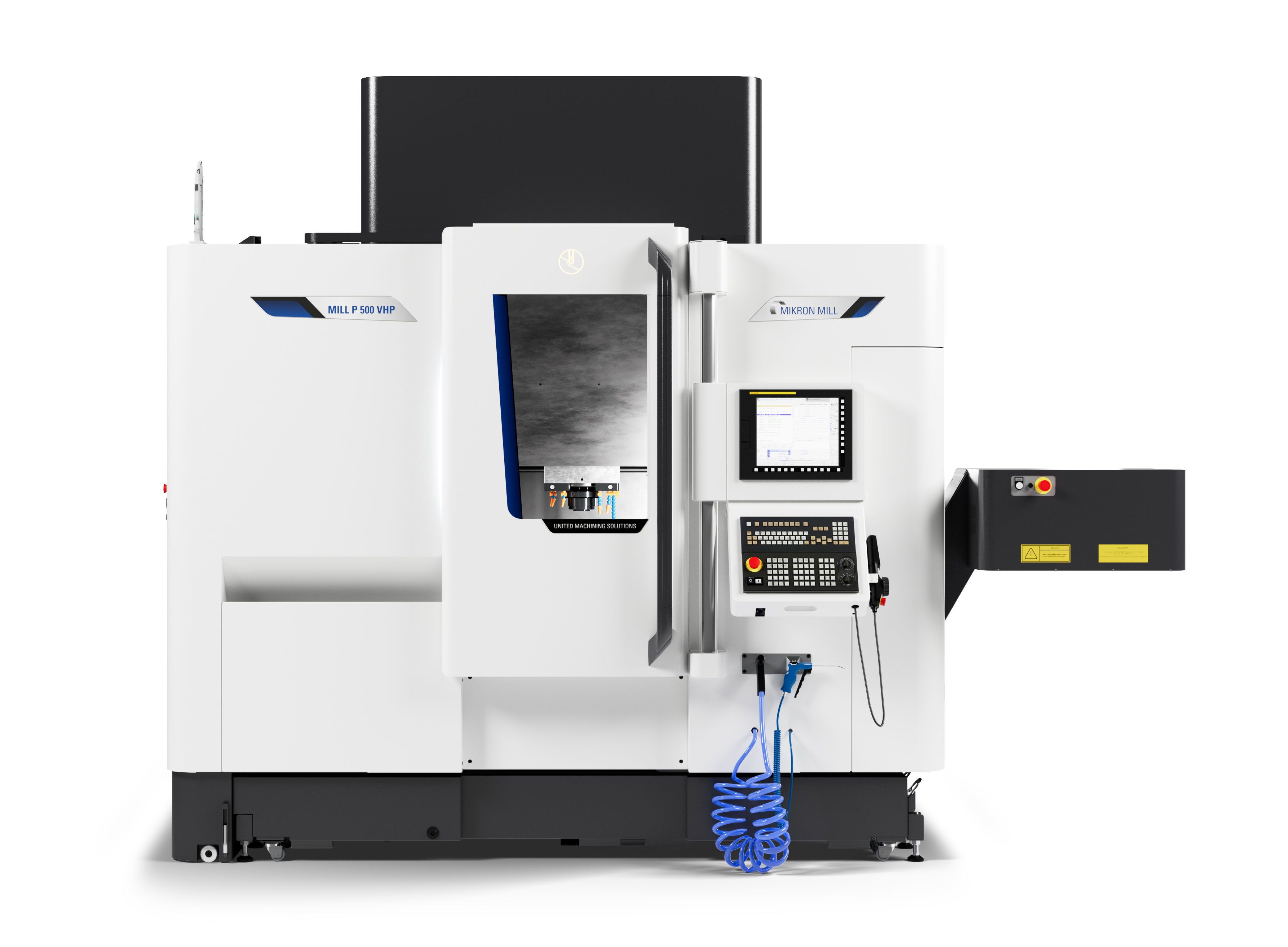
A 500 VHP without ball screws, in polymer concrete.
United Machining has added the Mikron MILL P 500 VHP, a three-axis high-precision machining centre for mould tool work. Its linear axes use linear direct drive instead of ball screws, so no backlash works into the surface finish, and it sits on a polymer concrete bed with a symmetric portal frame. Spindles run at up to 42,000 rpm. The rear-loading machine is aimed at mould inserts for lenses and connectors.
A high-precision machining centre with no ball screws in its linear axes.
Linear direct drive leaves no backlash in the axes, so the surface finish holds over extended machining runs. The polymer concrete bed has high damping, which reduces vibration, and the symmetric portal layout spreads cutting forces evenly across the structure. Intelligent Thermal Control and the Operator Support System sit alongside the spindles.
United Machining describes the machine as a three-axis high-precision machining centre for demanding mould tool work. The applications it lists are mould inserts for lenses and connectors, reflector moulds for automotive and household appliances, fuel cell tooling and medical device moulds. The Step-Tec Opticool/CoolCore spindles run at up to 42,000 rpm, and the symmetric portal and Intelligent Thermal Control give the long-term thermal stability that keeps process reliability high when the machine runs continuously.
The machine is rear-loading, and the company puts the case that way. Juan Martin, Head of Customer Development at United Machining, said the intelligent automation concept with rear-loading enables significant productivity gains, and its compact footprint allows space-efficient integration into a range of different environments.
Frequently asked questions
The P 500 VHP has no ball screws in its linear axes. What does that change?
Competing machines traditionally use ball screws, which can hurt surface quality and finish because of backlash. Linear direct drive removes that problem, so the machine delivers reliable accuracy and exceptional surface quality over extended machining runs and long periods of operation. The polymer concrete bed adds the second half of the answer: its damping properties reduce vibrations, which also protects precision.
Why a polymer concrete bed rather than cast iron?
Polymer concrete has excellent damping properties. It reduces vibrations and, as a consequence, ensures high precision. That matters on the micro-components the machine is built for - mould inserts for lenses and connectors used in the information and communications technology sector, where the tolerances are tight enough for vibration to show up in the finish.
What does the symmetric portal frame do?
Two things. Optimal force distribution - the load spreads evenly across the structure rather than concentrating in one place - and long-term thermal stability, which is what keeps the machine accurate over a production run rather than only at start-up. Together they are what make high process reliability possible when the machine is running continuously.
What is Intelligent Thermal Control, and the Operator Support System?
Intelligent Thermal Control manages the machine's thermal behaviour, supporting the long-term stability the portal design provides. The Operator Support System is the machine-side support layer for operations and maintenance. Both sit alongside the Step-Tec Opticool/CoolCore spindles, which run at up to 42,000 rpm.
It is rear-loading, which is unusual for a machine this size. Why does that matter on a shop floor?
The machine is rear-loading, and United Machining puts the case that way: the intelligent automation concept with rear-loading enables significant productivity gains, and its compact footprint allows space-efficient integration into a range of different environments. Rear loading puts the operator side of the machine clear, which is what makes a machine this size fit into an existing cell rather than needing its own floor space.