
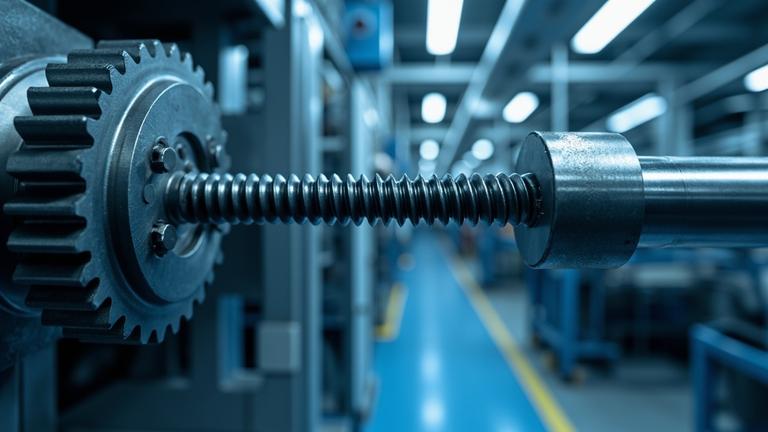
Rack and pinion scalability: Rack and pinion can be cut to length or chained together, scaling infinitely for long-travel axes.
- Ball screw limitation: Ball screws can offer higher precision over short distances but hit a length limit around 2-3 meters due to a phenomenon called whip.
- Linear motor trade-offs: Linear motors deliver speed and precise control but cost far more per meter to extend and need constant power to hold position.
- Clean room exception: Rack and pinion requires lubrication on gear teeth, while linear motors' lack of exposed moving parts makes them the best clean room fit.
- Component sourcing: GAM sells rack in standard one-meter sticks, cuts rack to shorter lengths, and helps engineers identify the right components and quantities for each application.
Pull a tape measure out a few inches and the blade stays rigid. Keep pulling, and it flexes, wobbles, and eventually buckles. Engineers designing long-travel axes know that problem well — and it sits at the heart of choosing between the three main ways to create precise straight-line motion in machines: rack and pinion, ball screws, and linear motors.
Where Each Technology Fits
Over shorter distances, rack and pinion and ball screws compete in the same space — and ball screws can offer higher precision. But like the tape measure, the ball screw has a length at which things go wrong: around 2-3 meters, depending on the size of the screw.
"As you get into longer distances with ball screws, there's a phenomenon called whip," says Matt Ruggles, senior design engineer at GAM, a U.S.-based manufacturer of servo gear reducers and other motion control components.
Rack and pinion, by contrast, is very easy to customize for length. Rack can be cut shorter or multiple pieces can be assembled together for much longer travel.
"The advantage is that the rack and pinion can basically scale infinitely," Ruggles says.
The Linear Motor Trade-Off
Linear motors bring two clear strengths: speed and highly precise control. But because a linear motor relies on magnetic flux, stiffness can be harder to manage, and the permanent magnets and electromagnets involved introduce complications — nearby objects can become magnetized, and chips and other debris can be collected as the system runs.
Cost is another dividing line. Both technologies can scale to longer distances, but the per-meter cost of extending a linear motor is much higher than adding another section of rack. Linear motors also need constant power just to hold position, while a rack and pinion system holds position as soon as the motor stops, with the motor brake handling the rest.
"You do have to buy the rack and pinion and usually a gearbox and a motor, but that combined cost is usually less than the linear motor implementation," Ruggles says.
The Clean Room Exception
Rack and pinion does have one environment where it falls short: clean rooms. The gear teeth need lubrication to work properly, which means exposed grease. Ball screws share the issue, though they can be protected with bellows and similar solutions. Linear motors have no exposed moving parts, making them the best fit for clean room environments.
Sizing the System
GAM sells rack in standard one-meter sticks that can be chained together, and can cut rack to shorter lengths as well. For engineers working through component selection, GAM's team can help identify the right components and quantities to meet each application's requirements. A gearbox, pinion, and rack system can even provide the 7th axis, or lateral movement, for an articulated robot.
Ruggles' closing advice applies to any of the three technologies:
"It's one of those things where you get out of it what you put into it."
Is this your company?
This article features your business. Claim it to add your logo, contact details, and a link to your website — or upgrade to reach more buyers.
Did you know 80% of Press Releases trigger AI content warnings? Reach out and the M4S team can assist.