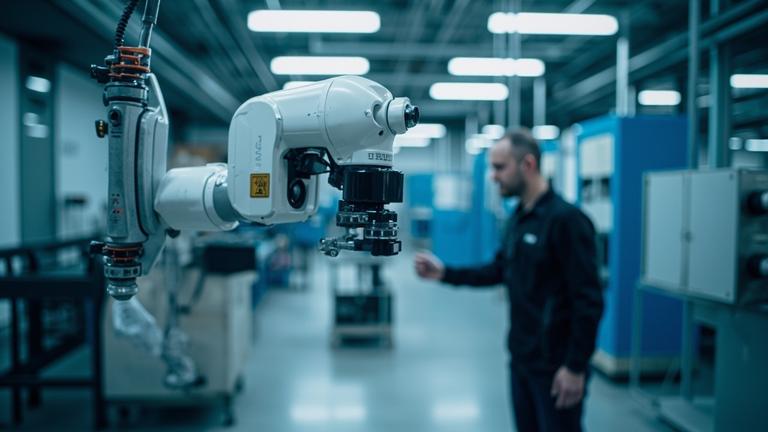
ABB Robotics has struck a deal with LandingAI to embed its vision AI platform directly into ABB's robot software suite.
- ABB is integrating this capability into its own software suite, including RobotStudio with its digital twin functionality.
- The claim: up to 80% reduction in training time, with end users able to retrain models themselves for new scenarios post-deployment.
- ABB has also invested venture capital through ABB Robotics Ventures, though financial terms were not disclosed.
Industrial robots with vision capabilities have been around for decades, but training them remains a bottleneck. Traditional approaches require specialist programmers, extensive datasets, and lengthy commissioning cycles. ABB Robotics President Sami Atiya put it bluntly: "The demand for AI in robotics is driven by the need for greater flexibility, faster commissioning cycles, and a shortage of the specialist skills needed to program and operate robots."
For sectors like logistics, healthcare, and food and beverage, where product lines change frequently and downtime is costly, this lag makes automation uneconomical. ABB has been piloting LandingAI's technology in applications including item-picking, sorting, depalletizing, and quality inspection, and the results convinced them to deepen the relationship. The Solution: Pre-Trained Models Inside RobotStudio
LandingAI's LandingLens platform uses pre-trained models and no-code tools to let non-specialists train vision systems. ABB is integrating this capability into its own software suite, including RobotStudio with its digital twin functionality. The claim: up to 80% reduction in training time, with end users able to retrain models themselves for new scenarios post-deployment.
> "By combining LandingAI's vision AI capabilities with ABB's robots and software, we can make automation more accessible," said LandingAI CEO Dan Maloney.
ABB has also invested venture capital through ABB Robotics Ventures, though financial terms were not disclosed. The company positions this as a step toward its Autonomous Versatile Robotics (AVR) vision, where robots adapt without constant reprogramming. What It Means for the Floor
ABB says it is the only robotics vendor offering fully integrated AI training within its own software suite. That integration matters. If an operator can retrain a picking robot for a new SKU in hours rather than calling in a systems integrator for weeks, the economics of flexible automation shift materially.
The 80% figure is ABB's claim, not independently verified, and real-world performance will vary with application complexity. Still, the direction is clear. Vision AI is moving from specialist tool to standard equipment feature, and ABB is betting that embedding it deeply in its stack, rather than bolting it on, will differentiate it from competitors.
The partnership is already in pilot. Full integration into ABB's vision AI applications is underway.
Simon McLoughlin
Is this your company?
This article features your business. Claim it to add your logo, contact details, and a link to your website — or upgrade to reach more buyers.
Did you know 80% of Press Releases trigger AI content warnings? Reach out and the M4S team can assist.