
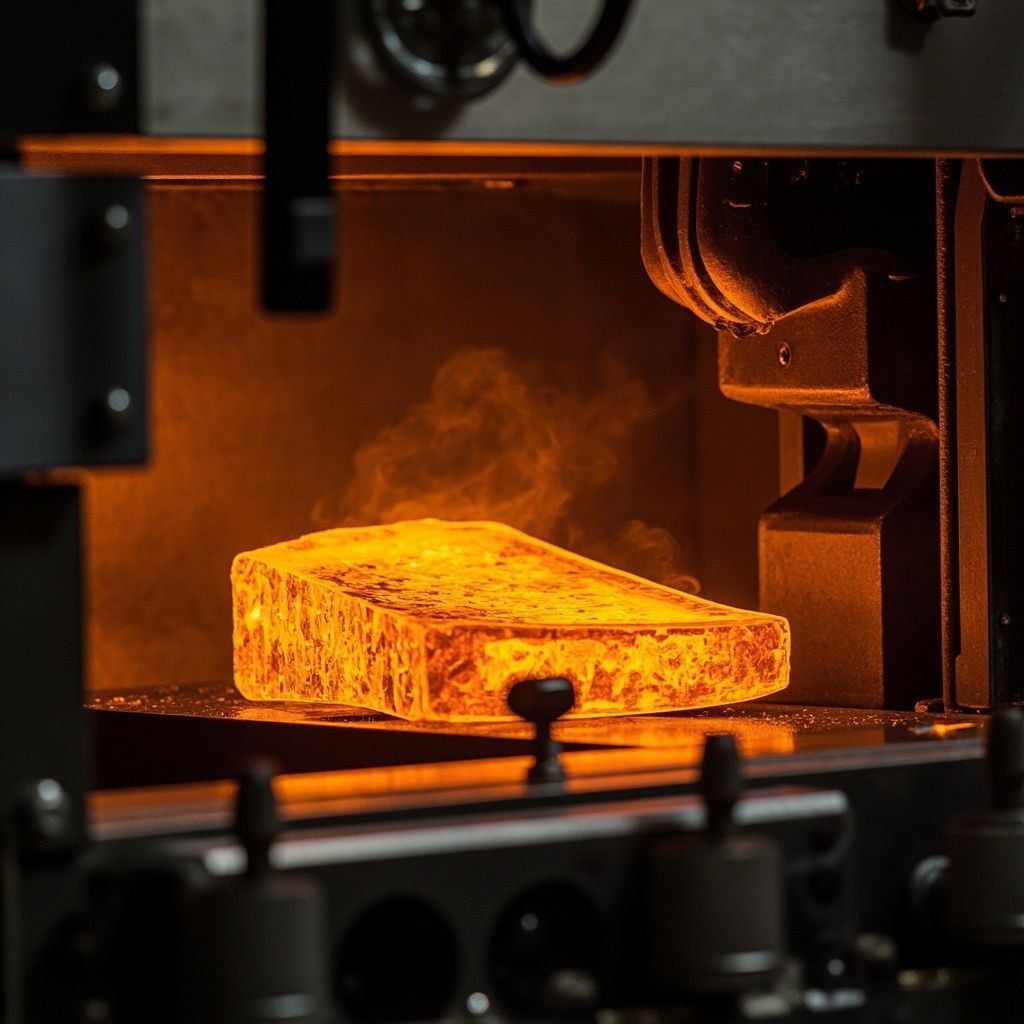
This development signals a credible push into the 900-1000°C operating range for LPBF nickel superalloys, directly expanding design options for turbomachinery and aerospace components where thermal margin has been a limiting factor.
The Problem: Thermal Limits Constraining AM Adoption
Additive manufacturing promised turbomachinery and aerospace engineers design freedom. In practice, materials kept getting in the way. Nickel-based superalloys developed for conventional manufacturing didn't translate well to laser powder bed fusion. Cracking, porosity, and inconsistent mechanical properties made打印件 unreliable for high-strain, high-temperature components.
Even when printability improved, thermal performance plateaued. Most打印件 nickel alloys maxed out around 800°C in service, forcing designers to compromise. You could either print a complex geometry or use traditional alloys at higher temperatures—not both.
"We were hitting a ceiling," André Németh, co-founder of Alloyed, told me. "Engineers wanted to push further, but the materials weren't there."
The Solution: Bottom-Up Design for LPBF
Alloyed, an Oxford University spinout, took a different approach. Instead of adapting existing alloys, they computationally designed ABD-900AM from scratch for laser powder bed fusion.
The result: the first nickel-based superalloy developed specifically for LPBF. ABD-900AM debuted in 2020 targeting the 800-900°C operating range. Since then, adoption has grown beyond prototyping into production parts.
Now Alloyed is extending that ceiling. The next-generation formulation pushes approximately 100°C higher, into the 900-1000°C range.
"We're seeing integration into real systems now, not just test coupons. A material designed bottom-up for AM enables new components. Because of its metallurgy, it also handles stresses and temperature ranges across a single part, so as you integrate more parts, your stress and temperature distributions get more complex. That's where we're seeing the real advantage."
The extended temperature range matters most for two reasons. First, it opens thermal margin that designers can spend on performance. Second, it allows more aggressive component integration—putting functions together that previously required multiple parts and joints.
The Results: From Test Beds to Production
The numbers are modest but growing. Alloyed won't disclose customer counts or order volumes, citing confidentiality agreements. What they will say: ABD-900AM now appears in active production parts across multiple turbomachinery platforms.
Németh sees the shift from R&D to production as the real milestone. "We're past the adoption curve for 'will this work?' The question now is 'how do we design for it?'"
For turbomachinery engineers, that matters. The ability to print single-piece components that operate at 950°C+ changes architecture options. No brazed joints. No multi-material transitions. Just a打印件 part doing the job.
I'll be honest: I'm skeptical of material announcements without production pedigrees. ABD-900AM has that pedigree now, but the extended high-temperature variant is still early. Engineers evaluating it should request mechanical property data at target temperatures and ask about lot-to-lot consistency. Material certification for aerospace takes time.
That said, the trajectory is clear. If the 100°C extension holds at scale, it widens the viable design space for打印件 turbomachinery significantly.
Simon McLoughlin
Is this your company?
This article features your business. Claim it to add your logo, contact details, and a link to your website — or upgrade to reach more buyers.
Did you know 80% of Press Releases trigger AI content warnings? Reach out and the M4S team can assist.