
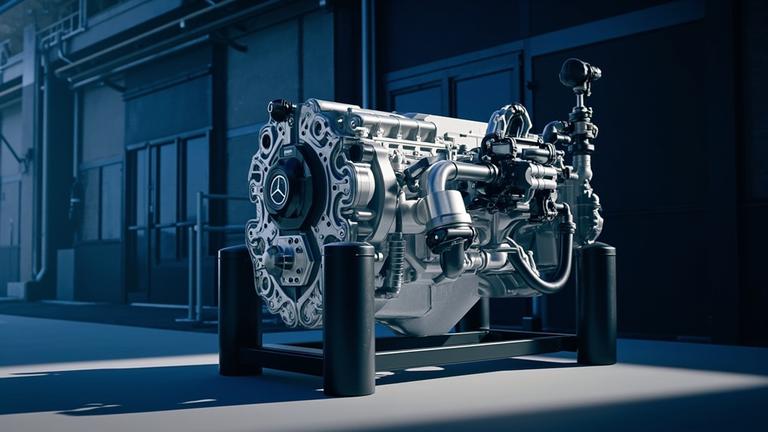
This marks the first transition of axial-flux motors from laboratory demonstration to production-vehicle deployment, signaling that the manufacturing barriers have finally fallen. For powertrain engineers, this opens new architectural possibilities in packaging-constrained applications.
The Problem: Unreachable Performance
Axial-flux motors have long promised higher power density and shorter package length than conventional radial-flux designs. Those advantages, however, remained theoretical because manufacturing couldn't deliver the tolerances the technology demands. At the Los Angeles media briefing for the 2027 Mercedes-AMG GT 4-Door Coupe, electric drivetrain development engineer Denis Blanusa walked through why this breakthrough took so long.
Single-digit-micron tolerances on rotor and stator components beat out what most high-volume manufacturing processes could achieve reliably. YASA, the British axial-flux specialist now owned by Mercedes-Benz, had demonstrated the technology in limited applications but couldn't scale it to automotive production volumes. The gap between laboratory demonstration and production feasibility represented years of manufacturing challenges that kept axial-flux out of every showroom.
The Solution: YASA Plus AMG Manufacturing Capability
Mercedes resolved this by combining YASA's motor topology with AMG's German manufacturing expertise. Blanusa's team rebuilt manufacturing processes around the axial-flux geometry rather than adapting radial-flux methods. This required custom winding equipment, new precision-assembly fixtures, and rework of quality-control protocols to catch micron-level deviations earlier in production.
The result is a three-motor drivetrain delivering 550 kilowatts of continuous power in the GT 4-Door Coupe. That's the first production battery-electric vehicle to employ axial-flux technology anywhere. Each motor fits into tighter spaces than radial-flux equivalents, enabling packaging advantages that cascaded through the vehicle's architecture.
The Results: Production Reality Over Prototype Claims
I asked Blanusa about the transition from prototype tolerances to production volumes. His answer confirmed what manufacturing engineers already know: the gap between a working prototype and reliable production often requires as much development time as the original design. AMG spent years closing that gap, with manufacturing process development running parallel to motor design refinement.
The GT 4-Door Coupe's deployment proves axial-flux technology has cleared the manufacturing hurdles that kept it out of production vehicles. Whether the performance claims hold up against real-world durability data will determine if this approach spreads to other platforms. For now, the engineering community has its first real-world case study on axial-flux manufacturing at scale.
"The challenges are real, but they're solved now," Blanusa said. "We're not talking about theoretical advantages anymore."
That shift from theoretical to production changes what engineers can propose in future vehicle programs. The manufacturing methodology exists. The question is whether other manufacturers will follow, and how quickly they can replicate AMG's approach.
Simon McLoughlin
Is this your company?
This article features your business. Claim it to add your logo, contact details, and a link to your website — or upgrade to reach more buyers.
Did you know 80% of Press Releases trigger AI content warnings? Reach out and the M4S team can assist.