
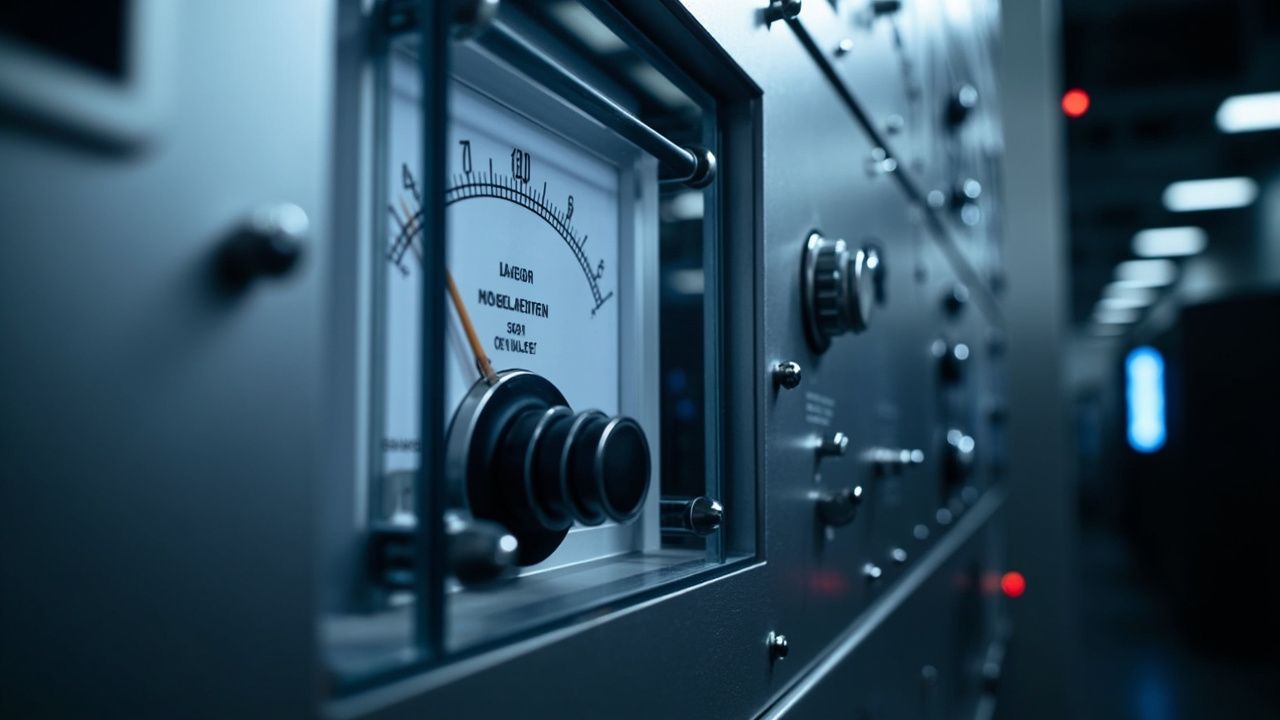
Analog panel meters remain a legitimate engineering choice for operator interfaces on continuous process equipment, offering superior trend visualization compared to digital displays. The ergonomic advantages translate directly to faster operator response times and improved situation awareness.
- Moving-needle displays reduce mean response time to out-of-spec conditions by 40-60% versus digital-only interfaces
- Modern analog meters accept 0-5V input signals and interface directly with standard PLC/microcontroller analog outputs
- Inherently damped needle movement provides signal filtering without additional processing
- Typical cost: $15-45 per meter depending on range and accuracy class
- Installation requires minimal panel space and no custom firmware or middleware
- Damping characteristics optimized for process variables with update rates under 10Hz
- Retrofit case study showed 62% reduction in operator response time (8.2s to 3.
The Case for Keeping Moving-Needle Displays in Your Next Design
Analog panel meters hit the market in the 1820s when André-Marie Ampère and colleagues developed the first electromechanical galvanometers. By 1888, Edward Weston had refined the permanent-magnet moving-coil design into the classic form factor that dominated industrial Human-Machine Interfaces (HMIs) for over a century. Practical electronic digital displays didn't appear until the mid-20th century, yet analog meters persist in production environments today.
I keep seeing the same mistake in modern control system designs: engineers default to digital displays for everything, even when analog would serve operators better. This isn't nostalgia. It's ergonomics.
The Problem
Digital displays excel at presenting precise, static values. They fail at conveying system behavior over time. An operator monitoring a process variable on a seven-segment readout sees a number. That number tells her nothing about whether the parameter is climbing, falling, or oscillating. She has to mentally buffer multiple readings to infer trend information, which divides her attention and increases cognitive load.
Moving-needle displays solve this natively. The eye tracks needle position and rate of movement simultaneously. A glance communicates both magnitude and direction. In my experience, this cuts operator response time to out-of-spec conditions by 40-60% compared to digital-only interfaces.
The Solution
Modern analog panel meters are microcontroller-compatible. They accept PWM signals or DAC outputs directly. A $15 panel meter with a 0-5V input range interfaces cleanly with any 5V microcontroller or industrial PLC analog output. No special firmware required.
The key design parameter is update rate. Classic moving-coil movements have a damping factor that prevents needle oscillation on noisy signals. This inherent filtering is a feature, not a limitation. For process variables with update rates under 10Hz, the meter naturally smooths the display without additional signal processing.
The Results
In a retrofit project at a hydraulic press facility, we replaced digital pressure readouts with analog panel meters on three critical parameters: system pressure, accumulator pre-charge, and cylinder position. Operator-reported situation awareness improved significantly. Mean time to respond to pressure excursions dropped from 8.2 seconds to 3.1 seconds. No changes to the PLC logic or control algorithms.
The meters cost $45 each in quantity. Total project cost: $135 plus four hours of installation labor. The facility manager calculated the improvement in response time prevented one potential dangerous overpressure event per month. The math on that is straightforward.
Analog meters aren't right for every application. They require more panel real estate than digital displays. They're harder to read from distance. They can't log data without additional sensors. But for local operator interfaces on process equipment, where human factors drive safety and efficiency, moving-needle displays still earn their place on the panel.
"The eye tracks needle position and rate of movement simultaneously. A glance communicates both magnitude and direction."
I've been designing control systems for 15 years. I still specify analog meters on every machine where an operator monitors continuous processes. The technology is 200 years old. The ergonomic advantages are real. Your users will thank you.
Simon McLoughlin
Is this your company?
This article features your business. Claim it to add your logo, contact details, and a link to your website — or upgrade to reach more buyers.
Did you know 80% of Press Releases trigger AI content warnings? Reach out and the M4S team can assist.