
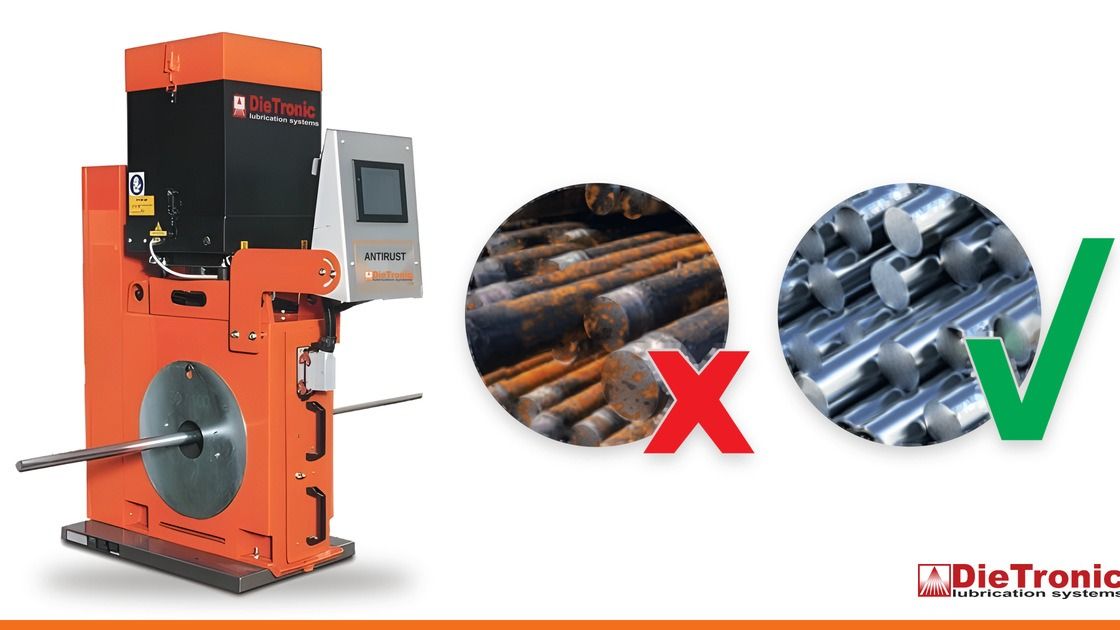
Antirust adds oil recovery and water-free cutting to anti-rust protection for bars in a single system.
Antirust is a single system for bars, tubes, wires and profiles from 2 to 406 mm. It includes oil recovery and water-free cutting, collecting, filtering and recirculating excess oil. Oil consumption falls 70%, rust-related complaints fall 90%, and the investment pays for itself in approximately one year. Nozzles are calibrated to bar cross-section and oil flow to feed speed.
Antirust handles bars, tubes, wires and profiles from 2 to 406 mm, so a single installation covers format changes.
Bars have long continuous surfaces and sections from round to hexagonal. Coolant residues and storage periods of months leave edges exposed, so protection needs nozzle calibration by cross-section and oil flow adjusted to feed speed. Antirust collects, filters and recirculates excess oil, cutting oil consumption by 70%.
Antirust uses minimum quantity lubrication for cutting, so the newly coated bar is not exposed to water again. That keeps the film intact after spraying and avoids the moisture that can restart corrosion beneath it. With a uniform film and no added moisture, rust-related complaints decrease by 90%.
Frequently asked questions
How does the cross-sectional shape of metal bars influence the effectiveness of anti-rust protection application?
The cross-sectional shape of metal bars significantly affects anti-rust protection. On round bars, the protective oil film tends to spread evenly. However, on square and hexagonal sections, the edges are weak points where the coating is thinner, making them prone to rust. Nozzle positioning must account for these profiles to ensure complete coverage, as sprays directed from above can leave lower faces unprotected.
What are the primary environmental factors that can lead to rust formation on stored metal bars?
Metal bars are susceptible to rust due to several environmental factors during storage. Coolant residues from machining operations, often water-based emulsions, can trap moisture against the metal surface. Furthermore, bars stacked in bundles for extended periods can experience condensation from day-night temperature fluctuations, and limited air circulation traps moisture. For bars destined for export, high humidity and salty air during sea freight pose additional corrosion risks.
What is the typical payback period for implementing an integrated anti-rust protection system like Antirust, and what metrics support this claim?
The investment in an integrated anti-rust protection system like Antirust can pay for itself in approximately one year. This return on investment is supported by significant reductions in operational issues and customer complaints. Specifically, the system's oil recovery and recirculation feature reduces oil consumption by 70%. Crucially, a uniform protective film and the elimination of additional moisture sources downstream lead to a 90% decrease in rust-related complaints.
What post-machining residues pose a significant risk to anti-rust protection on metal bars?
Water-based emulsions used in machining operations like peeling, grinding, and cutting leave coolant residues on metal bars. If oil-based anti-rust treatment is applied to a bar that is still damp from these emulsions, water becomes trapped against the metal surface. This trapped moisture can lead to oxidation developing beneath the protective film, remaining hidden until an incoming inspection.
How do variable production line speeds impact the consistency of anti-rust oil application, and what advanced systems address this?
Production line speeds that fluctuate—slowing down at start-up, stopping for changes, and speeding up during operation—can lead to inconsistent oil application with fixed flow rates. Bars receive too much oil when slow and too little when fast. Advanced spraying systems overcome this by adjusting the dispensed oil amount in real-time according to the feed speed, ensuring a consistent film thickness per meter of bar.
What specific parameters must be calibrated in a spraying system to achieve a uniform anti-rust film on moving bars?
Achieving a uniform film on a moving bar requires careful calibration of several parameters. These include the number and precise position of nozzles relative to the bar's cross-section, especially with sharp edges. The distance between the nozzle and the surface must be adjustable for different bar diameters. The spray pattern, whether flat fan or cone, is selected based on the surface width, and oil viscosity at the operating temperature influences atomization fineness.
Get the long read at Dietronic S.R.L.
Is this your company?
This article features your business. Claim it to add your logo, contact details, and a link to your website — or upgrade to reach more buyers.
Did you know 80% of Press Releases trigger AI content warnings? Reach out and the M4S team can assist.