
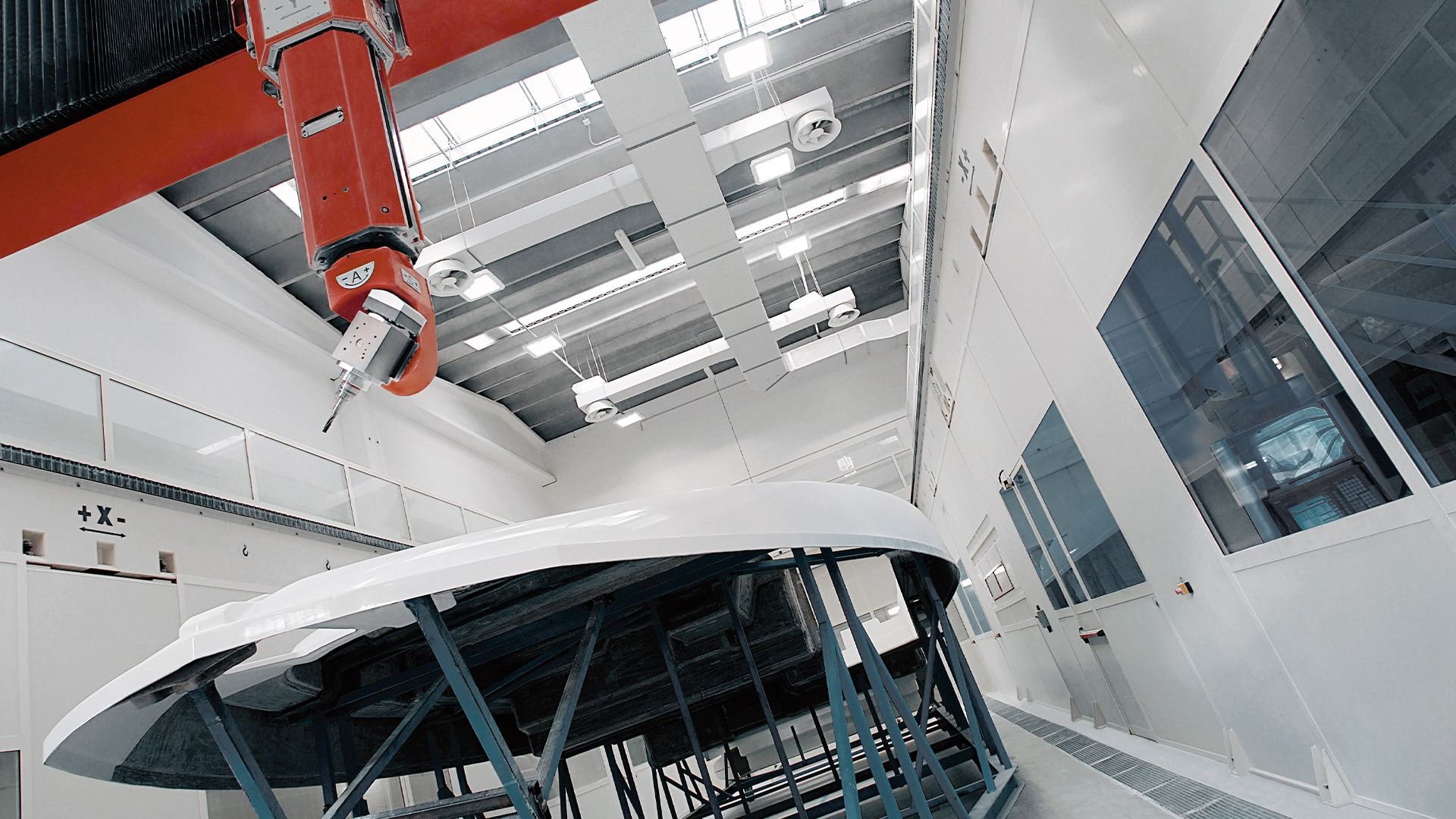
Azimut Yachts machines every hull at its Avigliana plant on a single Belotti NAVY Series center.
The Belotti NAVY Series center at Azimut Yachts’ Avigliana plant has a working area approximately 30 meters long. It carries a dual bridge, dual spindle, laser scanners, a Siemens ONE numerical control system and Tebis CAD/CAM. The configuration lets Azimut machine different components in the same production cycle and automate operations previously performed manually. Belotti lists X-axis stroke up to 43 meters.
Azimut Yachts uses a Belotti NAVY Series center with a working area approximately 30 meters long at its Avigliana plant.
The machine is equipped with a dual bridge and dual spindle, laser scanners, a Siemens ONE numerical control system, and the Tebis CAD/CAM platform. The configuration lets Azimut machine different components in the same production cycle and automate operations previously performed manually.
The suspended gantry Cartesian structure is available in a wide range of dimensional configurations. A second independent bridge can be equipped for simultaneous machining. The NAVY Series was developed for shipyards and manufacturers of large-scale models. It is available with X-axis stroke up to 43 meters.
Frequently asked questions
What specific challenges does the marine industry face when machining large-scale composite parts, and how does 5-axis CNC milling address them?
The marine industry grapples with managing large-scale geometries, composite materials, tolerances, and surface quality in digitalized processes. A significant challenge is accurately transferring digital designs onto large, complex, and potentially deforming physical parts. 5-axis CNC milling is crucial because it allows continuous adjustment of the cutting tool's orientation relative to the surface, enabling more favorable cutting conditions, reaching complex areas, reducing repositioning, and improving process continuity for large components like hulls and molds.
What is the ultimate goal for shipyards investing in advanced CNC machining technologies for hull and deck production?
The ultimate goal for shipyards investing in advanced CNC machining technologies is to manufacture hulls, decks, molds, or composite components not only with the correct geometry but also through a process that is repeatable, controllable, and industrially sustainable in terms of production time and output capacity. This involves integrating design, prototyping, measurement, deformation compensation, 5-axis machining, quality control, and automation into a cohesive workflow, which amplifies the effects of geometric errors and process variability.
What types of materials and components are typically machined using CNC centers in the marine industry?
CNC machining centers are used for a wide range of applications in the marine industry, including resin models and masters made from polystyrene, polyurethane foams, and epoxy pastes. They are also used for creating molds for hulls and decks, machining fiberglass and composite hulls and decks, and producing prototypes, scale models, structural and non-structural components, finished composite parts, aesthetic components, and production tooling and fixtures.
How does the integration of additive manufacturing with CNC milling, such as Belotti's Powered by Moi technology, benefit marine production?
Belotti's Powered by Moi technology combines thermoset composite 3D printing with CNC milling within the same gantry system. This 'hybrid manufacturing' approach allows material to be deposited using additive methods and then milled to achieve precise geometry, tolerances, and surface finishes. The primary advantage is the elimination of intermediate steps and the integration of additive and subtractive manufacturing without workpiece transfer, enabling a digital model to be deposited near-net-shape before precision milling to a finished product.
What are some of the key specifications for the electrospindles and tool changers available on Belotti NAVY Series machines?
Belotti NAVY Series machines can be equipped with electrospindles ranging from 15 to 42 kW, operating at speeds up to 24,000 rpm. For tool management, they can feature tool changers with capacities of up to 60 positions. Additionally, the machines can be configured with a second independent bridge, allowing for simultaneous machining on different parts or on the same workpiece to enhance production efficiency.
Get the long read at Belotti Spa
Is this your company?
This article features your business. Claim it to add your logo, contact details, and a link to your website — or upgrade to reach more buyers.
Did you know 80% of Press Releases trigger AI content warnings? Reach out and the M4S team can assist.