
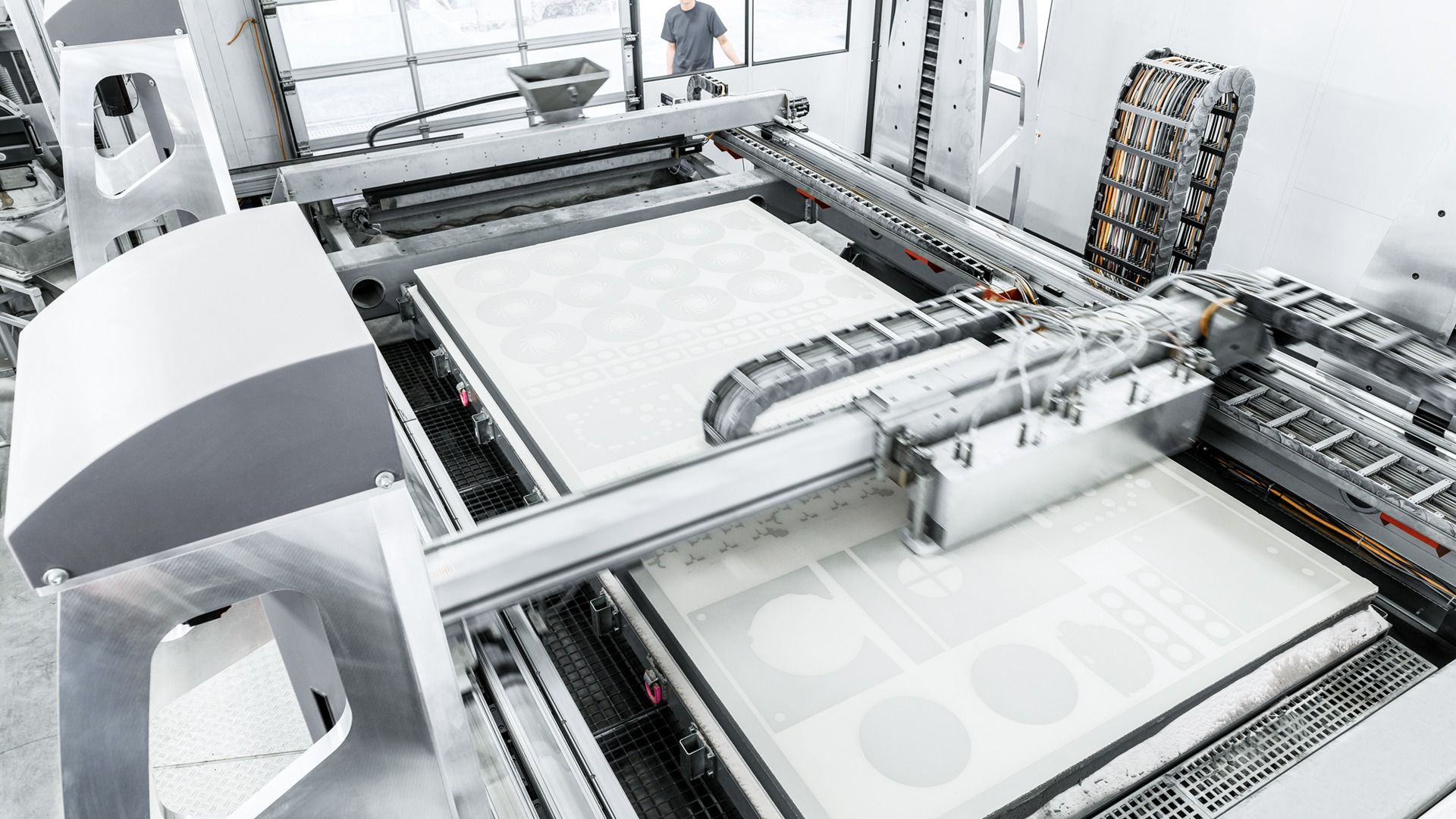
ExOne has launched a compact sand 3D printer for foundries with fewer than 100 employees.
ExOne launched the S-Print Pro in June 2026 at S-Max Pro part quality, aimed at shops with fewer than 100 employees. Speed 3D Mold of Thailand is among the first buyers, adding it to an S-Max used for large core packages.
The S-Print Pro has a footprint of less than 12 m² and matches S-Max Pro part quality and repeatability.
Speed 3D Mold, a Thailand mold and casting specialist, is one of the first customers. It runs an S-Max for large core packages and will move smaller, detailed cores to the S-Print Pro, whose CoreBoost printhead works at 400 dpi. The machine expands capabilities for fine contours and small quantities.
The S-Print Pro was launched in June 2026 with a 1,200 × 750 × 500 mm job box and 450 l build volume. A typical application is pump impellers with complex flow geometries; Speed 3D Mold printed four mold and core packages in one job box and delivered them in seven days.
First deliveries of the S-Print Pro began in the second half of 2026.
Frequently asked questions
How does the new S-Print Pro system enable smaller foundries to adopt industrial sand 3D printing technology?
The S-Print Pro system is designed to overcome the barriers of size, cost, and space typically associated with industrial sand 3D printing. By offering a compact footprint of less than 12 m² and transferring the technology from ExOne's larger S-Max series, it makes the adoption of additive manufacturing more accessible for small and medium-sized foundries. This allows them to benefit from the advantages of sand printing without the significant investment or spatial requirements of large-format systems.
What specific applications does the S-Print Pro system address that were not economically viable on larger machines?
The S-Print Pro is particularly suited for smaller, highly complex cores, development parts, samples, one-off pieces, and rush orders. Previously, using a large job box for such small-scale orders on an S-Max system was not always economical and could interrupt production. The new system allows for more efficient scheduling of these smaller requests, making them technically and economically viable, thus expanding the range of applications that can be addressed with sand 3D printing.
What are the key technical specifications of the S-Print Pro, and how do they compare to the S-Max series?
The S-Print Pro features a job box size of 1,200 × 750 × 500 mm with a build volume of 450 liters. It utilizes the new-generation CoreBoost™ printhead operating at 400 dpi, available in configurations for maximized print performance or lower operating costs. Optional StepX™ in-situ surface smoothing is also available. It shares the same user interface and part quality as the S-Max Pro, but in a significantly smaller format, making it ideal for single-shift operation.
What factors should foundries consider when deciding if sand printing is the right additive manufacturing solution for their operations?
Foundries should analyze their part portfolio to identify where additive manufacturing provides genuine technical and economic added value. The size and configuration of the system should be guided by actual applications, not solely by capacity. Complex cores that require extensive assembly on traditional machines, frequent design changes, or a lack of skilled labor for core assembly are prime candidates for sand printing. It's crucial to master the entire process chain, including application knowledge and process control, not just the printer itself.
How does the S-Print Pro facilitate ease of maintenance and minimize downtime?
The S-Print Pro was designed with accessibility for routine maintenance and service in mind. It features user-replaceable printhead modules, an easy-to-maintain recoater unit, and a dual-canister exchange system. These features are intended to keep downtime to a minimum, ensuring that the system remains operational and available for production runs, which is critical for efficient foundry operations.
What are the dimensional accuracy capabilities of the S-Print Pro?
The S-Print Pro system offers dimensional accuracy of ± 0.5 mm. For larger dimensions, it can achieve ± 0.1 % over 500 mm. This level of precision is important for printing delicate cores and components where tight tolerances are required, ensuring that the printed parts meet the specifications for complex casting applications.
Is this your company?
This article features your business. Claim it to add your logo, contact details, and a link to your website — or upgrade to reach more buyers.
Did you know 80% of Press Releases trigger AI content warnings? Reach out and the M4S team can assist.