
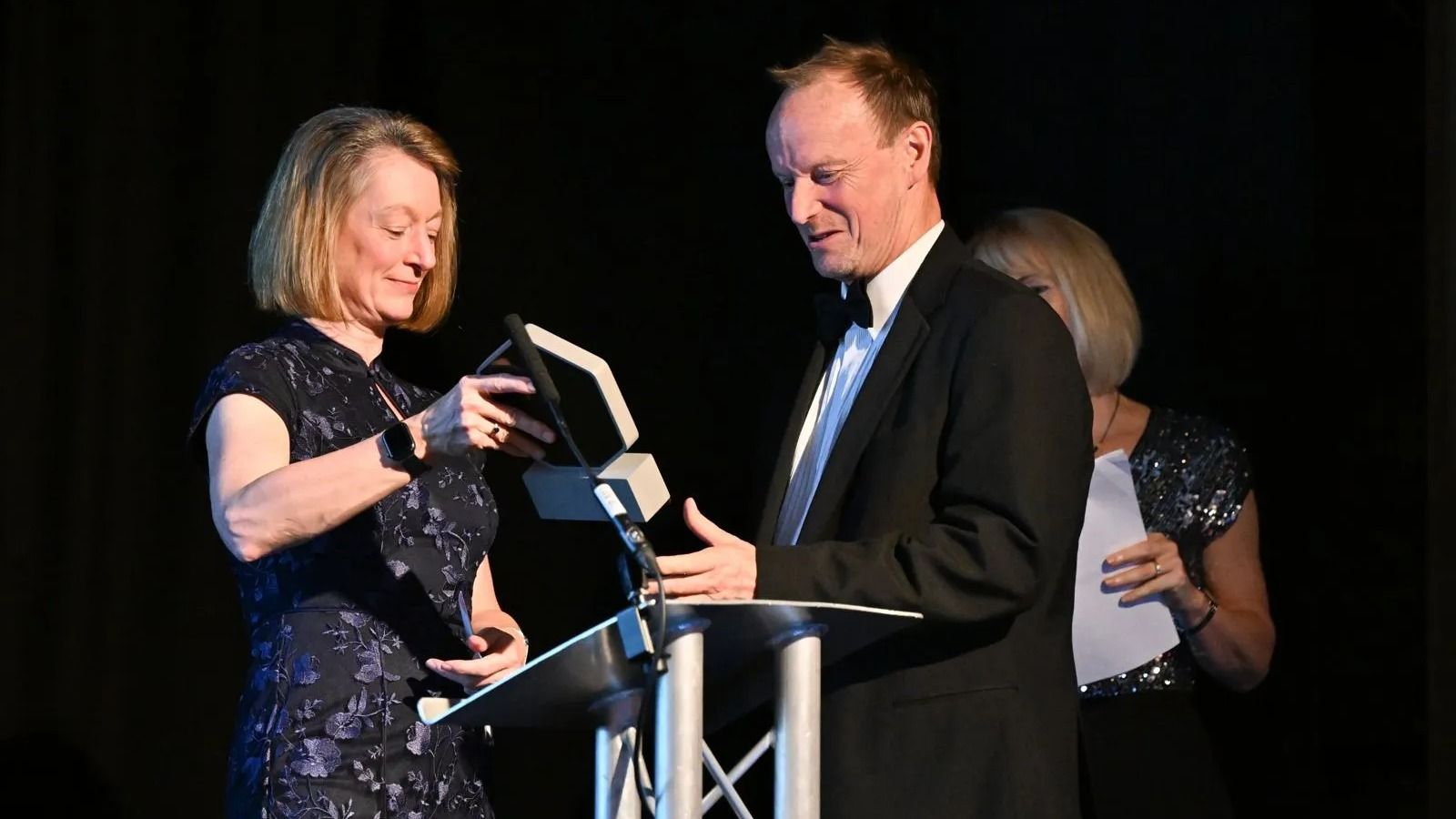
Alun Reece has won the Outstanding Contribution to the Composites Industry Award.
Alun Reece, CEO and founder of Loop Technology, received the Outstanding Contribution to the Composites Industry Award on 4 November 2026 in Birmingham. Trials at the National Composites Centre reached dry-fibre deposition above 350 kg per hour, against around 50 kg per hour for typical automated fibre placement on large structures.
Reece founded Loop Technology in 1998. The company developed FibreLINE, a modular automation system for composite preforming that cuts, sequences, picks, forms, places, tacks and inspects large dry-fibre or pre-preg plies. Loop Group has offices in Dorchester, Bristol and Sheffield.
The award ceremony was held on Wednesday 4 November 2026 at the National Motorcycle Museum in Birmingham. FibreLINE, with stated positional repeatability of less than ±2 mm, is used on highly shaped parts such as wing skins, nacelles, fairings and wing tips.
Trials of the Ultra High-Rate Composite Deposition system at the National Composites Centre achieved dry-fibre deposition rates above 350 kg per hour, compared with typical automated fibre placement rates of around 50 kg per hour for large structures.
Frequently asked questions
What is the FibreLINE system and what are its key capabilities for manufacturing composite structures?
FibreLINE is a modular automation system for composite preforming developed by Loop Technology. It automates critical processes including cutting, sequencing, picking, forming, placing, tacking, and inspection of large dry fibre or pre-preg plies. The system is assembled from Loop Technology’s end effectors and can be configured for various part sizes and cell layouts, handling plies up to 2 meters wide and beyond 30 meters long with a positional repeatability of less than ±2 mm.
How does the FibreLINE system improve upon traditional automated fibre placement rates?
FibreLINE delivers significantly higher material deposition rates compared to typical automated fibre placement for large structures. While conventional automated fibre placement rates hover around 50 kg per hour, development trials of Loop Technology's Ultra High-Rate Composite Deposition system, featuring FibreLINE end effectors, have achieved dry-fibre deposition rates exceeding 350 kg per hour. This represents a substantial increase in manufacturing efficiency.
What are the potential applications for FibreLINE technology beyond aerospace?
While primarily developed for large aerospace structures, the automation principles of FibreLINE are applicable to other composite manufacturing sectors. Loop Technology has identified potential uses in wind energy, defence, automotive, marine, and drone manufacturing. The system's multi-sector capability is being explored for defence, renewable energy, transport, and urban air mobility applications.
What is the FibreFORM end effector and how does it handle composite plies?
The FibreFORM is a pick-and-place end effector within the FibreLINE system. It utilizes high-flow vacuum grippers to precisely pick up large composite plies. It then forms these plies into complex three-dimensional, double-curvature shapes before placing them into the mould. This process is designed to accurately form and place the material without causing damage.
What are the maximum dimensions of plies that FibreLINE can handle with its FibreLINE and FibreROLL configurations?
The standard FibreLINE configuration, using FibreFORM end effectors, can handle plies up to 2 meters wide and beyond 30 meters long. The FibreROLL configuration, designed for less complex geometries, utilizes interchangeable storage rollers and can handle plies up to 5 meters wide and 20 meters long. A more compact FibreLINE 2x1 configuration is available for smaller parts.
Can you provide details on the COMPASS facility installation of FibreLINE technology?
At the University of Sheffield's COMPASS facility, FibreLINE is integrated into the Boeing-led Isothermic High-Rate Sustainable Structures (IHSS) project. This cell includes five Loop Technology end effectors (two FibreFORM, one FibreEYE inspection, and two bespoke systems), integrated with five FANUC M-2000 Series robots. It also features two 21.4-metre Zünd cutting tables for single-operation ply cutting, aiming to reduce manufacturing time significantly.
Get the long read at Loop Technology Ltd
Is this your company?
This article features your business. Claim it to add your logo, contact details, and a link to your website — or upgrade to reach more buyers.
Did you know 80% of Press Releases trigger AI content warnings? Reach out and the M4S team can assist.