
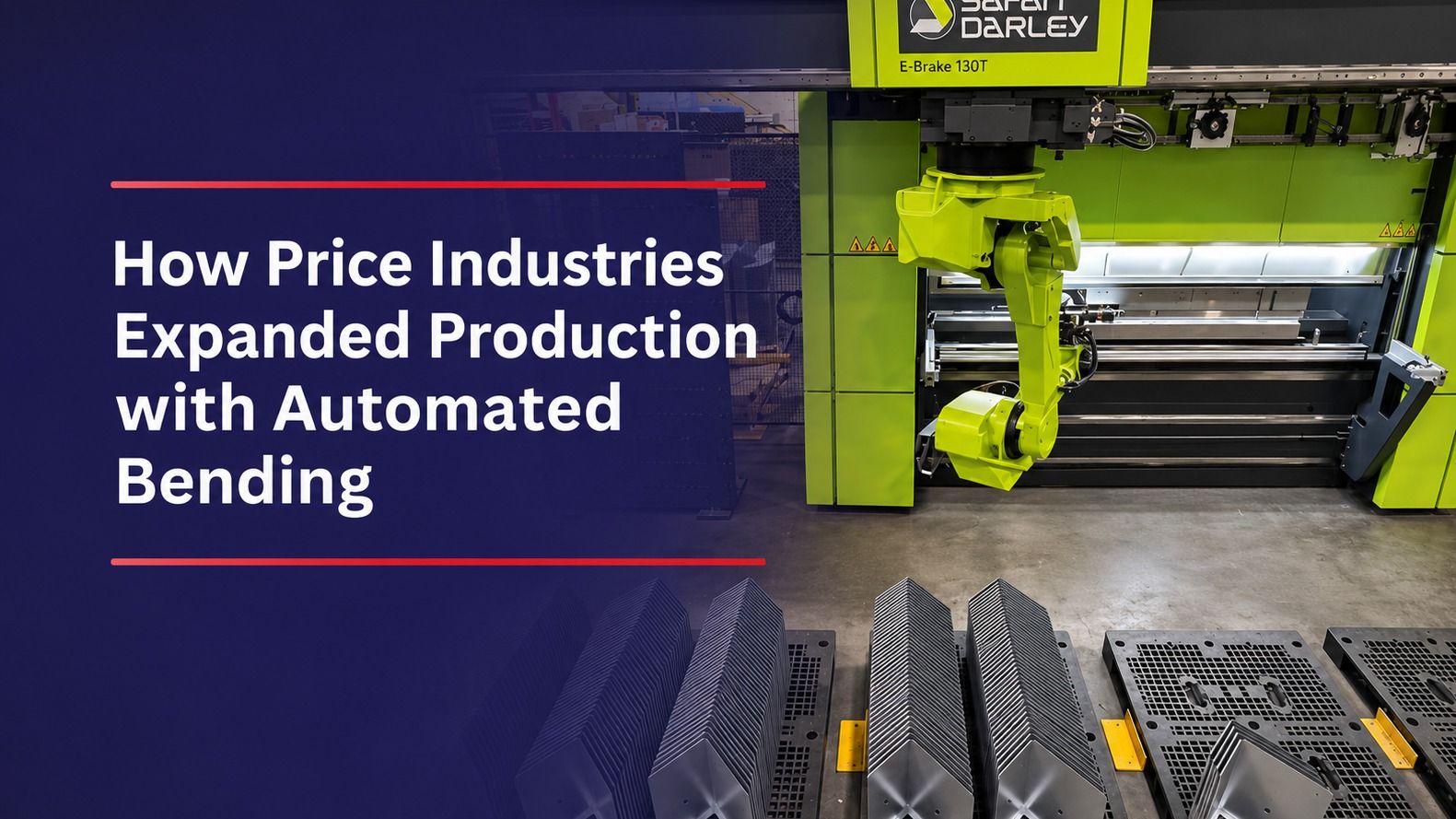
Price Industries installed two SafanDarley R-Brake 130-ton robotic bending systems in 2024.
Price Industries, an HVAC manufacturer, installed two SafanDarley R-Brake 130-ton robotic bending systems in 2024 with Capital Machine. Each unit pairs an electric press brake with a gantry-mounted robotic arm. Manufacturing Engineer Alex Herring reports cycle times under two minutes per part and reliable uptime, while offline programming and simulation have cut setup time and scrap. Price Industries also reports consistent part quality.
The HVAC manufacturer worked with Capital Machine on the installation. Each system pairs an electric press brake with a gantry-mounted robotic arm.
Manufacturing Engineer Alex Herring reports cycle times of under two minutes per part, plus reliable uptime. Price Industries also uses offline programming and simulation for job preparation, which has reduced setup time and scrap. The company reports consistent part quality across its sheet metal bending operation.
Price Industries reports the ability to run production overnight. The company runs lights-out, returning the next morning to unload completed components. Automated bending has helped address an immediate production need while adding capacity for the future.
Frequently asked questions
What specific SafanDarley robotic bending systems has Price Industries installed to address increased demand for sheet metal components?
Price Industries has installed two SafanDarley R-Brake 130-ton robotic bending systems. These systems combine an electric press brake with a gantry-mounted robotic arm designed to automate the handling and forming of sheet metal parts. This installation was completed in 2024 and was a collaborative effort between Capital Machine and SafanDarley, aiming to enhance Price Industries' capacity and efficiency in sheet metal bending operations.
How has the implementation of SafanDarley R-Brake systems impacted Price Industries' production cycle times and part quality?
Since the installation of the SafanDarley R-Brake systems, Price Industries has reported significant improvements, including shorter cycle times per part, with Manufacturing Engineer Alex Herring noting cycle times under two minutes. The systems have also delivered consistent part quality, allowing for reliable uptime and the ability to run production overnight. This enhanced consistency and speed have been crucial in meeting growing customer demand while maintaining expected quality standards.
What process improvements has Price Industries adopted alongside the robotic bending systems to reduce setup time and material waste?
Price Industries has implemented offline programming and simulation for job preparation. This allows the team to verify bend sequences and tooling requirements before the job is physically set up on the machines. This pre-production planning helps in identifying and resolving potential issues early on, thereby reducing setup time and minimizing scrap by avoiding the use of actual material and machine time for troubleshooting. This leads to more efficient use of resources.
When did Capital Machine and SafanDarley work with Price Industries on this robotic bending system installation?
The installation of the SafanDarley R-Brake robotic bending systems at Price Industries was completed in 2024. Capital Machine collaborated with SafanDarley to facilitate this implementation, which aimed to boost Price Industries' sheet metal bending capabilities. The project focused on automating processes that were previously handled manually, contributing to shorter cycle times and improved production efficiency for the HVAC manufacturer.
What type of manufacturing does Price Industries specialize in?
Price Industries is an HVAC manufacturer. Their core manufacturing process involves producing sheet metal components that are essential for their heating, ventilation, and air conditioning products. The recent upgrades to their sheet metal bending operations, including the installation of robotic bending systems, are directly aimed at improving their capacity and quality in producing these vital components for their industry.
How does offline programming and simulation benefit Price Industries' production floor?
Offline programming and simulation allow Price Industries to digitally plan and test bending operations before they occur on the physical machines. This proactive approach helps in optimizing bend sequences and identifying tooling compatibility issues in a virtual environment. Consequently, it significantly reduces the time spent on manual setup at the machine and minimizes the generation of scrap material, as potential errors are caught and corrected in the planning phase.
Get the long read at Capital Machine and Capital Robotics
Is this your company?
This article features your business. Claim it to add your logo, contact details, and a link to your website — or upgrade to reach more buyers.
Did you know 80% of Press Releases trigger AI content warnings? Reach out and the M4S team can assist.