
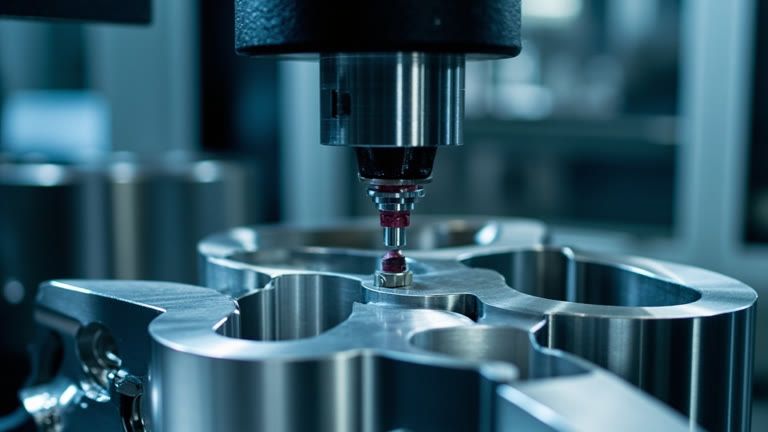
Magnetorheological Polishing for Mirror-Finish Aerospace Components: Precision Without Compromise Aerospace components demand near-perfect surface finishes—not just for performance, but for safety.
- Under a magnetic field, these particles align into a semi-solid abrasive medium, conforming precisely to the workpiece’s contours.
- When the field is adjusted, the fluid’s viscosity changes instantly, allowing dynamic control over material removal.
- Unlike fixed abrasive tools, MR fluids eliminate edge rounding and mid-spatial frequency errors—common pitfalls in conventional polishing.
Aerospace components demand near-perfect surface finishes—not just for performance, but for safety. Turbine blades, fuel nozzles, and optical systems require sub-micron roughness to minimise friction, prevent fatigue cracks, and ensure optimal fluid dynamics. Traditional polishing methods, however, struggle to achieve these tolerances consistently without introducing subsurface damage or geometric inaccuracies.
Magnetorheological polishing (MRP) has emerged as a solution, combining the precision of computer-controlled abrasion with the adaptability of smart fluids. For mission-critical aerospace parts, this technology delivers mirror finishes while preserving dimensional integrity—a capability that mechanical polishing alone cannot match.
How Magnetorheological Polishing Works
Smart Fluids as Precision Tools
At the core of MRP is a magnetorheological (MR) fluid—a mixture of magnetic particles suspended in a carrier liquid. Under a magnetic field, these particles align into a semi-solid abrasive medium, conforming precisely to the workpiece’s contours. When the field is adjusted, the fluid’s viscosity changes instantly, allowing dynamic control over material removal.
Unlike fixed abrasive tools, MR fluids eliminate edge rounding and mid-spatial frequency errors—common pitfalls in conventional polishing. This adaptability makes MRP ideal for freeform optics, complex airfoils, and other geometries where consistency is paramount.
Deterministic Finishing Through Process Control
MRP systems integrate CNC positioning with real-time surface metrology, enabling closed-loop corrections. As the polishing head traverses the component, sensors monitor surface roughness and adjust magnetic field strength, tool pressure, and dwell time accordingly. This deterministic approach ensures repeatability across production batches, even for high-value components like laser gyroscopes or combustion liners.
Advantages Over Conventional Polishing Methods
Eliminating Subsurface Damage in Critical Components
Mechanical polishing and lapping often introduce micro-cracks or residual stress, compromising fatigue life. MRP’s shear-based material removal avoids these issues, achieving Ra values below 1 nm without altering the substrate’s metallurgical properties. For nickel superalloys and titanium components, this translates to longer service life and reduced inspection overhead.
Preserving Complex Geometries
Abrasive flow machining (AFM) and electropolishing struggle with asymmetric features or thin-walled structures. MRP’s conformable tooling adapts to intricate geometries, maintaining uniform material removal across curved vanes, cooling channels, and other high-stress zones. This capability is particularly valuable for additively manufactured parts, where support structure removal often leaves irregular surfaces.
Reducing Manual Labour and Scrap Rates
Hand polishing remains prevalent in aerospace but is time-consuming and prone to human error. MRP automates the finishing process, cutting cycle times by up to 70% while eliminating variability. For manufacturers producing thousands of turbine blades annually, this consistency is critical to meeting delivery schedules without compromising quality.
Implementing MRP in Aerospace Production
Integrating MRP into Existing Workflows
Adopting MRP requires more than just procuring equipment—it demands process re-engineering. Pre-polishing steps like grinding or EDM must leave surfaces within MRP’s operable range, typically under 0.5 µm Ra. Post-process metrology, such as white-light interferometry, should also be aligned to validate results against aerospace standards like AMS 2700 or ISO 10110.
Cost-Benefit Considerations
The capital investment for MRP systems is significant, often exceeding £500,000 for turnkey installations. However, the reduction in scrap, rework, and labour can yield ROI within 18–36 months for high-volume applications. For low-volume, high-value components like satellite optics, the justification shifts from throughput to risk mitigation—preventing a single defective part from causing mission failure.
The Future: MRP and Industry 4.0
Emerging advancements are pushing MRP further into smart manufacturing. AI-driven adaptive polishing, for instance, uses machine learning to predict optimal tool paths based on historical data. Meanwhile, inline metrology systems now feed real-time adjustments back to MRP units, enabling lights-out production for critical components.
Why Aerospace Can’t Afford to Ignore MRP
In an industry where surface imperfections can lead to catastrophic failures, magnetorheological polishing represents more than an incremental improvement—it’s a paradigm shift. The technology’s ability to merge nanometre-level finishes with geometric fidelity addresses the core challenge of modern aerospace manufacturing: achieving perfection at scale.
For suppliers aiming to secure contracts with OEMs like Rolls-Royce or Airbus, investing in MRP isn’t optional—it’s a strategic necessity. The alternative—relying on outdated methods—risks both competitiveness and compliance in an era where tolerances only grow tighter.
- * * *
Simon McLoughlin
Is this your company?
This article features your business. Claim it to add your logo, contact details, and a link to your website — or upgrade to reach more buyers.
Did you know 80% of Press Releases trigger AI content warnings? Reach out and the M4S team can assist.