
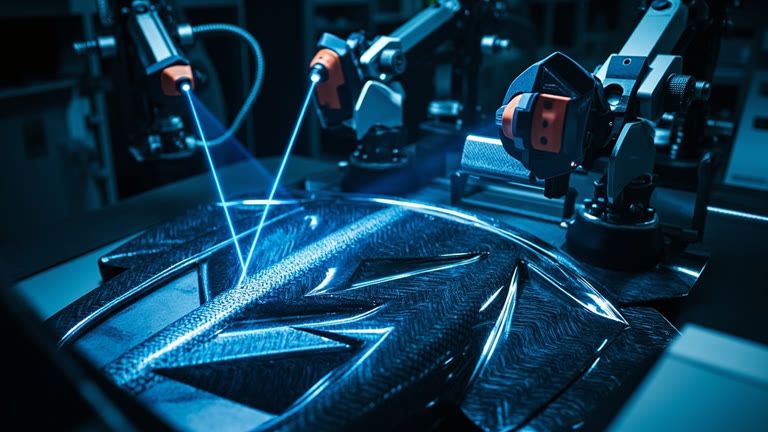
Fibre Monocoque The Problem: Measuring Something You Can't See Properly Bugatti-Rimac's Nevera monocoque weighs 200 kg.
- They're built for controlled environments, discrete point measurement, and parts that fit within their fixed envelopes.
- A 200 kg vehicle structure doesn't tick any of those boxes.
- No covering the part in markers.
Bugatti-Rimac's Nevera monocoque weighs 200 kg. That sounds manageable until you try to measure it. The carbon fibre structure is dark, highly reflective, and large enough that conventional optical metrology equipment simply can't cope. Yet its dimensional precision determines how every suspension component, chassis element, and body panel fits together. Get it wrong, and you're looking at assembly problems, performance compromises, or worse.
Traditional coordinate measuring machines (CMMs) would struggle here for obvious reasons. They're built for controlled environments, discrete point measurement, and parts that fit within their fixed envelopes. A 200 kg vehicle structure doesn't tick any of those boxes. The Solution: Scanning Without the Faff
Bugatti-Rimac's answer was the SHINING 3D FreeScan Trak Pro2, a dynamic tracking 3D scanner that achieves 0.023 mm accuracy across the full monocoque. No scan spray. No covering the part in markers. No removing it from the assembly fixture.
> "3D scanning stands out for its precision, efficiency, and versatility, making it a superior choice for many applications. That's why we opted for FreeScan Trak Pro2." > — Annamaria Hamata, Quality Analyst, Bugatti-Rimac
A few mounting points on the suspension and chassis elements provide the reference frame, and the scanner captures the entire surface in one go. The data feeds straight into Bugatti-Rimac's in-house inspection software. What previously required multiple setups, surface preparation, and significant downtime now happens in a single session. Automotive Stamping: From Two-Month Gauges to Minutes
The same shift is playing out less glamorously but more widely across automotive manufacturing. At Liuzhou Yinrui Automotive, inspecting stamped sheet metal parts used to mean commissioning custom gauges. Design and build time: up to two months. Data returned: a handful of discrete points.
The FreeScan Trak Nova replaced that entirely. The handheld scanner captures full geometry in minutes and generates a chromatic deviation map showing springback deformation across the entire surface, directly comparable against CAD. Project timelines dropped by at least a third. Die compensation analysis went from iterative guesswork to immediate, data-driven decisions. Aviation MRO: Bird Strike Documentation in 10 Minutes
Civil aviation maintenance presents a different challenge with the same underlying problem. When a Boeing 737 takes a bird strike to the engine inlet lip, engineers have historically used the grid method: hand-drawn measurement grids, manual depth gauge readings, caliper measurements. It's slow, operator-dependent, and produces none of the traceable digital documentation that airworthiness certification now demands.
The FreeScan UE Pro2 changes this entirely. At one MRO provider, a damaged inlet lip is now fully captured in 10 minutes, in situ, without removal. Capture rate: 3,460,000 points per second. Volumetric accuracy: 0.02 + 0.015 mm/m. The output is a standardised digital report with complete geometric damage data, suitable for both certification and long-term airframe monitoring. What This Actually Means for Metrology
These aren't isolated case studies. They're symptoms of a broader shift documented in SHINING 3D's white paper, Advancing Quality with High-Accuracy 3D Metrology, covering applications from BIW dimensional verification and EV battery housing validation to weld distortion analysis, turbine blade inspection, and CFD validation.
The common thread: CMMs and manual gauges are hitting hard limits on large, complex, or high-mix parts. Handheld 3D scanning is filling gaps that fixed infrastructure simply cannot address, without requiring organisations to rip out existing CAD, PLM, or inspection software.
SHINING 3D's equipment carries ISO 17025, VDI/VDE 2634, ISO 10360, and TISAX AL3 certifications. The white paper is available via their website with registration.
Simon McLoughlin
Is this your company?
This article features your business. Claim it to add your logo, contact details, and a link to your website — or upgrade to reach more buyers.
Did you know 80% of Press Releases trigger AI content warnings? Reach out and the M4S team can assist.