
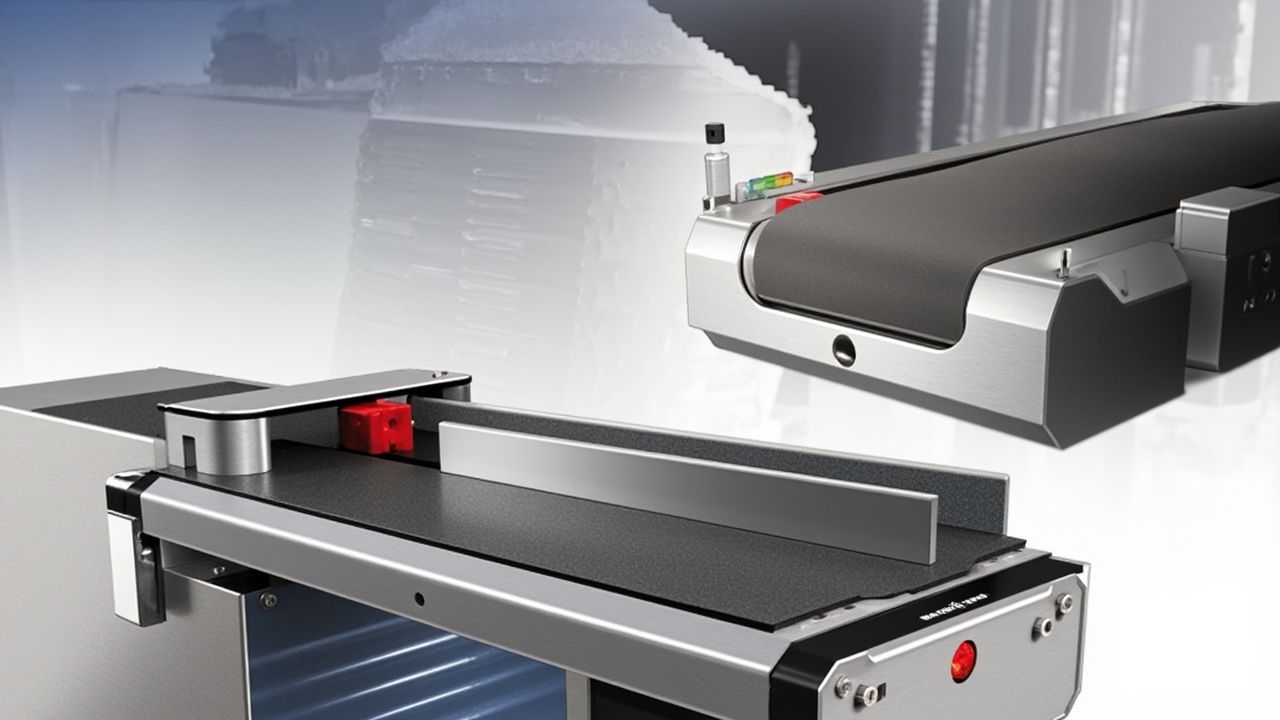
These aren't revolutionary products, but they solve specific, expensive problems in metalworking and material handling operations. The MunchMan's twin-belt design addresses a known failure mode in chip conveyance that costs manufacturers hours of unplanned downtime. The Advanced Lifts VRCs provide OSHA-compliant inter-floor transport with the safety redundancy that heavy industrial applications demand.
- MunchMan uses patent-pending twin-belt architecture through lower curve, incline, and discharge sections
- AR400 wear-resistant steel standard on all wear surfaces
- Footprint matches single-belt conveyor dimensions for easy retrofit
- VRCs feature dual chain drives with automatic mechanical locking brakes on chain failure
- ASME B20.
Problem: Long Stringy Chips Plague High-Volume Machining Operations
If you've ever watched a CNC lathe spit out long, tangled strings of chips, you know the headache they cause. These nested chip balls don't flow through conventional single-belt conveyors. They tumble at the lower curve, wedge in incline sections, and bring entire machining cells to a halt.
I visited a transmission parts manufacturer in Michigan last year that was losing 3-4 hours per shift to conveyor jams on their twin-spindle turning centers. Their maintenance crew had tried everything: faster belt speeds, periodic air blasts, manual intervention. Nothing worked long-term. The root issue was physics. Single-belt conveyors simply can't grip and compress irregular chip geometries through vertical transitions.
Solution: Twin-Belt Architecture Compresses and Carries Chips Through Critical Zones
Jorgensen Conveyor and Filtration Solutions (Mequon, WI) addressed this with their MunchMan hinged steel Dual-Belt Conveyor. The patent-pending design runs two synchronized belts through the lower curve, incline, and discharge sections.
The primary and secondary belts operate in unison, grabbing chips and compressing them into a manageable cross-section before attempting the incline. This eliminates the tumbling and wedging that causes jams. The system handles long, stringy chips and nested chip balls that would destroy a single-belt setup.
AR400 wear-resistant steel covers all wear surfaces. The company builds these custom to customer requirements, and footprint dimensions match traditional single-belt conveyors, so retrofits don't require cell reconfiguration. Control comes via UVS Ecologic Control with JamManager software for real-time performance monitoring. The MunchMan integrates with Jorgensen's EcoFilter and PermaClean filtration systems and serves as the feeder conveyor for their Chip Processing System.
Vertical Reciprocating Conveyors: Safety Redundancy That Actually Matters
On the material handling side, Advanced Lifts (St. Charles, IL) manufactures mechanical vertical reciprocating conveyors for inter-floor transport. These aren't glamour products, but for multi-level manufacturing and distribution facilities, they're workhorses.
The mechanical VRCs support C, Z, or L loading patterns with floor or pit mounting. Platform sizes and capacities are application-specific. Here's what caught my attention: each unit uses dual chain drives with integral motor holding brakes. If a chain fails, mechanical locking brakes engage automatically. That second safety layer isn't optional in my book.
All control panels are assembled in Advanced Lifts' UL-listed shop. Every unit complies with ASME B20.1 and referenced VRC guidelines. The company backs these with a five-year structural warranty and one-year electrical coverage.
Results: What This Means for Your Operation
For high-volume CNC machining, the MunchMan eliminates the single biggest cause of unplanned conveyor downtime. There's no magic here, just sound mechanical engineering solving a specific failure mode. If your turning and milling cells produce stringy or nested chips, budget for a trial. The cost premium over single-belt conveyors pays back fast when you're not paying operators to clear jams every shift.
For VRC applications, the dual-chain with fail-safe braking meets the safety standard. Five-year structural warranty suggests the company stands behind their load calculations. I'd want to see the chain sizing documentation and brake engagement tests before specifying, but the redundancy approach is correct.
Simon McLoughlin
Is this your company?
This article features your business. Claim it to add your logo, contact details, and a link to your website — or upgrade to reach more buyers.
Did you know 80% of Press Releases trigger AI content warnings? Reach out and the M4S team can assist.