
Manufacturing Has a Place in the Incubator The Problem: Nature's Incubator Is Hard to Copy A bird eggshell looks simple.
- This is why Colossal Biosciences' latest announcement matters.
- The shells were prototyped on a Formlabs Form 4 using BioMed Black Resin before later iterations moved to titanium.
- Colossal's system is not a plastic container with a heating element.
A bird eggshell looks simple. It is not.
It regulates oxygen flow, controls humidity, manages gas exchange, and delivers calcium to the developing embryo. Get any of those wrong, and the chick dies. Researchers have spent decades trying to replicate these conditions artificially. Most attempts failed.
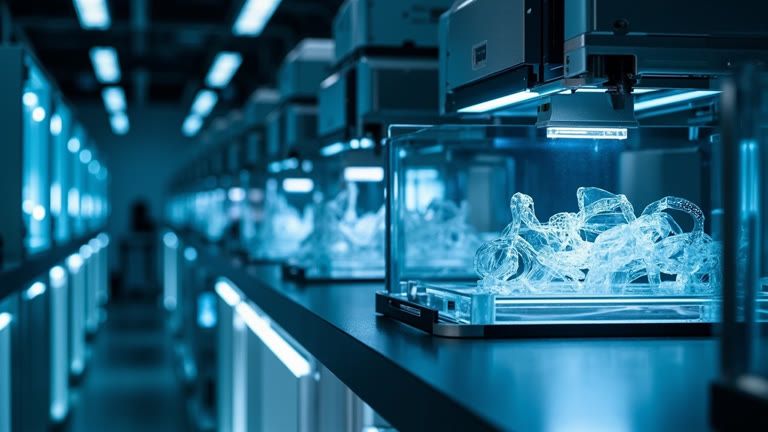
This is why Colossal Biosciences' latest announcement matters. The Dallas-based de-extinction company reports hatching 26 live chicks using an artificial egg system that pairs a silicone membrane with a 3D printed shell. The shells were prototyped on a Formlabs Form 4 using BioMed Black Resin before later iterations moved to titanium. The Solution: Engineering an Egg from Scratch
The project came into public view after Microsoft executive Mohak Shroff visited Colossal's Exogenous Development Lab and described seeing a "3D printed shell and a gas-permeable membrane" built to recreate what a natural shell does.
Colossal's system is not a plastic container with a heating element. It is an engineered structure designed to mimic specific eggshell functions: breathing, moisture control, and physical protection. The silicone membrane handles gas exchange. The 3D printed shell provides structural rigidity and can be shaped to match different egg geometries.
Why 3D printing? Because traditional manufacturing falls apart when every species needs a different shell thickness, shape, and porosity. A California condor egg is not a chicken egg. A giant moa egg, if Colossal ever gets that far, would dwarf both. Additive manufacturing handles that variability without retooling. The Results: 26 Chicks, Two Paths Forward
The 26 successful hatchings are a proof of concept, not a finished product. But they open two distinct application paths.
First, de-extinction. Colossal is already tied to projects targeting woolly mammoths, dire wolves, and dodos. For birds like the dodo or the giant moa, artificial incubation may be essential. No living bird is large enough to naturally incubate eggs of that size.
Second, and more immediately practical, endangered species conservation. Conservation groups already use incubators for birds like the California condor. Damaged eggs, abandoned clutches, or fragile shells that cannot survive natural incubation could be candidates for Colossal's system. The technology offers a fallback when nature's own incubator fails. The Engineering Angle
What struck me about this story is not the Jurassic Park headline. It is the materials problem.
Biology and manufacturing do not intersect cleanly. Living tissue has requirements that industrial processes are not designed to meet. Colossal's team had to solve for biocompatibility, gas permeability, structural integrity, and custom geometry simultaneously. The Form 4 and BioMed Black Resin got them to prototype. Titanium got them closer to something durable and repeatable.
This is where additive manufacturing earns its keep. Not in printing trinkets, but in problems where the geometry is irregular, the material requirements are strict, and traditional tooling would cost too much or take too long. The Caveats
Colossal has a habit of generating headlines that outrun its data. The company has announced ambitious de-extinction timelines before, and the scientific community has pushed back. This announcement is more grounded, 26 chicks is a concrete result, but the leap from hatching chickens in artificial eggs to resurrecting extinct species remains enormous.
The conservation application is more plausible in the near term. If the system can be scaled and adapted to different species, it could become a tool wildlife biologists actually use. That depends on cost, reliability, and whether Colossal is willing to share the technology beyond its own labs. Bottom Line
Colossal's artificial egg system demonstrates that 3D printing can solve real biological engineering problems when the application demands customization that traditional manufacturing cannot provide. The 26 chicks prove the concept works. Whether it becomes a conservation tool or a step toward de-extinction depends on what Colossal does next.
Simon McLoughlin
Is this your company?
This article features your business. Claim it to add your logo, contact details, and a link to your website — or upgrade to reach more buyers.
Did you know 80% of Press Releases trigger AI content warnings? Reach out and the M4S team can assist.