
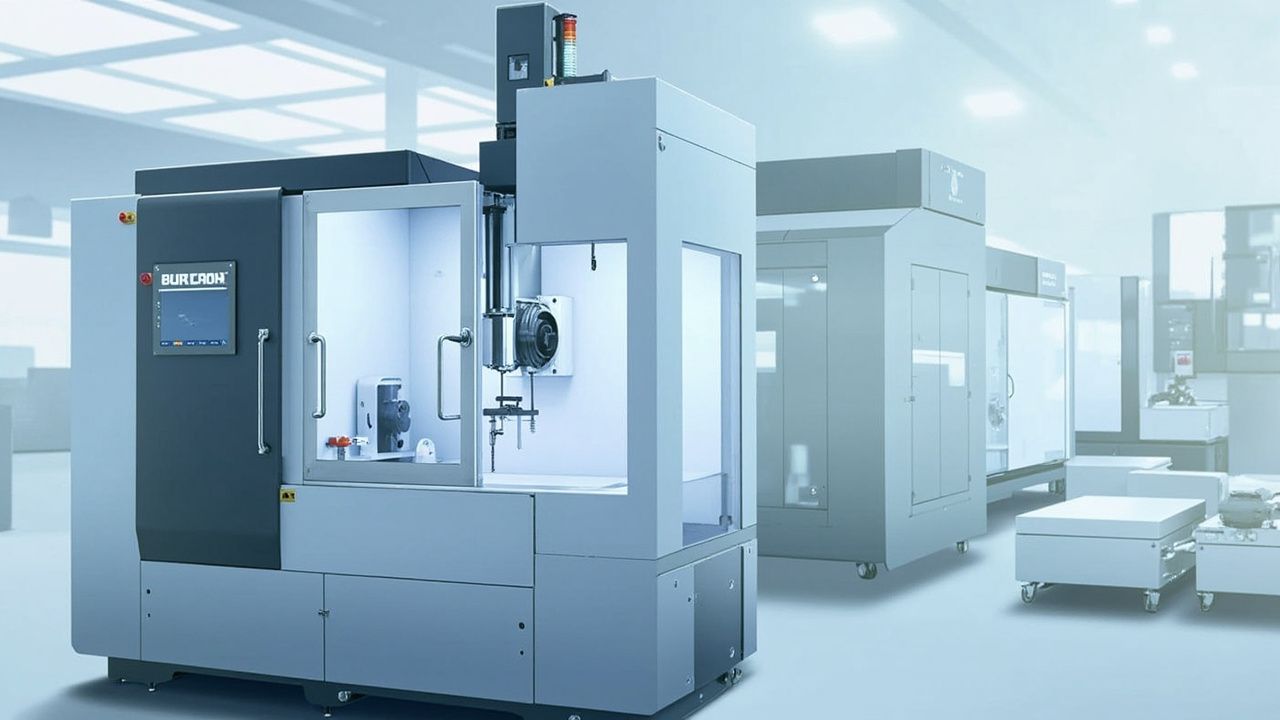
These platforms represent a maturation of configurable machining rather than any fundamental technology breakthrough
- For shops with stable high-volume work, the flexibility premium may not make sense
- For those managing unpredictable program schedules or maintaining capability for future work, modular architecture reduces the risk of stranded assets
Shops running complex, large-part machining are caught between rigidity and flexibility. Build for one part family and you're overequipped for smaller work. Go general-purpose and you'll spend more time retooling than cutting. Fives Giddings & Lewis and EMCO have taken different paths to solve the same underlying problem: how to configure a platform that handles today's job without becoming obsolete when production mix shifts.
The Core Challenge: Configuring for Uncertainty
Large aerospace and defense contractors face this daily. Parts don't arrive in neat batches anymore. A job might run 50 pieces this quarter and 5 next quarter, with geometries that don't share much commonality. The traditional answer has been dedicated cells for high-volume work and general-purpose horizontals elsewhere. That creates its own headache: different controls, different maintenance procedures, different operator training requirements.
Giddings & Lewis addresses this through a modular horizontal machining center architecture where the base platform stays constant while tool magazines, spindle options, and workholding configurations adapt to specific program requirements.
Giddings & Lewis HMC Platform Specifications
The HMC 1250 and 1600 models define their size envelope by part swing capacity rather than the typical pallet-size classification. Maximum swing diameter reaches 3,000 mm with shuttle capacity up to 7,000 kg. That's not unusual for large horizontals, but the configurability is.
Traverse speeds hit 40 meters per minute on all linear axes, which matters for reducing non-cutting time on large parts where approach and retract distances add up. The hydrostatic rotary table provides positioning accuracy without the thermal drift issues that plague conventional roller bearing designs under sustained cutting loads.
The ball screw arrangement uses hydraulic preloading rather than spring-loaded systems. This maintains consistent stiffness under thermal variation, which becomes critical when you're running flood coolant for hours on end through deep pockets in Inconel.
Spindle options span from the standard 10,000 rpm unit through high-torque configurations for roughing and high-speed options for finishing aluminum or composite tooling. The software layer monitors spindle load in real-time and compensates for thermal growth, adjusting feed rates when cutting conditions shift. This isn't groundbreaking adaptive control, but the integration with the machine's thermal management system is tighter than previous generations.
Controls run either Siemens Sinumerik or FANUC 31i, which covers most shopfloor preferences without forcing a control platform migration.
EMCO UMILL 1000 Bridges the Gap
EMCO took a different approach with the UMILL 1000, filling the gap between their 750 and 1500 platforms. The company combined resources from its Italian subsidiaries, leveraging roller guide technology from EMCO MECOF and turning capability from EMCO FAMUP into a unified platform.
Axis travels measure 900 mm (X), 1,000 mm (Y), and 700 mm (Z) with a 1,000 kg payload capacity. The A-axis swivels ±125°, providing enough tilt range for most 5-axis positioning needs without auxiliary heads.
Direct drives on linear axes and torque drives on rotary axes eliminate mechanical transmission losses and backlash. That's useful when you're interpolating simultaneous 5-axis toolpaths where any axis lag compounds geometric error at the cutter.
What This Means for Shopfloor Planning
Both platforms share a common thread: neither asks shops to bet everything on a single configuration. Giddings & Lewis does this through extensive option lists and modular tool magazines. EMCO positions the 1000 as a bridge model that can step up or step down within their range without retraining operators on fundamentally different control architectures.
The practical implication is procurement flexibility. A shop can spec a platform for current work and reconfigure as programs change, rather than buying separate machines for separate part families. Whether that flexibility justifies the base platform cost depends entirely on job mix, but the option value is real for shops running aerospace or defense work where program schedules are unpredictable.
Giddings & Lewis HMC Platform Specs
- Part swing diameter: 3,000 mm maximum
- Shuttle capacity: 7,000 kg
- Traverse speed: 40 m/min
- Spindle options: 10,000 rpm standard, high-speed and high-torque variants available
- Control options: Siemens Sinumerik or FANUC 31i
- Axis feedback: hydraulically preloaded ball screws, hydrostatic rotary table
EMCO UMILL 1000 Specs
- X/Y/Z travels: 900 / 1,000 / 700 mm
- A-axis swivel: ±125°
- Payload capacity: 1,000 kg
- Linear axis drives: direct drives with 55 mm roller guides
- Rotary axis drives: torque drives on A and C axes
Simon McLoughlin
Is this your company?
This article features your business. Claim it to add your logo, contact details, and a link to your website — or upgrade to reach more buyers.
Did you know 80% of Press Releases trigger AI content warnings? Reach out and the M4S team can assist.